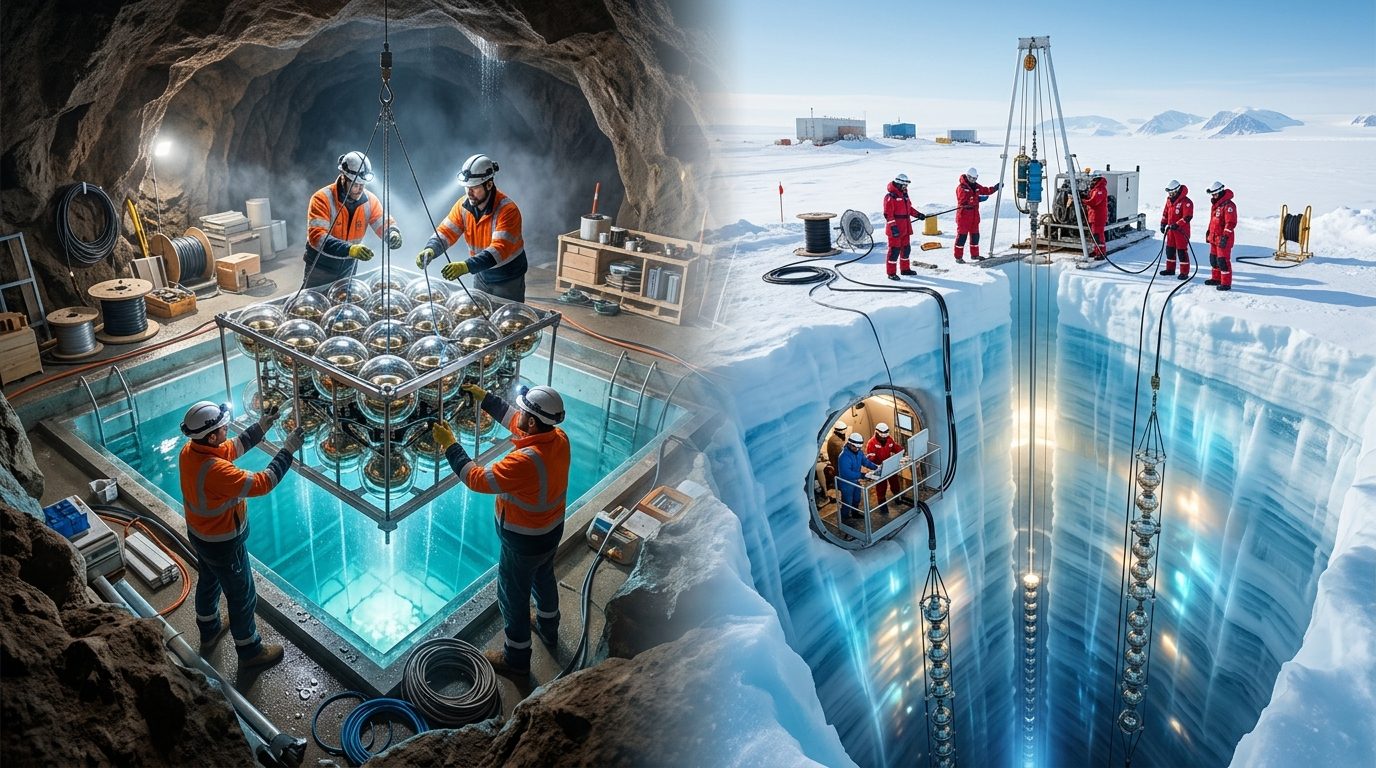
Scientists are placing observatories deep underground and beneath Antarctic ice to detect particles that can pass through Earth almost without leaving a trace.
These remote instruments target neutrinos, tiny particles produced by stars, nuclear reactions, and violent events in space. Their weak interaction with matter makes them valuable scientific messengers, but also makes them extremely difficult to detect.
“Observatories have been built in mines, deep under the Antarctic ice sheet, and elsewhere in an effort to detect the fleeting particles.”
Why Scientists Search in Extreme Places
Neutrinos carry no electric charge and have very little mass. Trillions may pass through a person every second without causing a measurable effect.
A detector must therefore monitor a large volume of material for rare collisions. Water, ice, and specialized fluids can produce brief flashes of light when a neutrino strikes an atom.
Location is just as important as size. Cosmic rays and ordinary radioactive materials can create signals that resemble a particle interaction. Thick layers of rock or ice block much of that interference.
- Deep mines shield instruments from particles arriving at Earth’s surface.
- Antarctic ice provides a large, clear detection medium.
- Remote sites reduce human-made electrical and physical interference.
Ice and Rock Serve Different Missions
Detectors under Antarctic ice watch for faint light produced by energetic neutrinos. Thousands of sensors can be installed across a large section of ice, turning the frozen material into part of the observatory.
Underground laboratories often pursue lower-energy neutrinos and other rare events. Mines provide ready access to deep locations, although researchers must control heat, dust, vibration, and radiation from surrounding rock.
The two approaches are not direct rivals. Ice-based observatories can study high-energy particles arriving from distant space. Mine-based experiments may examine neutrinos from the Sun, Earth, nuclear reactors, or past stellar explosions.
Particles Offer a New View of Space
Light can be absorbed, scattered, or blocked by dust. Charged cosmic particles are deflected by magnetic fields, making their origins hard to trace. Neutrinos usually travel in straight paths from their sources.
That quality can help scientists investigate black holes, exploding stars, and other high-energy events. A confirmed neutrino arriving with light or gravitational waves may give researchers a fuller account of what happened.
Neutrino studies also address basic questions about matter. Researchers continue to examine how neutrinos change type while traveling, why their masses are so small, and whether unknown particle behavior exists.
Rare Signals Demand Careful Verification
The main challenge is separating genuine detections from background noise. A single unusual flash is rarely enough. Research teams compare timing, direction, energy, and detector conditions before classifying an event.
Independent observatories can strengthen a finding by recording related signals. Coordination with telescopes and gravitational-wave instruments also helps scientists identify possible sources.
Building in extreme locations brings high costs and practical risks. Equipment must operate for long periods with limited access. Repairs beneath ice or deep underground can require major planning, while data systems must remain stable.
Despite those limits, hidden observatories give researchers access to information unavailable through ordinary telescopes. Future progress will depend on larger detectors, lower background noise, and faster cooperation among facilities. Each verified particle may provide a rare clue about distant cosmic events and the basic rules governing matter.

Senior Software Engineer with a passion for building practical, user-centric applications. He specializes in full-stack development with a strong focus on crafting elegant, performant interfaces and scalable backend solutions. With experience leading teams and delivering robust, end-to-end products, he thrives on solving complex problems through clean and efficient code.