As artificial intelligence spreads into robotics and interactive apps, a core issue is coming into focus: most large language models do not understand how the physical world works. Researchers say “world models” are rising to fill that gap by learning cause and effect from sensory data. Three families of methods are getting attention now, each with different trade-offs and early signs of convergence.
Large language models lack grounding in physical causality — a gap world models are designed to fill. Here’s how three distinct architectural approaches (JEPA, Gaussian splats, and end-to-end generation) work, where each fits, and what hybrid architectures are already emerging.
Why Causality Matters for AI
Language models excel at patterns in text. They predict the next word from past words. That helps with search, writing help, and coding. But predicting words is not the same as predicting physics.
Physical causality links actions to outcomes. If a robot pushes a cup, it should expect the cup to move and maybe topple. Without that link, systems can make fluent plans that fail in the real world. This is why teams working on robotics, video modeling, and simulation are turning to world models that learn dynamics from images, depth, sound, and actions.
Inside the Architectures
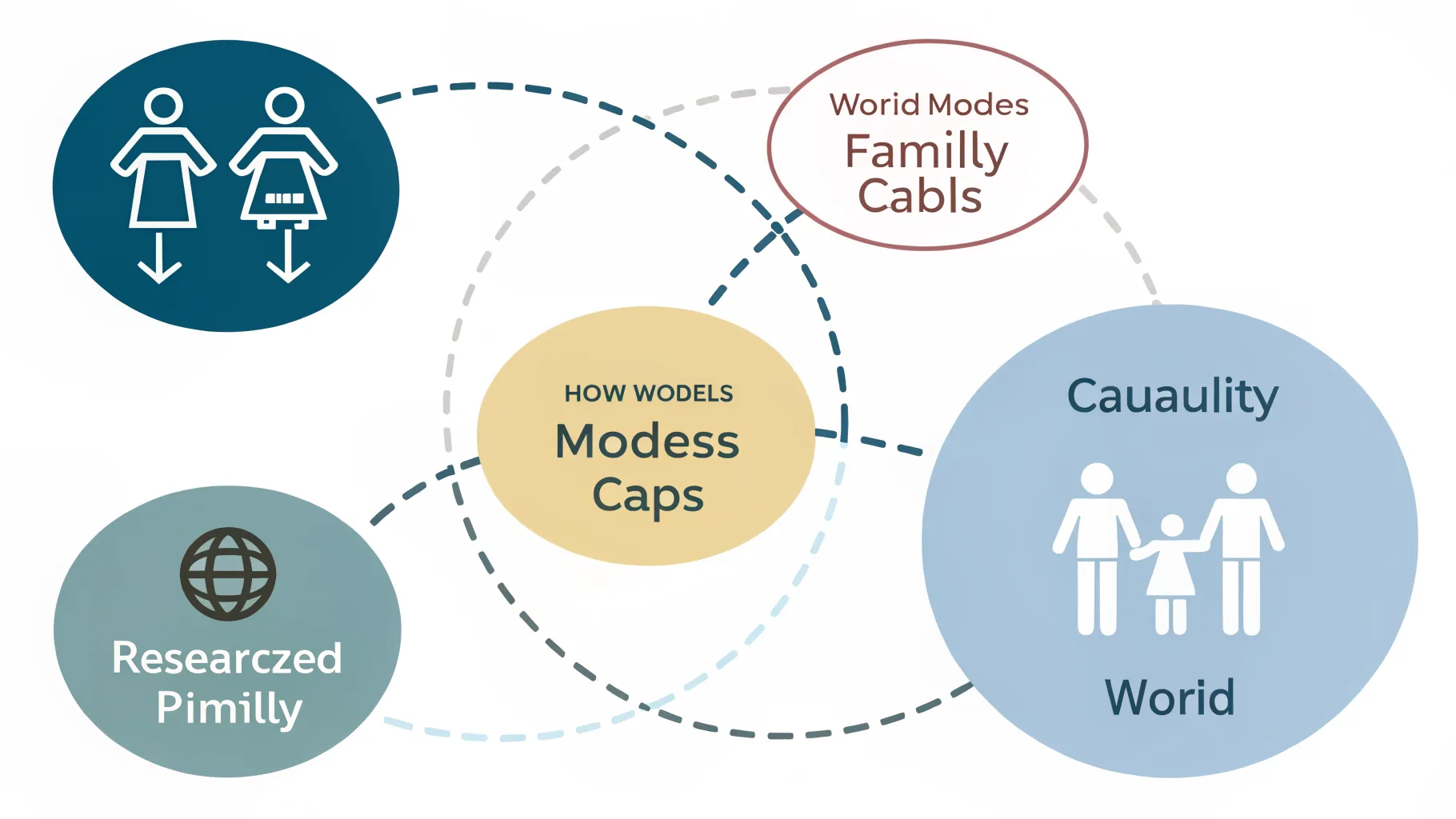
Three approaches stand out in recent work. Each tries to capture how the world changes over time, but they do so in different ways.
JEPA: Predict in a Shared Space
Joint Embedding Predictive Architectures, or JEPA, learn a compact space where past and future observations are mapped to vectors. The model predicts future embeddings from current context. It avoids guessing every pixel and instead focuses on what matters for control or reasoning.
This can make learning faster. It also helps the model ignore noise. But success depends on the quality of the learned space. If key details are lost in the embedding, predictions miss important effects.
Gaussian Splats: Fast 3D Scene Models
Gaussian splats represent scenes as many tiny 3D blobs with color and opacity. They render views quickly and can update when objects move. For physical reasoning, they offer a strong sense of depth, lighting, and occlusion.
These models shine in tasks that need accurate views from new angles, such as mapping, AR, and planning paths around obstacles. They are less direct about forces and contact. On their own, they need help to model how things interact under push, pull, and friction.
End-to-End Generation: Learn the Full Sequence
End-to-end models try to predict future frames, states, or actions directly from past inputs. They optimize one large system for the task goal. This can capture rich dynamics and edge cases, given enough data and compute.
The risk is that such systems may memorize appearances rather than true causes. Without constraints, they can produce sharp video but weak control. Careful training and action conditioning are key.
Where Each Approach Fits
- JEPA: Good for planning and control when you value compact state and speed.
- Gaussian splats: Strong for 3D understanding, view synthesis, and navigation.
- End-to-end: Useful when data is abundant and the task is narrow but complex.
In robotics, a team might use splats for scene geometry, a JEPA core for state, and a small policy head for actions. In video forecasting, end-to-end models can produce frames, while a JEPA module tracks objects to keep predictions consistent.
Hybrid Designs Are Emerging
Groups are mixing methods to get the best of each. Common hybrids include:
- JEPA + splats: Learn a latent state while keeping a fast, editable 3D map.
- Splats + dynamics: Add a physics layer that updates blobs based on forces.
- End-to-end + constraints: Train a generator but regularize it with object tracking or geometry.
These mixes aim to tie appearance to cause. They help models predict not just what the scene looks like, but how it will change when touched.
What to Watch Next
Two themes will shape progress. First, data. World models need diverse motion, contact, and feedback. Synthetic data from simulators can help, but real-world noise matters. Second, evaluation. Benchmarks must test cause and effect, not only image sharpness or text fluency.
Expect tighter links between perception and control. Expect systems that can plan several steps ahead and update beliefs as they act. Safety will also be in focus, as errors in causality can damage property or harm people.
The path forward points to practical blends. JEPA can give a stable state. Gaussian splats can ground that state in 3D. End-to-end pieces can handle complex edges. Together, they can narrow the causality gap that holds back current AI. The key test will be simple: when an agent acts, does the world change as it predicts—and can it correct itself when it does not?

Rashan is a seasoned technology journalist and visionary leader serving as the Editor-in-Chief of DevX.com, a leading online publication focused on software development, programming languages, and emerging technologies. With his deep expertise in the tech industry and her passion for empowering developers, Rashan has transformed DevX.com into a vibrant hub of knowledge and innovation. Reach out to Rashan at [email protected]