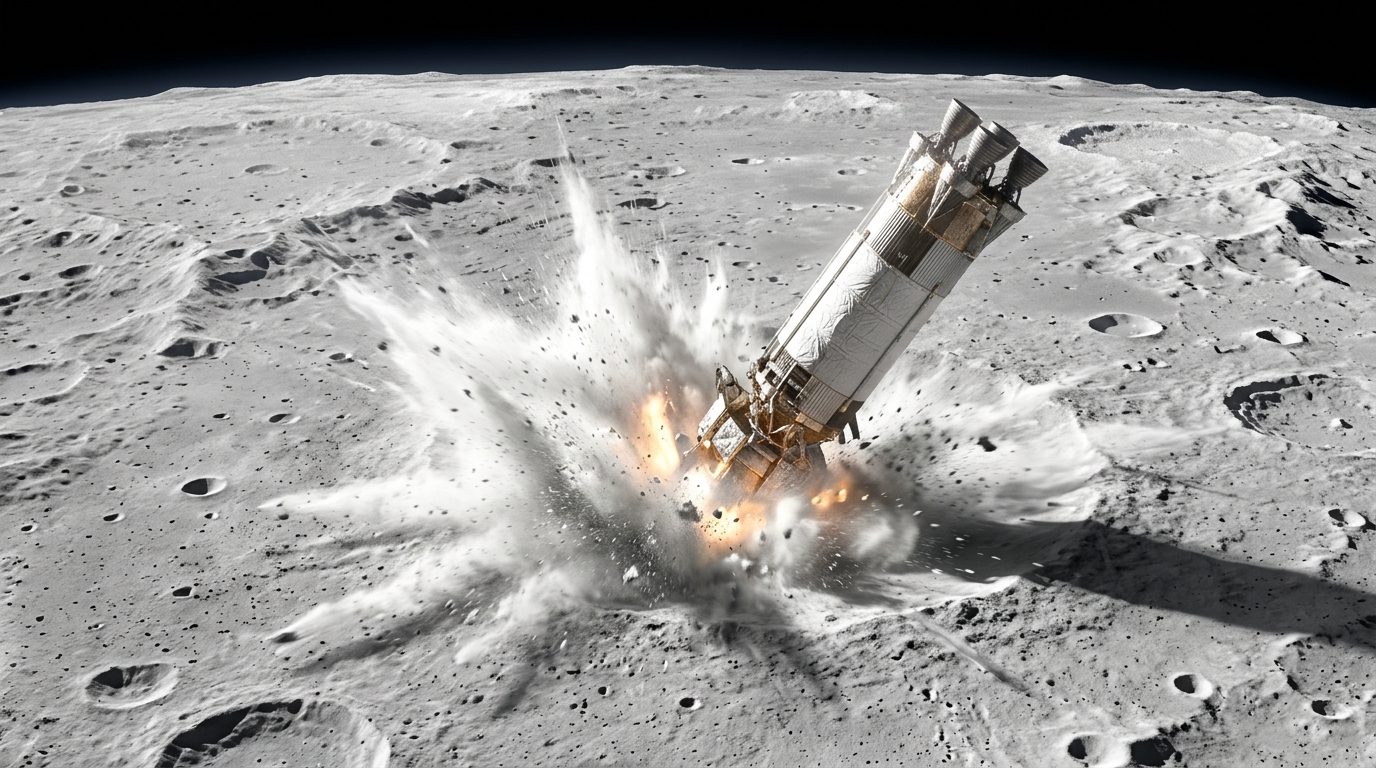
A rocket sent to deliver a lander is now expected to strike the moon, turning a planned surface mission into an uncontrolled impact. The failed delivery will likely leave a new crater, while ending the vehicle’s original scientific or exploration role.
Key details remain unconfirmed, including the rocket’s operator, impact date, landing region, and current flight path. Those gaps limit estimates of the crater’s size and the threat to nearby equipment.
From Controlled Landing to High-Speed Collision
Lunar landers are designed to separate from their launch vehicles and slow down before reaching the surface. Engines, navigation systems, and onboard computers guide the final descent.
A rocket or lander that cannot complete those steps may remain on a collision course. The central change in this case is stark:
“Initially intended to deliver a lander, the rocket is expected to leave a crater on the moon instead.”
The outcome suggests the mission can no longer achieve a controlled touchdown. However, the available information does not identify the failure or explain whether engineers attempted to recover the spacecraft.
Several problems can cause a lunar mission to miss its goal:
- Engine or propulsion failure
- Navigation and guidance errors
- Loss of communications
- Incorrect orbit or trajectory
- Failure to separate from the launch stage
What Determines the Damage
The expected crater size will depend on the rocket’s mass, speed, angle, and construction. Lunar geology at the impact site will also shape the result.
The moon has almost no atmosphere to slow an incoming vehicle. A spacecraft can therefore hit at high speed, releasing energy into the soil and rock. The collision may throw dust and debris across the surrounding area.
Researchers would need precise tracking data to predict the impact point. They could later compare images taken before and after the crash. That work may reveal the crater’s width, the debris pattern, and changes to the surface.
Artificial impacts are not new. Space agencies have previously directed hardware into the moon after missions ended. NASA’s LCROSS mission struck the lunar surface in 2009 to study material ejected from a shadowed crater. Other spent stages have also reached the moon.
This case differs because the rocket was meant to support a landing. Its expected impact represents a mission loss rather than a planned scientific experiment.
Risks for Lunar Exploration
A single crash is unlikely to cause broad harm to the moon. The immediate concern is local. An impact near an operating lander, rover, or historic site could spread debris or disturb an area valued for research.
The incident also highlights the difficulty of lunar flight. Reaching the moon requires precise timing, reliable propulsion, and accurate navigation. Landing adds another difficult sequence, because the craft must reduce its speed without atmospheric braking.
More information is needed before the event can be assessed fully. Mission officials will need to identify the spacecraft, publish tracking estimates, and explain why the lander delivery failed.
The impact may still produce useful observations if lunar orbiters can photograph the site. Yet any scientific value would come after the loss of the original mission. The next key developments will be confirmation of the collision point, the crater’s measured size, and findings from the failure investigation.

Deanna Ritchie is a managing editor at DevX. She has a degree in English Literature. She has written 2000+ articles on getting out of debt and mastering your finances. She has edited over 60,000 articles in her life. She has a passion for helping writers inspire others through their words. Deanna has also been an editor at Entrepreneur Magazine and ReadWrite.