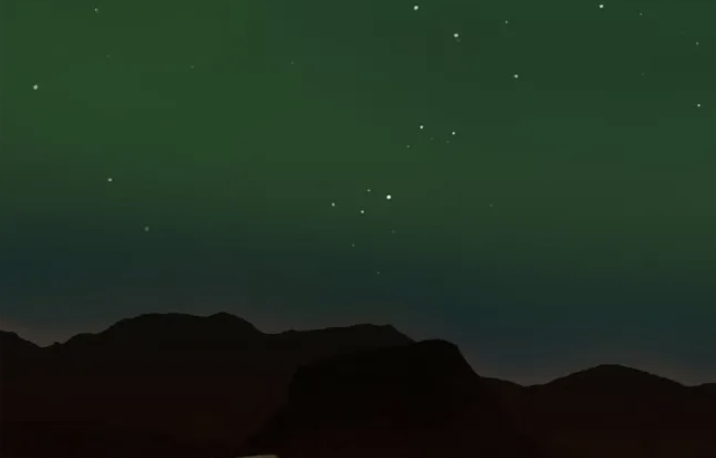
NASA’s Perseverance Mars rover has captured the first visible-light images of auroras on Mars. This groundbreaking observation provides new insights into Martian auroral phenomena and opens up exciting possibilities for future research. Auroras occur when solar energetic particles interact with a planet’s magnetic field and collide with atmospheric gases, emitting light.
https://x.com/NASA/status/1921943067805802762
On Earth, auroras often produce a green hue due to excited oxygen atoms.
https://x.com/SquigglyVolcano/status/1922716064112169229
However, Mars lacks a global magnetic field, resulting in solar energetic particle (SEP) auroras that illuminate the Martian night sky in ultraviolet light. The breakthrough came on March 15, 2024, when a solar flare and coronal mass ejection (CME) from the Sun interacted with Mars’ atmosphere.
https://x.com/NASAPersevere/status/1922396977507025381
Elise Knutsen from the University of Oslo led a research team that predicted the event could trigger a bright aurora. They determined the optimal angle for capturing the phenomenon using Perseverance’s SuperCam spectrometer and Mastcam-Z camera. NASA’s solar monitoring teams provided real-time analysis of the CME, and space physicist Christina Lee at the University of California, Berkeley, alerted the team about the impending solar storm.
https://x.com/elishasauers/status/1922744927647129774
Martian aurora captured by Perseverance
A few days later, Perseverance’s instruments captured a spectacular auroral display, showing nearly uniform emissions at a wavelength of 557.7 nanometers. Data from the European Space Agency confirmed the presence of solar energetic particles, solidifying the detection of the green aurora visible to the naked eye.
“This exciting discovery opens up new possibilities for auroral research and confirms that auroras could be visible to future astronauts on Mars’ surface,” said Knutsen. Katie Stack Morgan, acting project scientist for Perseverance at NASA’s Jet Propulsion Laboratory, highlighted that these observations provide a new way to study Martian auroras, complementary to orbital data. Shannon Curry, principal investigator at the University of Colorado Boulder’s Laboratory for Atmospheric and Space Physics, commented, “This was a fantastic example of cross-mission coordination.
We are thrilled to have finally gotten a sneak peek of what astronauts will be able to see there someday.”
Understanding these auroral displays and the conditions leading to them is vital as NASA prepares to send human explorers to Mars. The insights gained from Perseverance’s observations significantly advance our knowledge of Martian atmospheric phenomena. NASA’s Mars 2020 Perseverance mission, part of the broader Mars Exploration Program, continues to lay the groundwork for future human missions to the Red Planet.
The MAVEN mission remains a critical component for understanding Mars’ atmosphere and space weather environment.

Rashan is a seasoned technology journalist and visionary leader serving as the Editor-in-Chief of DevX.com, a leading online publication focused on software development, programming languages, and emerging technologies. With his deep expertise in the tech industry and her passion for empowering developers, Rashan has transformed DevX.com into a vibrant hub of knowledge and innovation. Reach out to Rashan at [email protected]