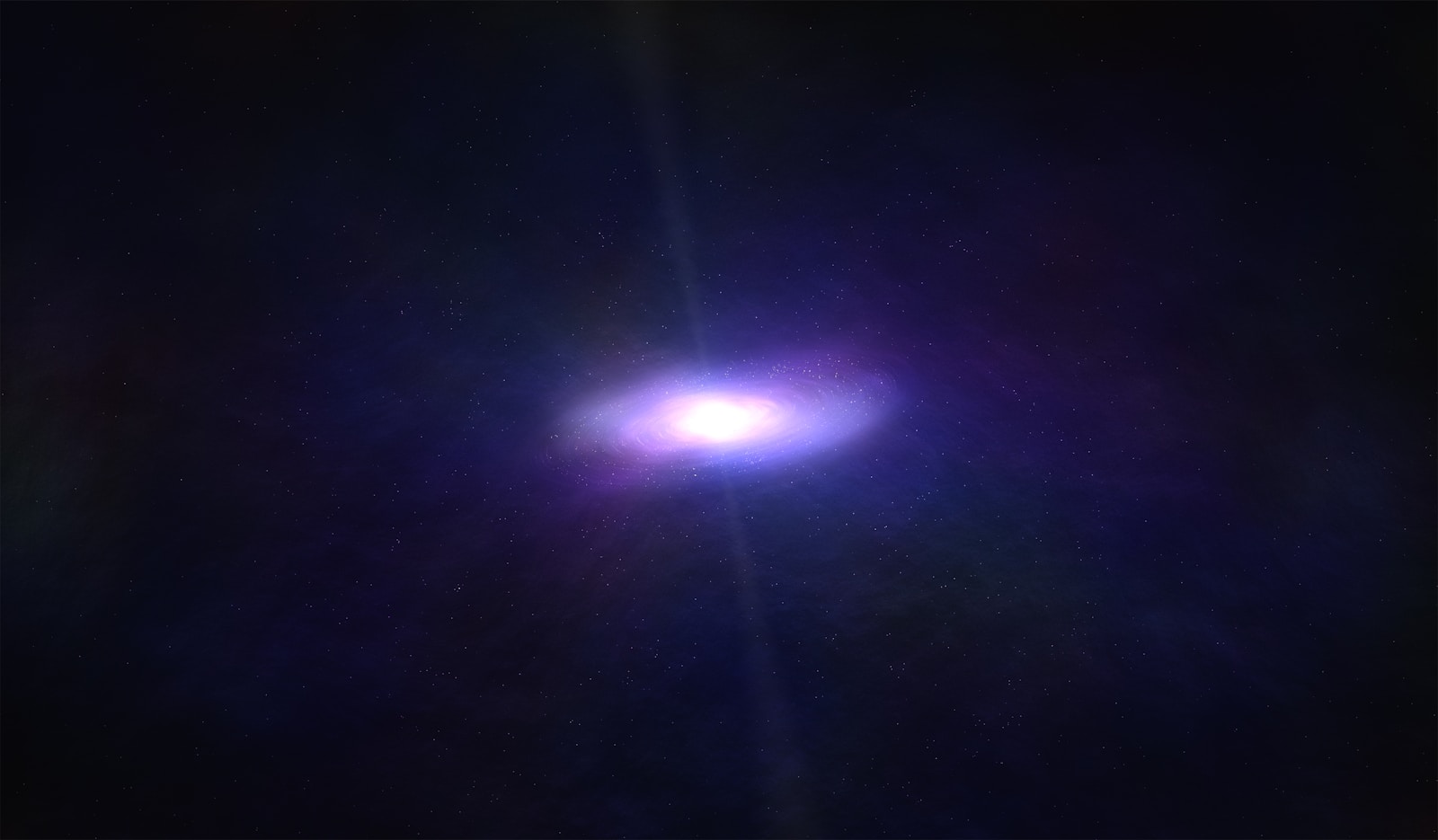
The Big Bang, long considered the explosive birth of the universe, may not have been the beginning of everything after all. A new theory proposed by a group of physicists suggests that our universe could have originated from inside a black hole formed in a previous “parent” universe. Professor Enrique Gaztanaga of the Institute of Cosmos Sciences in Barcelona and his team argue that the Big Bang was a cosmic transition point in a never-ending cycle.
Their idea centers around the Pauli exclusion principle, a quantum rule that prevents identical particles from occupying the same space. Gaztanaga believes this principle stops the total collapse of matter in a dying universe, forcing it to “bounce” and expand again, forming a new universe inside what we would call a black hole. This model doesn’t require exotic particles or untestable fields.
The bounce, according to the paper, occurs naturally within Einstein’s framework of general relativity. Even the two phases of expansion, inflation and dark energy, can be explained by the dynamics of the bounce itself. What makes this model compelling is that it’s testable.
The team predicts a slightly curved universe and a small but measurable cosmological constant. These could potentially be confirmed by upcoming missions like the European Space Agency’s Arrakihs satellite.
Black hole-born cosmic cycle theory
If proven correct, it would upend the deeply held belief that the universe began with a singularity. Instead, we’d be part of an endless chain of universes, each born from the collapse of the last. “We are not witnessing the birth of everything from nothing,” Gaztanaga writes.
“But rather the continuation of a cosmic cycle.”
The traditional model, based on the Big Bang and cosmic inflation, has been successful in explaining the structure and evolution of the universe. However, it leaves some fundamental questions unanswered, like where did everything come from and why did it begin this way. The new model tackles these questions by looking inward instead of outward.
It considers what happens when an overly dense collection of matter collapses under gravity, a familiar process seen in stars collapsing into black holes. The research shows that gravitational collapse doesn’t have to end in a singularity. An exact mathematical solution describes how a collapsing cloud of matter can reach a high-density state and then bounce, rebounding outward into a new expanding phase.
The black hole universe offers a new perspective on our place in the cosmos. In this framework, our entire observable universe lies inside the interior of a black hole formed in some larger “parent” universe. We are witnessing not the birth of everything from nothing, but the continuation of a cosmic cycle shaped by gravity, quantum mechanics, and their interconnections.

Kirstie a technology news reporter at DevX. She reports on emerging technologies and startups waiting to skyrocket.