
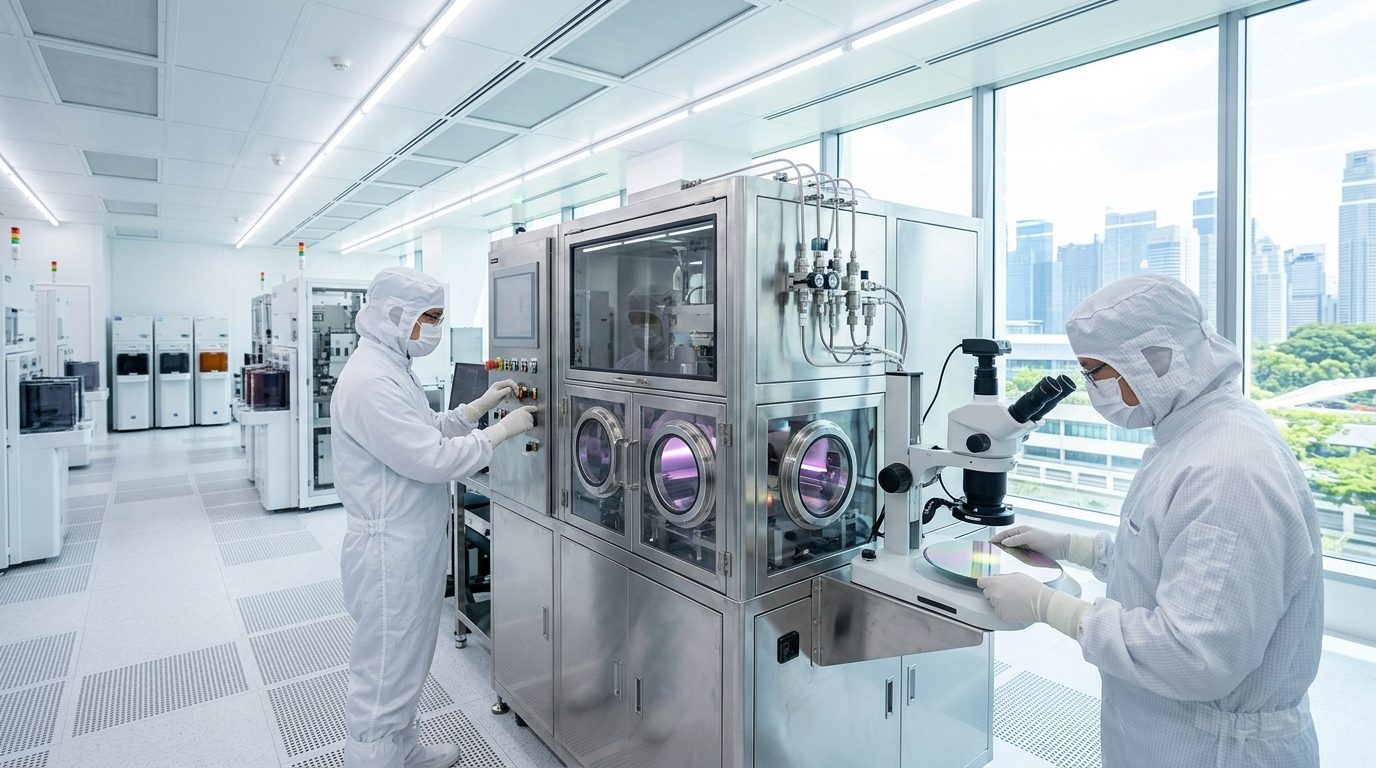
Singapore-based Nexstrom has secured new funding to develop equipment for producing two-dimensional semiconductor materials at commercial scale. The financing places the company in a growing effort to move these ultra-thin materials from research laboratories into chip factories.
Nexstrom has not disclosed the size of the funding round, its investors, or a timetable for commercial deployment. The company said the equipment could “help chipmakers manufacture 2D semiconductor materials at scale.”
Materials Designed for Smaller Devices
Two-dimensional semiconductors are crystalline materials that can be only one or several atoms thick. Common research candidates include molybdenum disulfide and tungsten diselenide.
The materials may allow engineers to build smaller transistors while maintaining control over electrical current. That goal has gained importance as conventional silicon designs face physical and economic limits.
However, promising laboratory results do not guarantee reliable factory production. Chipmakers need materials with consistent thickness, few defects, and predictable electrical performance across large wafers.
Nexstrom’s focus on manufacturing equipment addresses one of the sector’s central problems. Processes that work on small research samples often become less stable when applied across industrial production lines.
Scaling Remains the Main Test
Semiconductor manufacturers judge new equipment by more than material quality. Tools must also meet strict standards for speed, contamination control, maintenance, energy use, and cost.
Several technical and commercial questions remain unanswered:
- Whether Nexstrom’s tools can produce uniform films across full wafers
- How easily the equipment can fit into existing chip factories
- Whether production costs can compete with established materials
- When customers might begin testing or purchasing the systems
Integration may prove as difficult as material production. New films must work with metal contacts, insulating layers, and other manufacturing steps without losing their desired properties.
Yield will also matter. Even a technically successful process may struggle commercially if too many chips fail inspection. Equipment makers must demonstrate repeatable results over many production cycles.
Singapore’s Semiconductor Opportunity
Nexstrom’s location could support its development plans. Singapore hosts major semiconductor manufacturers, equipment suppliers, research institutions, and advanced manufacturing operations.
That local network may give the company access to engineering talent and potential testing partners. It also places Nexstrom near Asian chip supply chains, where much of the industry’s manufacturing capacity is concentrated.
Still, semiconductor equipment is a capital-intensive business. Product development can require lengthy qualification programs, specialized facilities, and close cooperation with customers. Further financing may be needed before Nexstrom reaches high-volume sales.
Commercial Validation Comes Next
The funding gives Nexstrom resources to advance its equipment, but the company has provided few details about performance or customer trials. Those disclosures will be important for measuring progress.
Key indicators will include wafer size, film uniformity, production speed, defect rates, and compatibility with standard factory processes. Partnerships with established chipmakers would offer another sign of commercial traction.
If Nexstrom can meet those requirements, its equipment could help narrow the gap between 2D-material research and industrial manufacturing. For now, the financing marks an early development step rather than proof of mass production.
The next phase will depend on execution. Investors and manufacturers will watch whether Nexstrom can turn atom-thin materials into repeatable, affordable products for chip factories.

Senior Software Engineer with a passion for building practical, user-centric applications. He specializes in full-stack development with a strong focus on crafting elegant, performant interfaces and scalable backend solutions. With experience leading teams and delivering robust, end-to-end products, he thrives on solving complex problems through clean and efficient code.