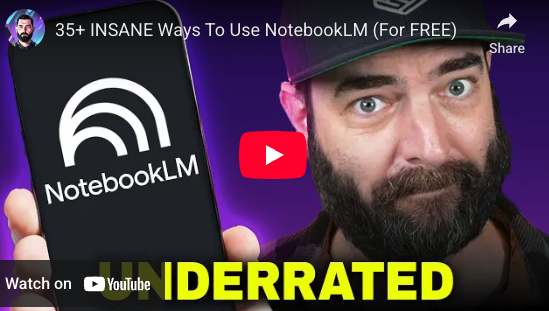
Notebook LM has captured my attention like few others. This powerful yet underappreciated Google tool deserves more recognition for what it can do — and I’m not just saying that because my son and I spent hours learning about Saturn through a custom-made podcast and video it generated.
What makes Notebook LM special is how it focuses on the knowledge you provide rather than pulling from the vast internet. Unlike many AI tools that hallucinate facts, Notebook LM grounds its responses in your sources and even cites where it found information, making it significantly more reliable.
After testing it extensively, I’m convinced this might be one of the most useful AI platforms available today – yet hardly anyone is talking about it.
How Notebook LM Works
At its core, Notebook LM is a knowledge management system that lets you upload up to 50 sources (each containing up to 500,000 words) and interact with that information through chat. You can upload PDFs, text files, markdown files, MP3 audio files, Google Drive documents, website links, YouTube videos, or simply copy-paste text.
When you ask questions, the AI responds solely on the information in your sources, citing exactly where it found each piece. This makes it much more reliable than general AI chatbots.
If you don’t have specific sources, Notebook LM can search the web for relevant information on your topic and import those sources for you. For example, when I asked about humanoid robotics, it found and imported comprehensive guides, historical data, and technical details.
One clever workaround for paywalled content: simply copy the text and paste it directly as a source.
Practical Applications That Impressed Me
After using Notebook LM for several weeks, I’ve found numerous practical applications:
- Creating a personal knowledge base of product manuals for all my tech equipment
- Consolidating research for video projects and efficiently querying that information
- Building company training resources where team members can chat with collective company knowledge
- Generating timelines, mind maps, and visual representations of complex topics
- Analyzing infographics and dense visual information
For students, Notebook LM is a game-changer. It can generate flashcards, quizzes, study guides, and mind maps from your course materials. I tested this with quantum computing materials and was impressed by how it organized complex information into digestible learning tools.
The Content Creation Powerhouse
What truly sets Notebook LM apart are its content creation capabilities. The audio overview feature creates podcast-style conversations between two hosts discussing your topic. You can even interject with questions during playback, making it interactive.
Even more impressive is the video overview feature, which uses Google’s Vids technology to create presentation-style videos with voiceovers and visuals. You can choose from a variety of visual styles, including classic, whiteboard, watercolor, retro paint, heritage paper craft, and anime.
For content creators, the repurposing potential is enormous:
- Turn videos into blog posts or podcasts
- Convert podcasts into videos or written content
- Transform audio notes into structured content
- Create social media posts for different platforms from any content type
Some creators have already leveraged this technology to produce entire podcast series. For example, Andre Carpathy, an OpenAI founder, created “Histories of Mysteries” – a podcast entirely generated by Notebook LM that has received positive reviews.
Personal Knowledge Management
I’ve found unexpected value in using Notebook LM for personal journaling. By uploading my journal entries or audio recordings of my thoughts, I can generate mind maps that visualize my thinking patterns. This has helped me identify blind spots and gain new perspectives on my own ideas.
The ability to create separate notebooks for different topics essentially gives you a personalized knowledge base that you can chat with, organized by subject area.
Pro Tips for Getting the Most from Notebook LM
Remember to save valuable outputs. Notebook LM doesn’t retain chat history, so use the “Save to Note” feature to save responses you want to keep.
Feed it diverse media types. The best results come from providing a variety of formats— videos, blog posts, audio, PDFs, and more.
Selectively activate sources. You can check or uncheck specific sources to control which information the AI uses when responding.
Add your own notes. You can create personal notes within the interface and even convert them to sources if you want the AI to reference them.
While everyone’s talking about ChatGPT, Sora, and Claude, Notebook LM quietly offers some of the most practical AI functionality available today. It’s an educational resource, a self-understanding tool, a content creation platform, and so much more – all for free.
If you’re looking to integrate AI into your learning or creative process, this underrated tool deserves your attention. I’m betting it will become an essential part of your toolkit once you experience what it can do.
Frequently Asked Questions
Q: How is Notebook LM different from regular AI chatbots?
Notebook LM differs from standard AI chatbots because it only responds based on sources you provide rather than drawing from general training data. It cites its sources, making it more reliable and less prone to hallucinations. This focused approach makes it ideal for specific research, learning, and content creation tasks.
Q: Is Notebook LM completely free to use?
Yes, Notebook LM is currently available for free. You can access all features, including uploading up to 50 sources (each containing up to 500,000 words), generating audio and video overviews, creating study materials, and more, at no cost.
Q: What types of files can I upload to Notebook LM?
Notebook LM accepts a wide range of file types, including PDFs, text files, markdown files, MP3 audio files, Google Drive documents, and spreadsheets. You can also add content via website URLs, YouTube video links, or by directly copying and pasting text.
Q: Can I share my notebooks with other people?
Yes, you can share access to your notebooks with team members or colleagues. This makes it an excellent tool for collaborative research, company training resources, or educational purposes. Additionally, if you’re using a personal Google account, you can access public notebooks created by expert curators.
Q: How accurately does Notebook LM provide the information?
The accuracy of Notebook LM depends on the quality of sources you provide. Since it only draws information from your uploaded sources and cites where it found each piece of information, you can verify its responses. This source-based approach significantly reduces hallucinations compared to general AI chatbots, though it’s always good practice to verify critical information.