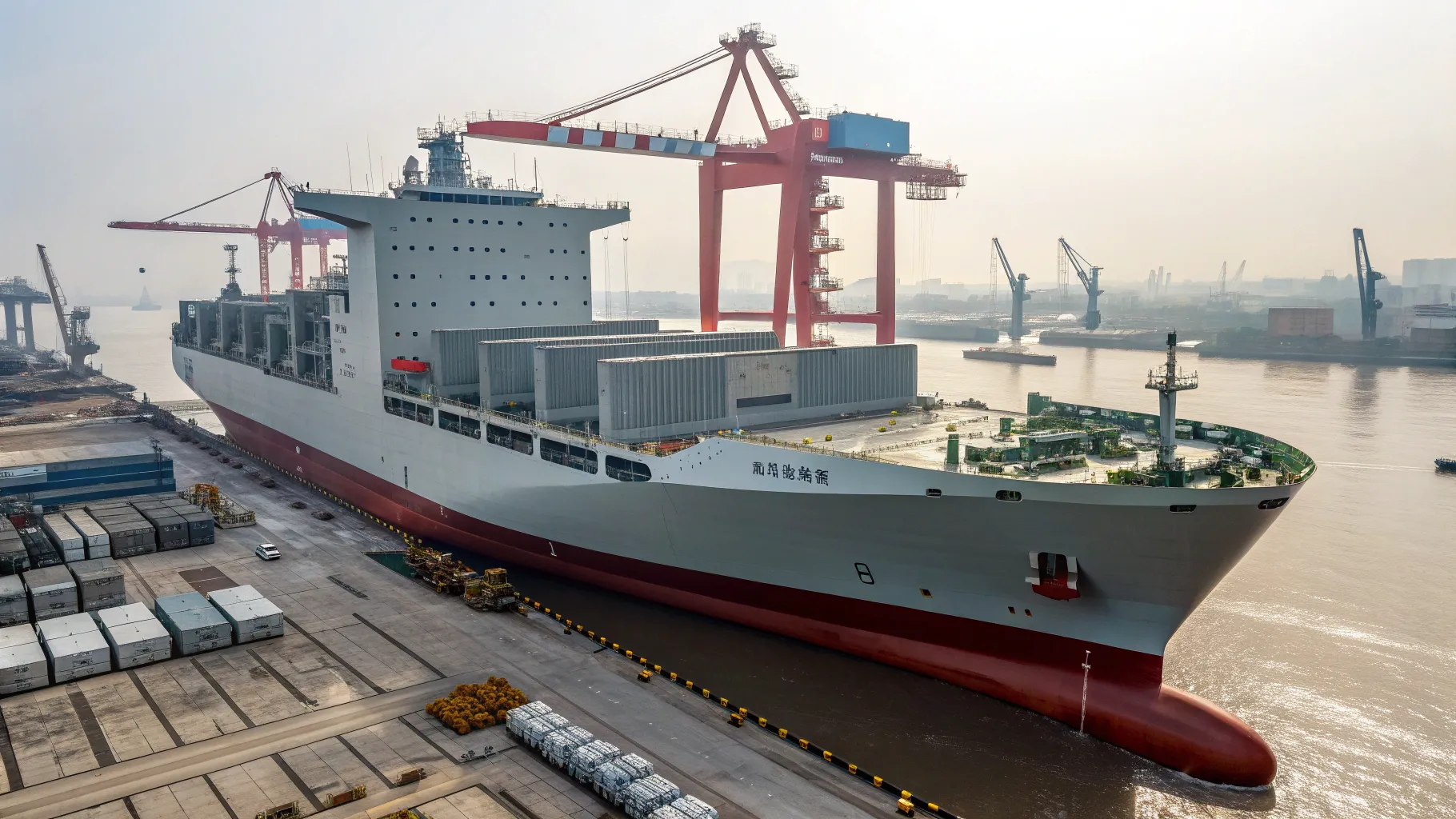
New images taken over the Christmas period appear to show a civilian-style Chinese cargo ship fitted with military systems at the Hudong–Zhonghua shipyard in Shanghai. Analysts say the vessel carries containerized launchers, advanced sensors, and point-defense hardware, raising questions about dual-use maritime platforms and the blurring of lines between commercial and military fleets.
The ship, photographed alongside military construction areas, sits at a facility known for building major surface vessels for China’s navy. The sighting fuels a wider debate over how far China’s military-civil integration has progressed and what it means for security in contested waters.
What The Photos Show
“The Christmas photos of the Chinese civilian-looking cargo ship that appears to be weaponized are real. It’s sitting exactly where analysts say it is – the Hudong–Zhonghua Shipyard in Shanghai. And yes, it absolutely looks like it’s been fitted with containerized missile launchers, sensors, and point-defense hardware.”
Imagery specialists who reviewed the pictures describe launcher-sized containers arranged on deck. They also point to mast-mounted sensors and turret-like mounts consistent with short-range defenses. While external appearance cannot confirm the exact systems, the visible layout mirrors known containerized launcher concepts that fit into standard cargo modules.
Strategic Context: Dual-Use at Sea
China has long promoted military-civil integration, encouraging commercial technologies and platforms that can support national defense. Maritime observers have tracked the rapid growth of auxiliary and militia fleets, as well as adaptations of civilian hulls for surveillance, logistics, and gray-zone missions.
Hudong–Zhonghua, part of the state-owned China State Shipbuilding Corporation, has delivered large amphibious ships and other major combatants. The presence of a seemingly weaponized cargo hull at this site suggests trials or integration work with naval oversight. Experts say such vessels could blend into merchant traffic, complicating threat detection and rules of engagement.
Why Containerized Launchers Matter
Containerized systems can hide missiles or drones in standard 20- or 40-foot boxes. That allows rapid loading or unloading and offers deniability. A commercial-looking ship could approach a conflict zone without drawing early attention, challenging maritime patrols and raising the risk of surprise strikes.
Several countries have experimented with container-based launchers for coastal defense or covert deployment. The concept is attractive because it uses existing logistics networks and port infrastructure. If China fields such capability at scale, it could alter naval planning in the Western Pacific.
Competing Views From Analysts
Some analysts warn that weaponized merchant-style ships could erode the safety of civilian shipping lanes. They argue that the practice may invite suspicion of ordinary cargo vessels, undermining maritime trade and insurance markets. The concern is acute in narrow seas and chokepoints, where ships operate in close proximity.
Others caution against firm conclusions from photographs alone. They note that the vessel could be a test platform or a demonstrator with inert systems. They also highlight that navies often use civilian hulls for trials and range support, which may not translate into fielded warfighting units.
Implications for Regional Security
In the South and East China Seas, any move that hides military capability inside civilian traffic complicates crisis management. Coast guards and navies could face split-second decisions about vessels that look commercial but act military. Misidentification could escalate a local incident into a broader clash.
For the United States and its allies, tracking dual-use vessels may require new identification methods and tighter fusion of commercial shipping data with military sensors. It may also prompt updates to rules of engagement and maritime law discussions about the status of disguised ships during peacetime and conflict.
Signals To Watch
- Repeat sightings of similar containerized layouts on additional hulls.
- Port activity showing rapid loading of launcher-sized containers onto civilian ships.
- Official statements or procurement notices tied to containerized maritime systems.
- Exercises featuring cargo-style vessels in combat roles.
What Comes Next
If China advances weaponized civilian-hull concepts, neighbors could respond with tighter port inspections, more uncrewed surveillance, and layered coastal defenses. Shipping firms may face new compliance burdens as authorities seek to verify cargoes and deck fittings. Insurers could revise risk models for ports near sensitive military facilities.
For now, the images provide a rare window into how a major shipyard may be experimenting with modular launchers and layered defenses on non-traditional platforms. The extent of deployment remains unclear, but the sighting aligns with a pattern of flexible, low-signature maritime capabilities.
The immediate takeaway is that naval planners can no longer assume that a cargo silhouette is benign. The line between merchantman and combatant appears thinner. Watch for additional imagery, maritime advisories, and training activities that clarify whether this is a one-off test or a sign of broader adoption.

Deanna Ritchie is a managing editor at DevX. She has a degree in English Literature. She has written 2000+ articles on getting out of debt and mastering your finances. She has edited over 60,000 articles in her life. She has a passion for helping writers inspire others through their words. Deanna has also been an editor at Entrepreneur Magazine and ReadWrite.