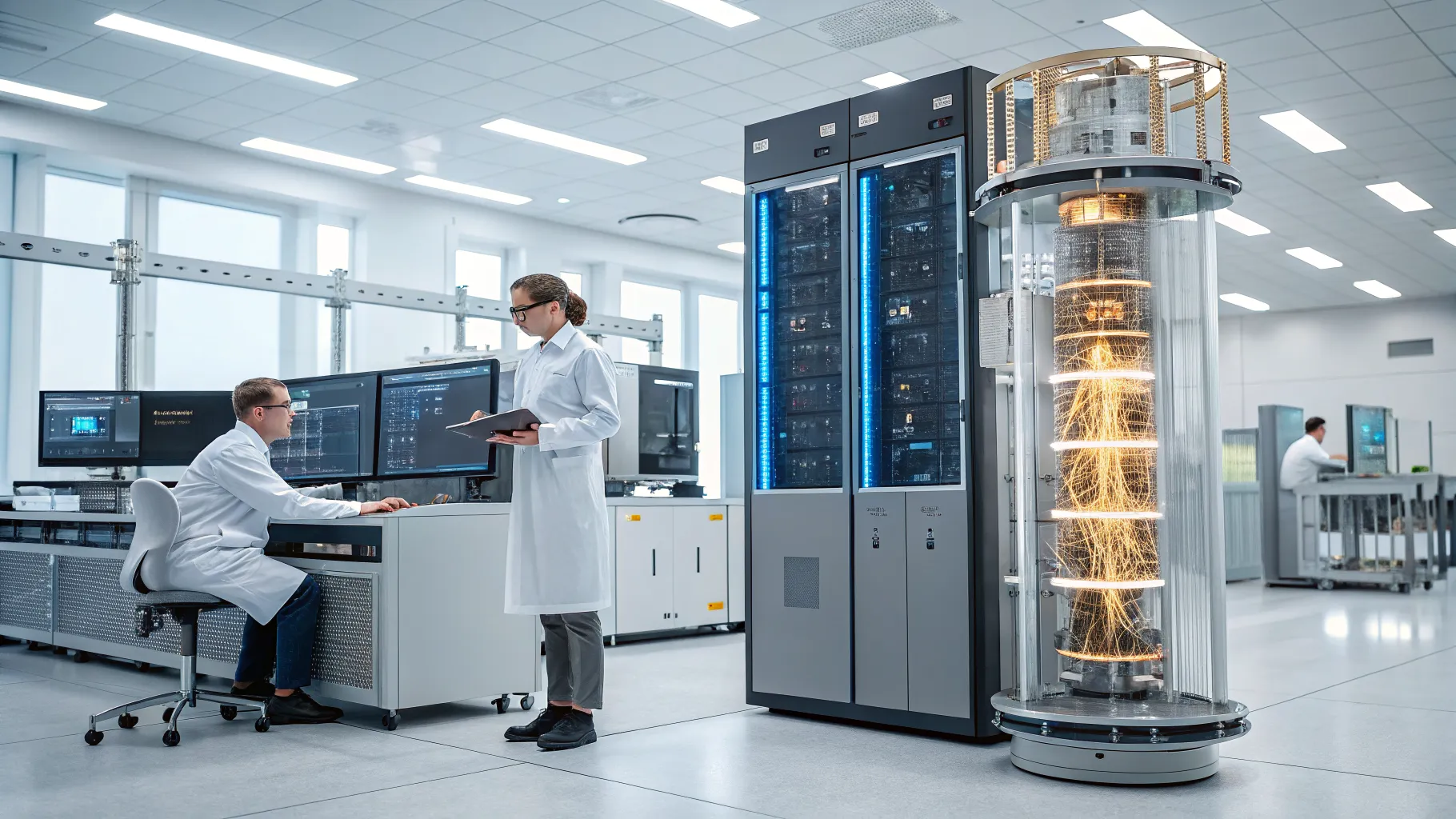
Physicists report building a larger and more complex version of a “time crystal” on a superconducting quantum computer, marking a step for research on unusual phases of matter. The work uses a programmable chip of qubits to create a material with a repeating pattern in time rather than space, and offers clues for how quantum devices might probe hard physics problems.
Time crystals were first proposed in 2012 as a new kind of order. Early experiments in 2016 and 2017 showed the effect in driven quantum systems, including trapped ions and solid-state defects. More recent studies used quantum processors to stabilize the effect for longer periods. The new result scales the idea up, aiming for larger system size and richer interactions.
“Using a superconducting quantum computer, physicists created a large and complex version of an odd quantum material that has a repeating structure in time.”
What the Team Built
The researchers programmed a network of superconducting qubits to flip in a repeating rhythm under a regular drive. Instead of settling into a simple repeat that matches the drive, the system locked into a pattern that ticks at a different rate. That time-based order is the signature of a time crystal.
By increasing the number of active qubits and the variety of interactions, the team pushed past earlier, smaller demonstrations. They also tuned how strongly qubits talk to one another. This let them test how stable the time pattern is as complexity grows.
Key goals included:
- Scaling the number of qubits involved.
- Extending how long the time crystal persists under noise.
- Mapping when the pattern holds and when it fails.
Why It Matters
Time crystals are a laboratory for studying systems that never reach equilibrium. These systems can show order even while driven and disturbed. That is unusual. Understanding their behavior could help scientists design quantum devices that resist certain kinds of errors.
The result also shows how a quantum computer can act as a flexible simulator. Instead of building a special material in the lab, the team programmed the chip to behave like one. That approach could speed research on phases of matter that are hard to create in real materials.
How This Compares to Past Work
Earlier studies often involved fewer particles or simpler couplings. Trapped-ion and solid-state platforms offered clean control but limited size. Some quantum processor experiments reached tens of qubits, hinting at stable subharmonic patterns.
The new experiment emphasizes scale and complexity on a superconducting platform. It explores more parameters in one device. This helps draw a clearer boundary between true time-crystal order and look-alike effects caused by short-lived coherence.
What the Data Suggest
The team likely measured how the system responds after many drive cycles. They would look for a repeating signal that stays strong even as small errors creep in. If the pattern lasts far longer than the system’s basic timescales, that supports the time-crystal claim.
They also appear to probe when the order breaks. By dialing up noise or changing the drive, the pattern should fade. Charting this transition helps define where time crystals can exist and what protects them.
Open Questions and Next Steps
Several hurdles remain. Verification is hard at scale, since full state readout on many qubits is costly. Noise still limits how long the pattern survives. And scientists are still testing how general these results are across different devices and algorithms.
Future work will likely target larger qubit counts, smarter error mitigation, and new drives that stabilize order for longer. Researchers will also test whether similar methods can model other out-of-equilibrium phases and help benchmark quantum hardware.
The latest advance shows that programmable quantum chips can host intricate phases not found in everyday materials. It points to a practical path: use quantum computers as testbeds for new physics while refining the machines themselves. The next milestones to watch are bigger systems, longer lifetimes, and clear links between these phases and more reliable quantum operations.

Deanna Ritchie is a managing editor at DevX. She has a degree in English Literature. She has written 2000+ articles on getting out of debt and mastering your finances. She has edited over 60,000 articles in her life. She has a passion for helping writers inspire others through their words. Deanna has also been an editor at Entrepreneur Magazine and ReadWrite.