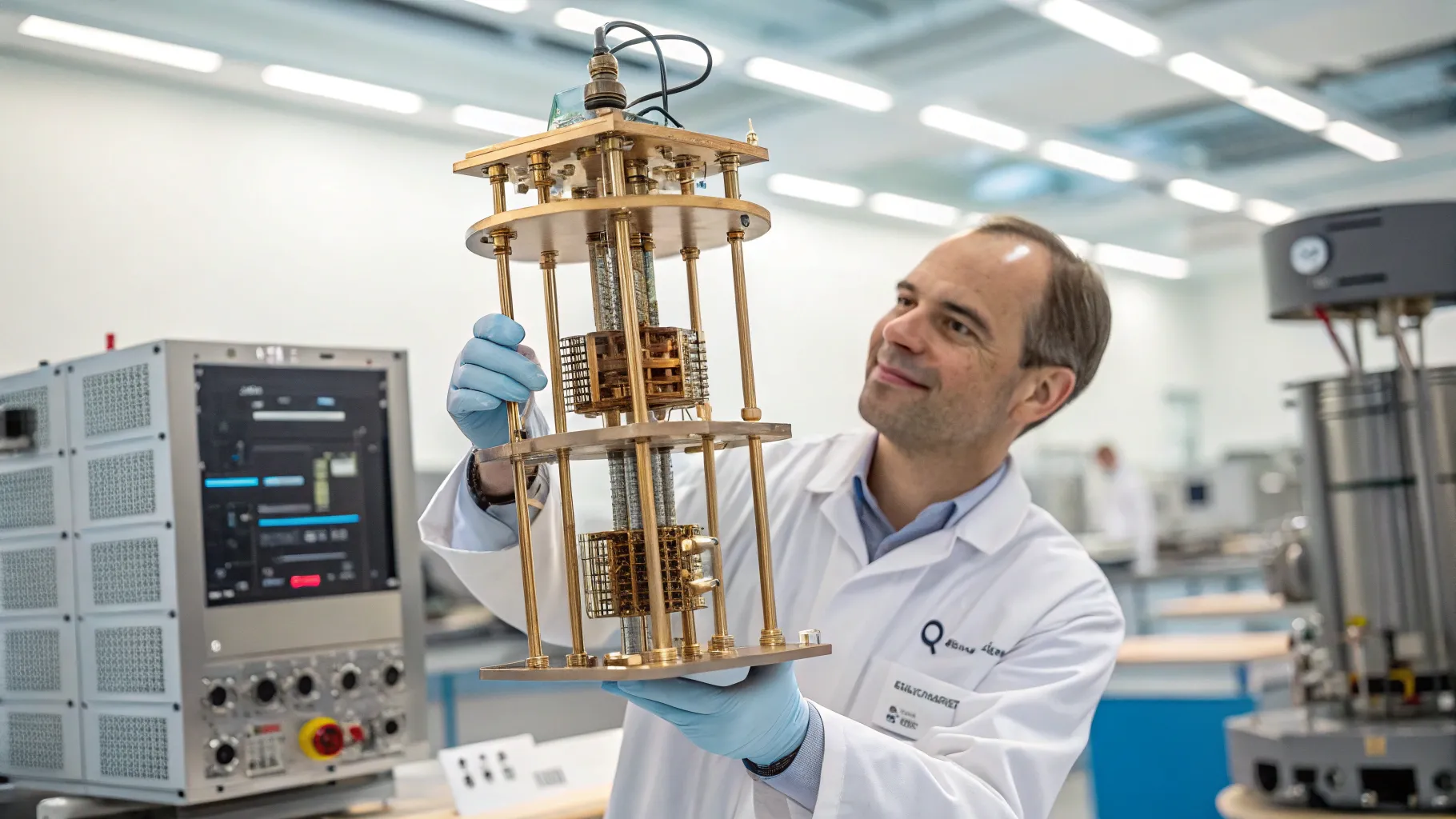
A new device built from superconducting qubits is being held up as a strong path to practical quantum computing, with potential spillovers for quantum machine learning. The claim speaks to the high stakes race among labs and companies seeking useful quantum advantage. It also reflects growing confidence that hardware progress, error control, and smarter algorithms can move experimental ideas into real-world use.
“A device made from superconducting qubits could prove a powerful technology for enabling practical quantum computing or more experimental propositions like quantum machine learning.”
The statement aligns with years of investment by firms such as IBM, Google, and Rigetti, as well as national labs and universities. Superconducting qubits are among the most mature hardware approaches. They are built on tiny circuits cooled near absolute zero, where electrical resistance drops and quantum effects emerge.
What Superconducting Qubits Offer
Superconducting qubits are fast and compatible with existing chip fabrication methods. They can be coupled and controlled with microwave pulses. That makes them suitable for multi-qubit processors and repeated gate operations.
Tech giants have published steady gains. IBM has shown larger devices and longer coherence times. Google reported a milestone experiment in 2019 using a 53-qubit chip to sample a random circuit. Academic groups have also pushed coherence and gate fidelity upward, reducing common noise sources.
These advances matter because useful quantum computing needs many qubits and low error rates. Hardware and software must improve together. Programmers also need toolchains and libraries that make hybrid workflows easier.
The Hurdles: Error, Scale, and Stability
Even with momentum, the field faces clear limits. Decoherence and gate errors still cut into performance. Scaling beyond a few hundred qubits while keeping precision is a core challenge.
- Error correction remains expensive, requiring many physical qubits per logical qubit.
- Control electronics and cryogenic systems add complexity and cost.
- Benchmarking methods are evolving and can be hard to compare across labs.
Researchers are testing surface code schemes and better calibration methods. The goal is to maintain reliable operations over longer circuits. Progress will likely be gradual, with niche tasks becoming useful first.
Why Quantum Machine Learning Is Mentioned
The link to quantum machine learning reflects a hope that certain data problems map well to quantum circuits. Proposed uses include kernel methods, feature embeddings, and sampling for model training. These ideas are promising but early.
Most studies so far use small, noisy devices. Many show parity with classical baselines rather than clear wins. Still, researchers see testing grounds in chemistry data, graph features, and optimization. If error rates fall and circuit depth rises, more complex models may be tried.
To manage expectations, experts stress hybrid strategies. Classical systems do heavy lifting. Quantum circuits handle subroutines that may yield speed or quality on specific structures.
Industry Race and Timelines
Companies continue to announce roadmaps with bigger devices and higher fidelity. Some target thousands of qubits later this decade, with error correction built in. Government funding in the United States, Europe, and Asia backs this push with grants and testbeds.
Users in finance, pharma, energy, and logistics are running pilots. Most focus on proof-of-concept tasks in optimization, simulation, and secure communication. The near-term value is learning what works, what does not, and how to integrate quantum calls into normal workflows.
Standards bodies and open-source groups are also shaping common formats for circuits, results, and benchmarks. This should help separate marketing claims from measurable gains.
What Comes Next
The near-term test for superconducting devices is whether they can deliver repeatable gains on targeted problems. Tighter error bounds, better calibration, and scalable interconnects will be key milestones. Clear comparisons against classical solvers will build trust.
Looking ahead, watch for demonstrations of small logical qubits with sustained operations, early error-corrected circuits, and domain wins in chemistry or materials. For quantum machine learning, expect more head-to-head trials on public datasets with transparent metrics.
The promise of superconducting qubits remains strong. The path to practical use will be stepwise, guided by evidence and careful testing. If the hardware keeps improving, the case for real-world advantage will grow.

Rashan is a seasoned technology journalist and visionary leader serving as the Editor-in-Chief of DevX.com, a leading online publication focused on software development, programming languages, and emerging technologies. With his deep expertise in the tech industry and her passion for empowering developers, Rashan has transformed DevX.com into a vibrant hub of knowledge and innovation. Reach out to Rashan at [email protected]