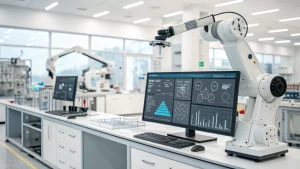
XPeng unveiled its humanoid robot, Iron, at the Shanghai Auto Show. Iron is already working on XPeng’s production lines, assembling electric vehicles. It stands at the same height as Tesla’s Optimus robot but has more processing power, with 3,000 TOPS.
XPeng’s advantage is in real-world deployment. Iron uses the same AI that powers XPeng’s autonomous vehicles, creating a smart ecosystem that combines mobility and robotics. It has a proprietary “Turing AI chip” and “Tianji AIOS” that enable spatial awareness and voice interaction.
Iron moves and works smoothly with 60 joints and 200 degrees of freedom.
Iron starts factory work
Tesla’s Optimus is powered by the company’s Full Self-Driving (FSD) technology and integrates with Tesla’s AI and hardware ecosystem.
However, rare earth export restrictions from China have delayed Elon Musk’s plans for mass production this year. Chinese regulators want assurances that the robots won’t be used as weapons amid geopolitical tensions. According to Morgan Stanley, the global market for humanoid robots is projected to reach $5 trillion by 2050.
Tesla and XPeng are pursuing a future where humanoids take over tasks in factories, households, and retail spaces. Projections suggest that robots could replace 62.7 million jobs by 2050, with a billion bots in use. While Tesla has strong brand recognition and expertise, XPeng is already putting Iron to work in the real world.
The race to dominate this new frontier of humanoid robotics is shaping up to be a showdown between two formidable competitors.

Rashan is a seasoned technology journalist and visionary leader serving as the Editor-in-Chief of DevX.com, a leading online publication focused on software development, programming languages, and emerging technologies. With his deep expertise in the tech industry and her passion for empowering developers, Rashan has transformed DevX.com into a vibrant hub of knowledge and innovation. Reach out to Rashan at [email protected]