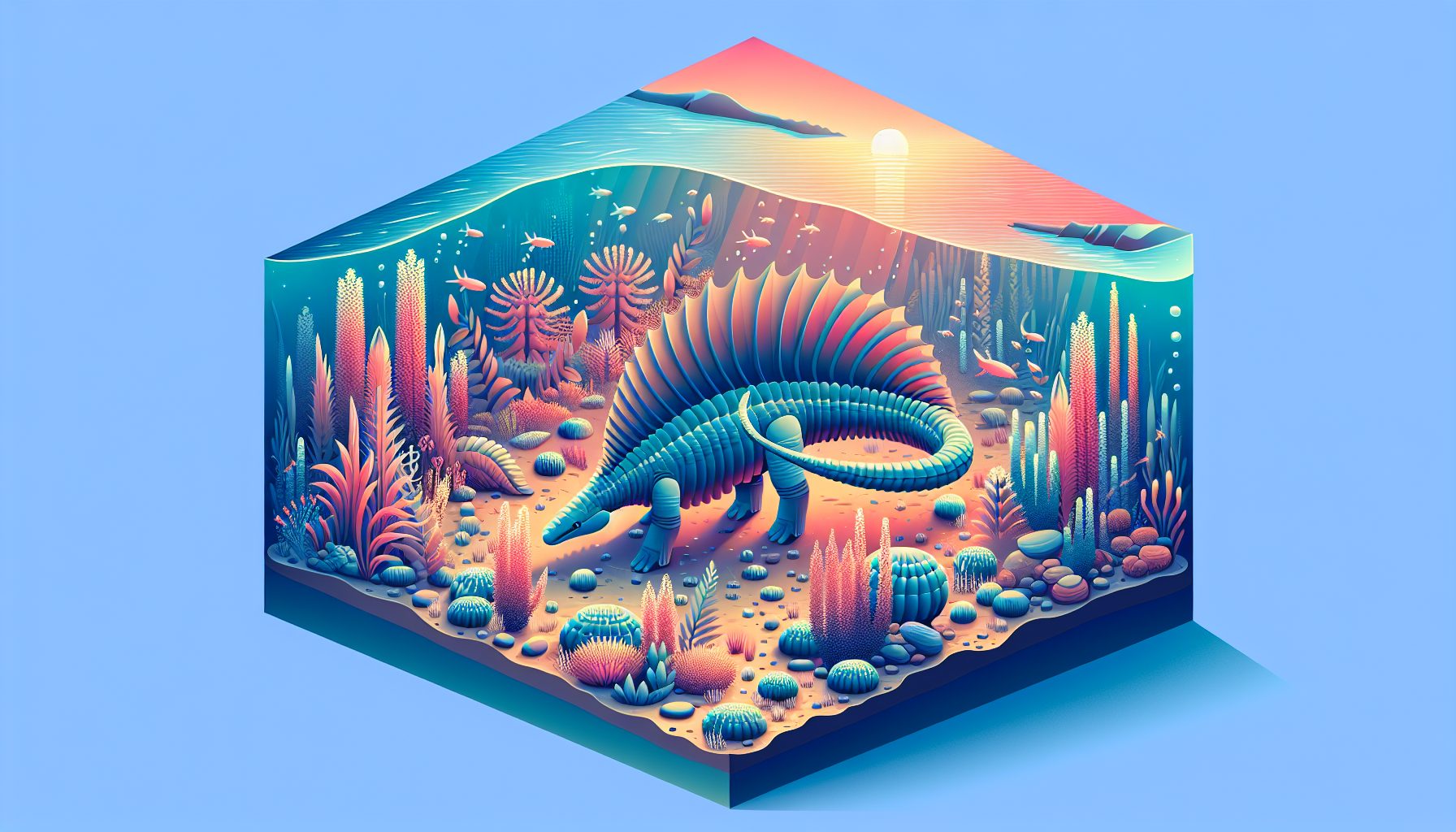
Scientists have discovered a 555-million-year-old creature in the Australian outback that may be the earliest known animal to show evidence of an asymmetrical body. The animal, named Quaestio simpsonorum, was about the size of a palm and had a unique “backward question mark”-shaped protrusion on its back. This asymmetry is considered a crucial step in the evolution of complex life, as it allowed for the development of more intricate body parts.
The fossils were found in South Australia’s Nilpena Ediacara National Park, a site known for yielding many of the earliest complex animal fossils. “The animal is a little smaller than the size of your palm and has a question-mark shape in the middle of its body that distinguishes between the left and right side,” said Scott Evans, a paleobiologist at Florida State University and lead author of the study. “There aren’t other fossils from this time that have shown this type of organization so definitively.”
The discovery also suggests that Quaestio simpsonorum was capable of movement.
Fossilized tracks found directly behind one of the fossils indicate that the creature moved along the ocean floor, consuming nutrients from microscopic algae and bacteria, much like a “small marine Roomba vacuum.”
Mary Droser, a paleontologist at the University of California, Riverside and co-author of the study, emphasized the significance of the findings.
Early asymmetry evolution in fossils
“It’s incredibly insightful in terms of telling us about the unfolding of animal life on Earth.
We’re the only planet that we know of with life, so as we look to find life on other planets, we can go back in time on Earth to see how life evolved on this planet.”
The research team, which includes scientists from various institutions, has been excavating the Nilpena Ediacara National Park for decades. The park, which opened to the public in early 2023, is part of a bid to be recognized as a UNESCO World Heritage Site. “As the oldest fossil animals, the Ediacara biota can tell us a great deal about early developmental processes,” Evans noted.
“Because animals today use the same basic genetic programming to form distinct left and right sides, we can be reasonably confident those same genes were operating to produce these features in Quaestio simpsonorum, an animal that has been extinct for more than half-a-billion years.”
The team continues to reexamine sites throughout the park’s nearly 150,000 acres, hoping to uncover more insights into the early evolution of animal life on Earth. “We’re still finding new things every time we dig,” said Ian Hughes, a Harvard University graduate student and one of the researchers. “Even though these were some of the first animal ecosystems in the world, they were already very diverse.
We see an explosion of life very early on in the history of animal evolution.”

April Isaacs is a news contributor for DevX.com She is long-term, self-proclaimed nerd. She loves all things tech and computers and still has her first Dreamcast system. It is lovingly named Joni, after Joni Mitchell.