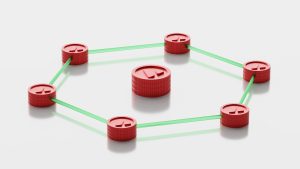
A distributed SQL database is a database that looks and feels like a traditional relational system, tables, SQL, joins, indexes, transactions, but stores and replicates data across multiple machines while presenting it as one logical database. The promise is straightforward: you get horizontal scale and fault tolerance without giving up ACID transactions or rewriting your application around eventual consistency.
Under the hood, most distributed SQL systems solve three difficult problems so application teams do not have to.
First, they automatically shard or partition data. Rows are split into ranges or shards across nodes, and the database routes queries to the right places. Second, they use synchronous replication with consensus, typically via Raft or Paxos-style protocols, so replicas agree on write order and durability. Third, they support distributed transactions, allowing updates across multiple shards to commit safely.
If this sounds like a traditional relational database that can survive node or zone failures and scale out, that is the right mental model.
How a Distributed SQL Database Differs from “Postgres Plus Replicas” or Manual Sharding
A single-node SQL database with read replicas usually has one primary handling writes, and multiple replicas serving reads. It is simple, fast, and well understood, until the primary becomes a ceiling.
Distributed SQL flips that model. Multiple nodes can accept SQL, data is distributed and replicated by default, and the database itself manages rebalancing and failover.
Manual sharding sits in between. You split data by a shard key, run multiple databases, and teach your application which shard to hit. Distributed SQL exists largely to eliminate this category of engineering work.
Why Distributed SQL Exists at All
The modern wave of distributed SQL systems was inspired by internal databases built at hyperscalers, especially systems designed to support global applications with strong consistency guarantees.
In the open ecosystem, the best-known systems position themselves around the same core idea: keep SQL and transactions, but remove the single-machine limit. The pitch is not novelty; it is survival at scale.
When You Should Adopt a Distributed SQL Database
Distributed SQL makes sense when your constraints are structural, not incremental.
Adopt When These Are True
1) You need to write scalability, not just read scalability.
Read replicas help reads. Vertical scaling helps until it does not. Distributed SQL becomes attractive when write throughput, data volume, or concurrency exceed what a single primary can handle.
2) High availability across zones is non-negotiable.
If a single-node failure regularly causes customer-visible incidents, quorum-based replication and automatic failover become operational necessities rather than luxuries.
3) You cannot tolerate inconsistent reads or uncertain writes.
Many scalable data stores relax consistency guarantees. Distributed SQL exists specifically to preserve ACID semantics while distributing the system.
4) You are building multi-region systems where correctness matters.
Multi-region architectures force hard tradeoffs. Distributed SQL can help, but only if you are deliberate about data placement and transaction boundaries.
Do Not Adopt Yet When These Are True
1) You mostly need a reading scale.
A well-tuned relational database with read replicas, caching, and indexing is often cheaper and faster to operate.
2) Hot keys dominate your workload.
If most writes hit a narrow key range, you can still bottleneck even in a distributed system.
3) You cannot tolerate extra write latency.
Consensus and distributed transactions add coordination. You are trading raw latency for resilience and scale, and that tradeoff is fundamental.
The Tradeoffs in Plain Terms
Distributed SQL is not “better Postgres.” It is a different set of compromises.
| Dimension | Single-Node SQL | Distributed SQL |
|---|---|---|
| Write latency | Typically lower | Higher due to coordination |
| Operational complexity | Lower | Higher, but automated |
| Failure tolerance | Primary is a single point | Designed to survive failures |
| Application impact | Minimal | Requires awareness of data layout |
The biggest shift is mental. You stop thinking in terms of machines and start thinking in terms of data locality and transaction scope.
A Worked Example: Why Coordination Changes Performance
Imagine a payment transaction that updates three tables. In a distributed system, those rows may live on two different shards.
A strongly consistent write might require quorum replication for shard A, quorum replication for shard B, and a distributed transaction commit step. Even with fast internal networking, each coordination step adds milliseconds.
It is common to see single-digit or low double-digit millisecond increases at higher percentiles for cross-shard writes. That does not make the system slow, but it does push you to design schemas and transactions that stay single-shard whenever possible.
A Practical Adoption Checklist
You are in serious consideration territory if you can check three or more of the following:
-
Your primary database is frequently CPU or IOPS-constrained during write peaks.
-
Storage growth or maintenance windows are hurting uptime.
-
Multi-zone high availability is a hard requirement.
-
Strong consistency is required across regions.
-
You are already planning application-level sharding.
-
You can invest engineering effort in schema and access pattern design.
If you only check one or two, you usually get more return from indexing, query tuning, caching, partitioning within a single engine, or better replica usage.
FAQ
Is distributed SQL the same as NewSQL?
Not exactly. NewSQL is a broader category. Distributed SQL refers specifically to systems that keep SQL and ACID semantics while distributing data across nodes.
Will my existing SQL application run unchanged?
Sometimes, but do not assume it. Compatibility is often high, but performance characteristics and edge behaviors differ.
What is the biggest migration risk?
Workload shape. Concentrated access patterns and frequent cross-entity transactions can turn coordination overhead into a constant tax.
What should you prototype first?
A realistic dataset and your most critical write paths. Measure tail latency and test failure scenarios early.
Honest Takeaway
Adopting a distributed SQL database is a conscious trade. You accept coordination overhead in exchange for eliminating human overhead, manual sharding, brittle failover, and perpetual vertical scaling.
That trade is worth it when uptime and growth are existential. It is overkill when a well-run single-node database can comfortably support your next phase. The right answer is rarely ideological. It is architectural, grounded in workload shape, failure tolerance, and how much operational complexity your team is prepared to own. For related reading, explore capacity planning for fast-growing applications and dependency graphs in system latency.

Kirstie a technology news reporter at DevX. She reports on emerging technologies and startups waiting to skyrocket.