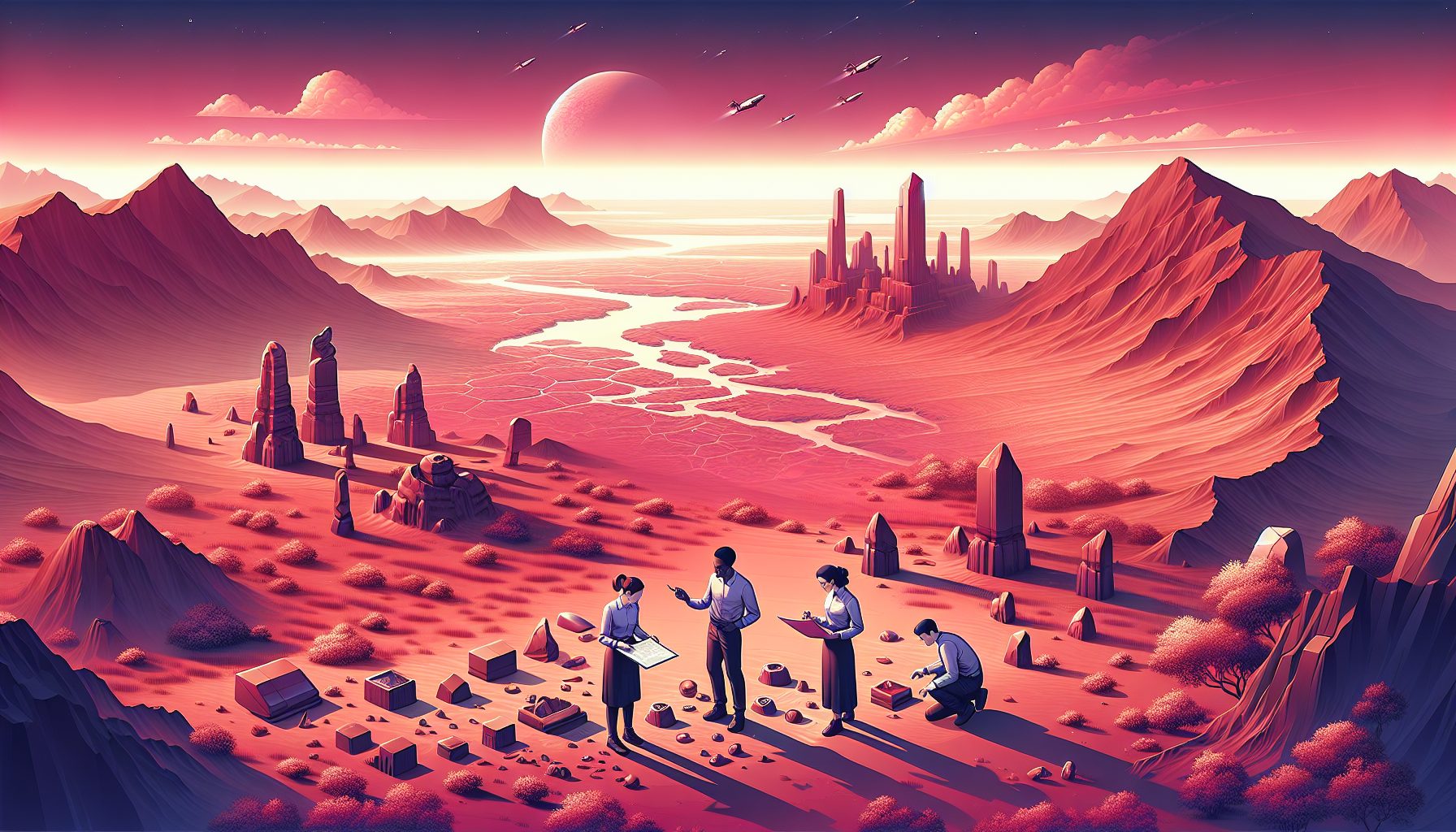
A new study argues that human spacecraft, landers, rovers, and other space-exploration debris on Mars should be regarded as vital artifacts that mark humanity’s first attempts at interplanetary exploration. The paper calls for the preservation and cataloging of these relics. University of Kansas anthropologist Justin Holcomb, the lead author of the study, says that as humans venture beyond Earth, tracking and preserving the remnants of our explorations will help document our off-world endeavors.
“Our main argument is that Homo sapiens are currently undergoing a dispersal, which first started out of Africa, reached other continents and has now begun in off-world environments,” Holcomb said. “We’ve started peopling the solar system. And just like we use artifacts and features to track our movement, evolution, and history on Earth, we can do that in outer space by following probes, satellites, landers, and various materials left behind.”
Holcomb suggests that these items should be seen as part of our human heritage, not just space trash.
“These are the first material records of our presence, and that’s important to us,” he said. “I’ve seen a lot of scientists referring to this material as space trash, galactic litter. Our argument is that it’s not trash; it’s actually really important.
Mars artifacts: preserving human heritage
It’s critical to shift that narrative towards heritage because the solution to trash is removal, but the solution to heritage is preservation.”
The study urges that future missions to Mars and other planets should consider the potential archaeological value of landing locations and other sites. Missions should be planned to minimize disturbances to these nascent archaeological records.
For instance, the Soviet Union’s Mars 2 crash in 1971 marked humanity’s first imprint on another planet. “The Mars 2 crash represents one of the first times our species touched another planet—not a celestial body because that was the moon—but the Mars 2 crash is the first time our species left a preserved imprint on the surface of another planet,” Holcomb explains. Understanding how the Martian environment affects these artifacts is crucial.
The field of geoarchaeology, which studies geological effects on archaeological materials, can provide insights. Future study in planetary geoarchaeology is warranted to understand the varying processes across different Martian environments. Holcomb and his co-authors Beth L.
O’Leary, Alberto Fairén, Rolfe Mandel, and Karl Wegmann underscore the need for a systematic approach to tracking and cataloging human-made objects on Mars, potentially via existing databases. These artifacts, Holcomb suggests, are historical markers akin to “hand axes in East Africa or Clovis points in America.”
This push for preservation echoes similar efforts on the moon, where Holcomb has advocated for the declaration of a “lunar anthropocene.” On Mars, while there is not yet an “anthropocene,” there is an emerging archaeological record that could be significant for future generations.

Johannah Lopez is a versatile professional who seamlessly navigates two worlds. By day, she excels as a SaaS freelance writer, crafting informative and persuasive content for tech companies. By night, she showcases her vibrant personality and customer service skills as a part-time bartender. Johannah's ability to blend her writing expertise with her social finesse makes her a well-rounded and engaging storyteller in any setting.