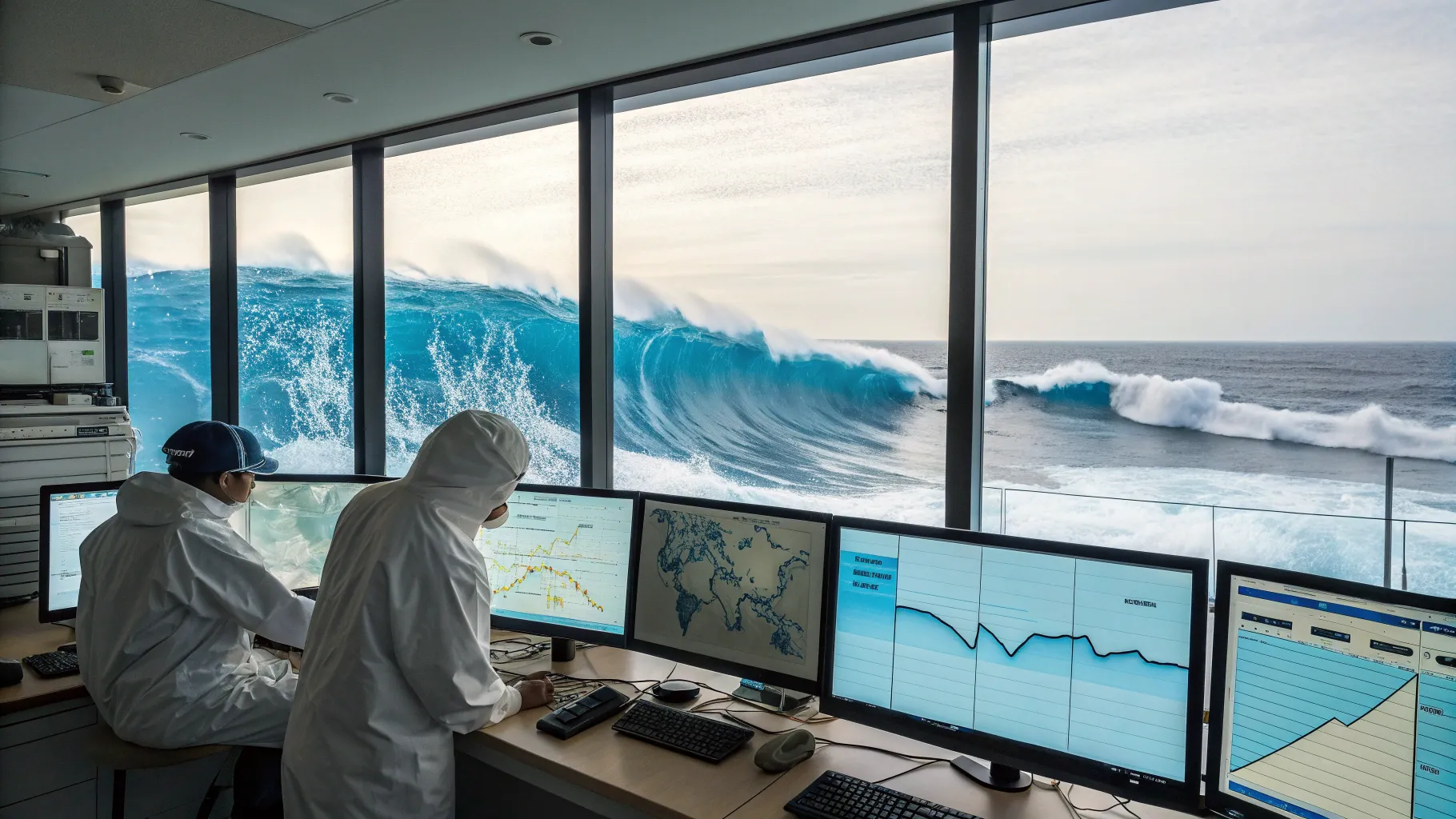
For the first time, researchers say they watched a tsunami unfold in real time during the summer of 2025, marking a potential shift in how coastal communities get warned. The observation, made on the open ocean where tsunamis are usually all but invisible, could reshape emergency alerts and save lives if adopted widely.
Tsunamis are hard to spot in deep water as they race to shore. Their waves are spread over long distances, with low heights that are easy to miss. Scientists have long relied on seafloor sensors and coastal gauges to confirm a wave after it forms. Seeing one live in the open ocean suggests a new capability for earlier, clearer warnings.
‘They Watched One Unfold’
But in the summer of 2025, scientists watched one unfold as it happened.
The simple claim carries weight. Real-time observation means distances, speeds, and energy could be tracked as the wave moved. That offers a clearer picture than inferring the threat only from seismology or waiting for coastal instruments to spike.
Researchers often stitch together multiple signals. Seismometers reveal the trigger. Deep-ocean pressure sensors confirm a wave exists. Coastal tide gauges show impact. Satellite altimetry and GPS can detect subtle changes at sea. Seeing the wave live suggests those pieces are getting sharper and faster.
Why Detection at Sea Is So Hard
A tsunami in deep water can pass under ships with little notice. The wave height may be less than a meter, yet the energy spans many kilometers. That is why early warning is difficult. By the time coastal gauges rise, evacuation windows can be short.
Traditional warning centers weigh rapid earthquake data, the location and depth of a rupture, and historic patterns. They then issue alerts that are refined as ocean data arrives. False alarms carry costs. Missed alarms cost lives. Real-time sighting at sea could tighten those calls.
What This Could Change for Warnings
Earlier confirmation at sea means emergency managers can act faster and with more confidence. That might lead to:
- More precise evacuation zones tailored to expected wave heights.
- Better timing for port closures and ship movements.
- Improved public messaging that reduces panic and confusion.
It could also help refine models that forecast how a wave will bend, slow, and grow over continental shelves. That matters for harbors, low-lying neighborhoods, and critical infrastructure such as power plants and hospitals.
Tools That Make Real-Time Viewing Possible
Scientists have been upgrading detection systems for years. While details of the 2025 observation were not disclosed, the toolkit likely includes:
- Seafloor pressure sensors that register passing waves.
- Satellite instruments that measure tiny sea-level changes.
- GPS networks that capture ground motion and ocean surface shifts.
- Coastal radar and tide gauges that confirm arrival and size.
The trend is clear: more sensors, faster data, and stronger models feeding into national and regional warning centers.
Balancing Speed and Certainty
Even with a live view at sea, judgment calls remain. Not every seafloor event generates a dangerous wave. Local topography can amplify or dampen impacts. Coastal communities need alerts that are fast and accurate.
Emergency planners also stress education. People should know evacuation routes, high-ground options, and how to respond to natural cues such as a strong quake or sudden ocean retreat. Technology helps, but clear action plans save lives.
What to Watch Next
The 2025 observation hints at a new phase for tsunami science. Wider coverage, better data sharing, and regular drills could bring real-world benefits. Researchers will aim to cut false alarms, increase lead time, and tailor forecasts to specific coastlines.
If live ocean tracking becomes standard, coastal warnings could move from broad advisories to street-level guidance. That shift would require funding, maintenance, training, and public trust. But the payoff is significant: more time to move people and assets out of harm’s way.
For now, the message is cautious optimism. A live view of a tsunami on the open ocean was once thought out of reach. The summer of 2025 suggests that is changing, with the promise of faster, clearer alerts when the next wave forms.

Rashan is a seasoned technology journalist and visionary leader serving as the Editor-in-Chief of DevX.com, a leading online publication focused on software development, programming languages, and emerging technologies. With his deep expertise in the tech industry and her passion for empowering developers, Rashan has transformed DevX.com into a vibrant hub of knowledge and innovation. Reach out to Rashan at [email protected]