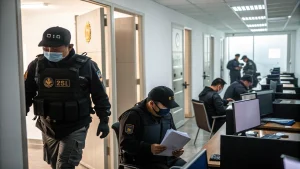
Cambodia has moved to tackle organized online fraud, drafting its first law aimed at operations that have trapped workers and siphoned money from victims worldwide. Officials say the measure seeks to address online scam centers linked to forced labor and cross-border crime, signaling a shift in policy after years of rapid growth in illicit compounds.
The draft comes as governments across Southeast Asia confront a surge in “scam factories” that run romance-investment schemes, crypto fraud, and extortion. Rights groups have reported widespread trafficking of workers into guarded compounds in coastal and border towns. The initiative is expected to reach parliament in the coming months, though a timeline for passage is not yet clear.
Cambodia has drafted its first law to crack down on online scam centers that fuel fraud and forced labor.
Rising Pressure Over Trafficking and Fraud
Over the past five years, Cambodia’s casino hubs and special economic zones drew networks that ran large-scale cyber schemes. During the pandemic, operators shifted from tourism to online crime, recruiting job seekers with false ads. Many arrivals reported confiscated passports, confinement, and beatings for missing “quotas.”
United Nations reports and regional police alerts have described tens of thousands of trafficking victims across the Mekong region, with Cambodia among the hotspots. Law enforcement agencies say global losses from online investment and romance scams reach into the billions of dollars each year. The growth of crypto, encrypted apps, and overseas payment layers has made investigations harder.
Authorities in Phnom Penh have staged raids since 2022, freeing trafficked workers and arresting suspected ringleaders. But rights monitors say prosecutions often fall on low-level staff, while financiers and landlords avoid charges. The government’s new draft law appears designed to address those gaps and deter repeat offenses.
What the Draft Law Seeks to Change
While full details are not yet public, officials describe a law focused on criminal networks that profit from online fraud and forced labor. Legal analysts expect measures that tighten penalties for running scam compounds, enhance tools for asset seizure, and strengthen cooperation with foreign police.
Advocates also want clear victim safeguards. They argue that trafficking survivors should receive immunity from prosecution for crimes committed under coercion, access to shelter, and fast-track repatriation. Without that, they warn, fear of arrest will continue to trap workers in abusive sites.
- Targeting organizers and financiers, not only frontline staff
- Asset tracing and seizure to disrupt profits
- Data-sharing with regional partners and tech platforms
- Protection and safe return for coerced workers
Industry And Regional Impacts
Telecom and fintech firms operating in Cambodia say a clear legal framework could help them report suspicious activity faster. Payment blacklists and Know Your Customer checks are common, but scam networks shift to new channels quickly. Better legal authority may speed account freezes and domain takedowns.
Neighboring countries are watching. Scam syndicates move across borders, often following weak enforcement. Coordinated action with Thailand, Vietnam, Laos, and Myanmar will be key to avoid displacement. Regional police bodies have urged synchronized raids and joint investigations to choke off recruitment pipelines.
The tourism sector also has a stake. Sihanoukville’s reputation suffered as compounds multiplied. A credible crackdown could improve investor confidence and support legal businesses, if combined with labor inspections and transparent court cases.
Risks, Trade-Offs, And Enforcement Tests
New laws can miss the mark without resources. Investigators will need training on digital forensics, crypto tracing, and victim screening. Corruption risks within local enforcement remain a concern for advocates, who say independent oversight and public reporting are essential.
There is also a free-speech test. Rules must target criminal operations without sweeping up legitimate online businesses. Clear definitions for “scam center,” “forced labor,” and “facilitation” will matter in court and in daily enforcement.
Analysts note that syndicates adapt. If compounds shut down, smaller cells may spread across apartments and co-working spaces, complicating raids. Continued cooperation with platforms and foreign banks will be needed to follow the money.
What To Watch Next
Key signals to monitor include the final text of the bill, the creation of victim-centered protocols, and the scope of asset recovery. Cross-border cases will test whether regional police links are strong enough to pursue ringleaders abroad.
For now, the draft marks a public commitment to confront a crime model that has damaged Cambodia’s standing and harmed victims worldwide. Its impact will depend on precise language, steady enforcement, and transparency in the courts.
If the law passes with strong safeguards and real teeth, Cambodia could shrink the market for online scam centers and set a model for neighbors. If not, networks are likely to regroup and shift, leaving victims and investigators one step behind.

Rashan is a seasoned technology journalist and visionary leader serving as the Editor-in-Chief of DevX.com, a leading online publication focused on software development, programming languages, and emerging technologies. With his deep expertise in the tech industry and her passion for empowering developers, Rashan has transformed DevX.com into a vibrant hub of knowledge and innovation. Reach out to Rashan at [email protected]