AI-driven development is helping teams write and ship software faster. But delivering more code faster can also mean more chances for bugs, vulnerabilities, and reliability problems to slip through. Those “day two” issues may be less visible than a new feature launch. But they can quickly become costly when they affect production systems and customers.
Gremlin is positioning its new product, Foresight AI, as a way for engineering teams to get ahead of those problems. The company says the tool can identify potential reliability risks. It can also recommend and deliver fixes. It then reruns tests to check whether those fixes adequately addressed the root causes.
For developers, this creates a “have your cake and eat it too” situation. Teams can embrace the velocity gains of AI-driven development while making sure reliability guardrails are in place. Those guardrails address risks in real time, so there’s no sacrifice in customer experience.
Why Faster Software Development Can Create Reliability Risks
The push to adopt AI-assisted development has intensified a familiar engineering challenge: shipping code quickly while keeping production systems reliable. Faster development can help teams deliver features and respond to customer needs. But it can also increase the volume of changes that teams need to test, review, and support.
Some problems only emerge after teams deploy software. A service may behave differently under load or fail when a dependency becomes unavailable. It may also expose an unexpected weakness in the way its components interact. These issues can lead to outages, degraded performance, or security risks. The engineering teams responsible for the software may have to investigate while also maintaining their regular delivery work.
Gremlin argues that this creates a need for reliability practices that keep pace with development. Teams cannot depend solely on responding quickly when something breaks. They also need ways to discover weaknesses before customers encounter them.
What Gremlin Foresight AI does for developers
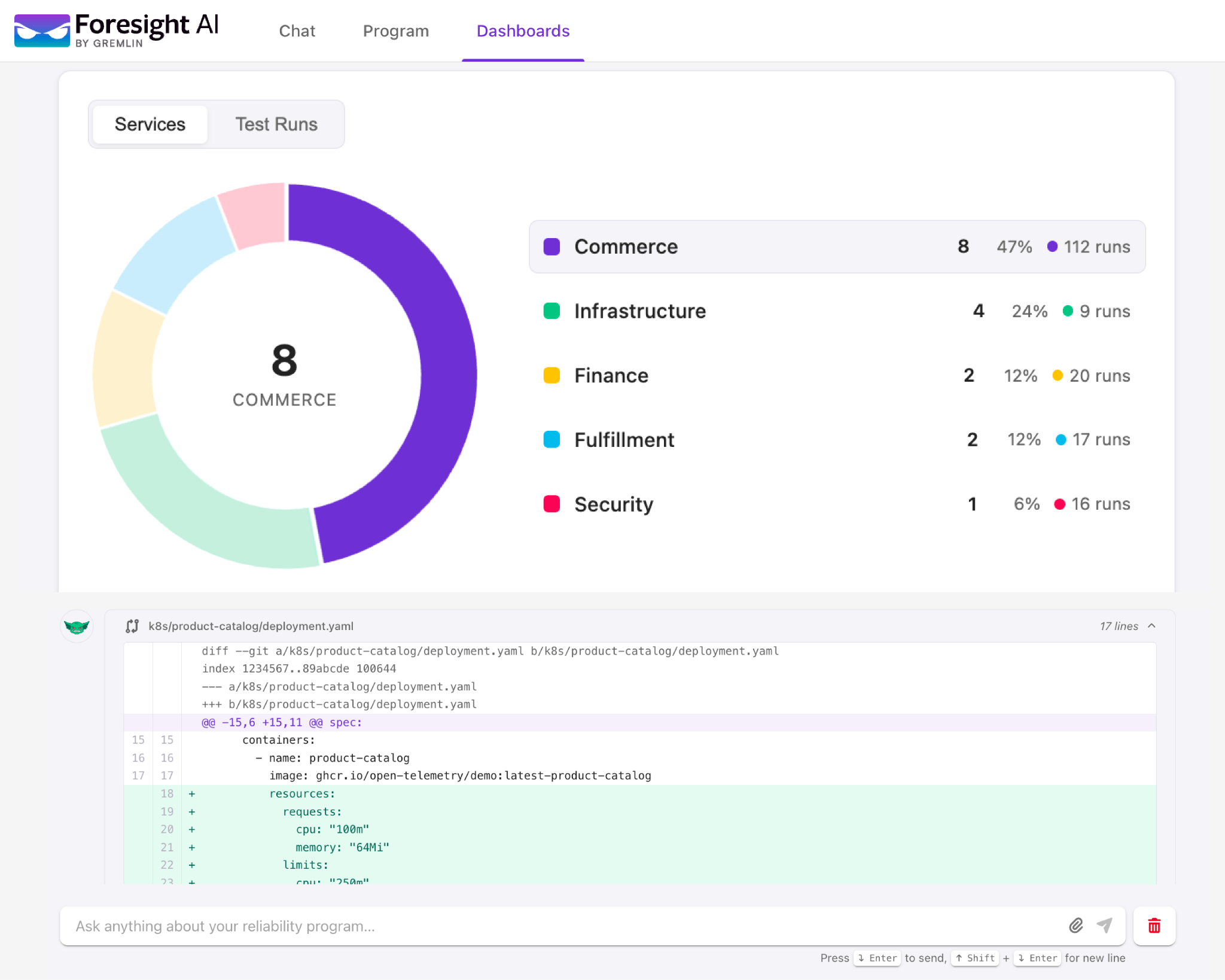
Gremlin designed Foresight AI to support that preventative work. It can identify potential weaknesses. It can also recommend remediation as a configuration patch or an infrastructure-as-code change. Then it can rerun the test that exposed the risk to see whether the fix resolved it.
That sequence is important for developers. A warning by itself can leave a team with more investigation to do: What caused the risk? What change should the team make? Did the proposed change address the underlying problem? By pairing a recommendation with a follow-up test, Foresight AI aims to make the process more actionable. It also aims to provide evidence that a change has worked.
The product also supports repeated testing as systems change. A fix that works today may not remain effective after teams introduce new code, infrastructure or dependencies. Gremlin says teams can use continuous validation to check reliability over time. That way, they need not treat a successful test as a one-off result.
The company also offers reliability scores across services and teams. Gremlin intends those scores to help engineering organizations track progress, spot areas needing further attention, and prioritize reliability work. For developers, they may provide a shared way to discuss service health with platform teams and engineering leaders.
How the Failure Atlas informs Foresight AI
Foresight AI draws on Gremlin’s Failure Atlas. The company says it contains more than a decade of data about how online systems fail and recover. Gremlin says this foundation helps the product make recommendations based on real-world failure patterns. It does not rely only on generic best practices.
The company’s history connects closely to Chaos Engineering. This discipline uses controlled experiments to test how systems respond to failure. Engineers with experience at Amazon and Netflix founded Gremlin. CEO Kolton Andrus worked on uptime for Amazon’s retail site. He later helped develop fault-injection tools at Netflix, following the open-source release of Chaos Monkey.
Foresight AI extends that proactive approach by automating parts of the process. The product does not ask every team to design and run each reliability exercise from scratch. Instead, it automates a lot of the manual work that historically prevented teams from maximizing the benefits of Chaos Engineering.
“Gremlin has always tried to help engineering teams improve the resiliency of their applications by running experiments proactively to identify weaknesses in their distributed systems, but many teams didn’t have the time or expertise to do that consistently,” said Mike Dauber, General Partner at Amplify Partners. “Foresight AI is like a trainer who does the reps for you. Your systems get stronger without your team doing all the manual work.
Proactive Reliability And AI SRE Tools Can Work Together
Foresight AI arrives amid growing interest in “AI SRE” tools. These tools use AI to help engineering teams investigate and respond to incidents. They can be useful when a production problem occurs, helping teams diagnose issues and coordinate their response. But incident response begins after a problem has surfaced.
Gremlin draws a distinction between responding to failures and trying to prevent them. In the company’s framing, AI SRE tools help teams treat problems after they occur. Foresight AI, by contrast, aims to support preventative reliability work before an incident happens. The approaches need not be alternatives: organizations may use both to improve their ability to prevent, detect, and manage failures.
An analogy may help explain the difference. If incident-response tools are medicine, proactive reliability testing is more like maintaining healthy habits and building strength. Neither approach guarantees that a system will never fail. But combining them can help teams prepare for problems and reduce the likelihood that weaknesses will reach customers.
Foresight AI is Now Generally Available
The launch of Foresight AI addresses a practical challenge for every development team today. Reliability work competes with feature development, maintenance, and incident response for limited engineering time. Automating portions of testing and verification will help online businesses stay resilient in the AI era. It does this by fixing the track in real time as companies move at breakneck speed.
Getting all of the benefits of robust, proactive reliability testing without the bulk of manual labor? Sounds like something your engineering org should look into. Check it out here.
Photo By Gremlin

Jordan Williams is a talented software writer who seamlessly transitioned from his former life as a semi-pro basketball player. With the same determination and focus that propelled him on the court, Jordan now crafts elegant code and develops innovative software solutions that elevate user experiences and drive technological advancements.