I review a lot of AI apps that promise to feel human, only to deliver a chatbot with a personality sticker slapped on top. So when PolyBuzz AI started showing up everywhere last year, I did what I always do: I ignored the marketing, made an account, and used the thing for a week. Here is what I actually found, and why I think the most interesting story about PolyBuzz AI is not the product at all. It is the curve.
What PolyBuzz AI Actually Is
Strip away the buzzwords, and PolyBuzz AI is a character-chat platform. You pick an AI persona, a fictional character, a historical figure, a custom one you build yourself, and you have a conversation. It runs on natural language processing, which is the same family of tech behind every chatbot you have used, and it leans hard into roleplay and companionship rather than answering your questions like a search engine. If you have tried Character.AI, you already understand the genre. PolyBuzz is the scrappier competitor that went mainstream.
Credit where it is due: the scale is real. As of early 2026, the app has racked up more than 50 million downloads on the Apple App Store and Google Play, holds a 3.8-star average across roughly 988,000 Google Play reviews, and pulls in around 42.8 million monthly visits with sessions averaging about 17 minutes. People are not just installing PolyBuzz AI. They are staying.
The Numbers Tell a Classic Hype-Cycle Story
Here is the chart I keep coming back to. This is U.S. monthly search demand for the term “polybuzz ai” over two years, pulled from Ahrefs Keywords Explorer.
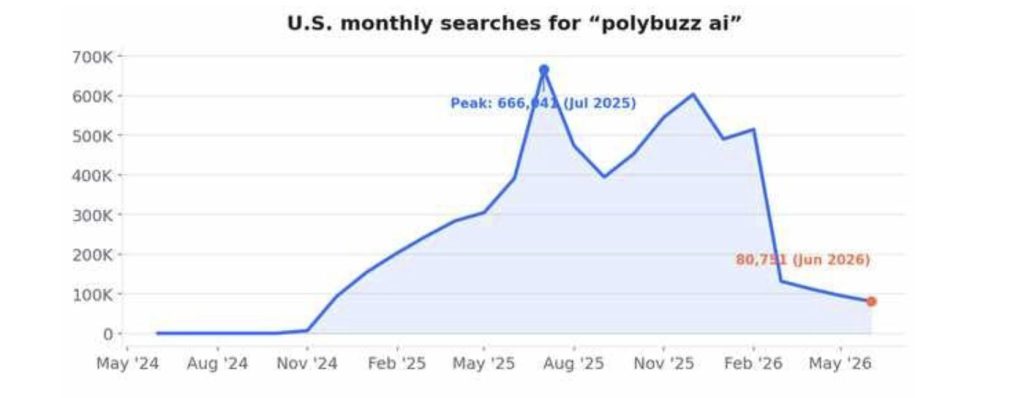
Searches for “polybuzz ai” exploded through 2025, peaked above 666,000 in July 2025, then fell off a cliff in early 2026. Source: Ahrefs Keywords Explorer, U.S.
From basically zero in late 2024 to 666,000 searches in a single month, then a slide back to about 81,000 by June 2026. That is not a failing product. Forty-plus million monthly visitors is a healthy business. But it is the unmistakable shape of a tool that rode a wave of curiosity and is now settling into its real, smaller, committed audience. My opinion: the people genuinely searching for “polybuzz ai” today are the ones who actually use it, not the ones who heard about it once on TikTok. That makes this a better moment to evaluate it honestly than the peak ever was.
Where it Genuinely Impressed Me
The variety of characters is the strongest part of the experience. There is an enormous range; the personas hold their tone better than I expected, and the voice-chat feature is more natural than most competitors I have tested. For casual roleplay, creative brainstorming, or just blowing off steam, PolyBuzz AI does the job, and the onboarding is friction-free even if you have never touched an AI app before.
- Big, genuinely diverse character library.
- Voice chat that does not feel like a robocall.
- A clean interface that doesn’t require you to read a manual.
Where it Fell Flat
Now, the part the app store screenshots skip. PolyBuzz AI is shaky on facts. The moment I pushed it on anything that needed accuracy, dates, technical detail, multi-step reasoning, it got confidently wrong, which is the worst kind of wrong. It also forgets. Memory across longer conversations is thin, so the “it really gets me” feeling has a short shelf life. And the free tier is heavy on ads, which is the single most common complaint in recent reviews.
My rule of thumb after a week: treat PolyBuzz AI as entertainment, not as a research assistant, a tutor, or a therapist. It is built for vibes, not verification.
PolyBuzz AI vs. Character.AI
People always ask which is better, and my answer is annoyingly honest: it depends on what you want. Character.AI feels slightly more polished and consistent. PolyBuzz AI feels more willing to lean into immersive, personalized roleplay, and it is the one that broke out commercially. If you want a believable character to play off, PolyBuzz. If you want the steadier, more buttoned-up option, Character.AI. Neither one should be trusted with a fact you actually need.
My verdict
PolyBuzz AI is a legitimately fun, surprisingly capable companion app that is past its hype peak and probably better for it. If you go in expecting entertainment, you will likely enjoy it. If you go in expecting accuracy, you will get burned. I would happily recommend it to someone who wants to mess around with AI characters, but I would actively steer a student away from using it for studying. That gap, between what it is sold as and what it is good at, is the whole review.
Photo by Oleg Ivanov: Unsplash

Marcus Whitfield writes about developer tools, programming languages, and the software trends shaping how engineers build. Before joining DevX, he spent five years as a full-stack developer and two more running a small dev-tools newsletter that topped 10,000 subscribers.