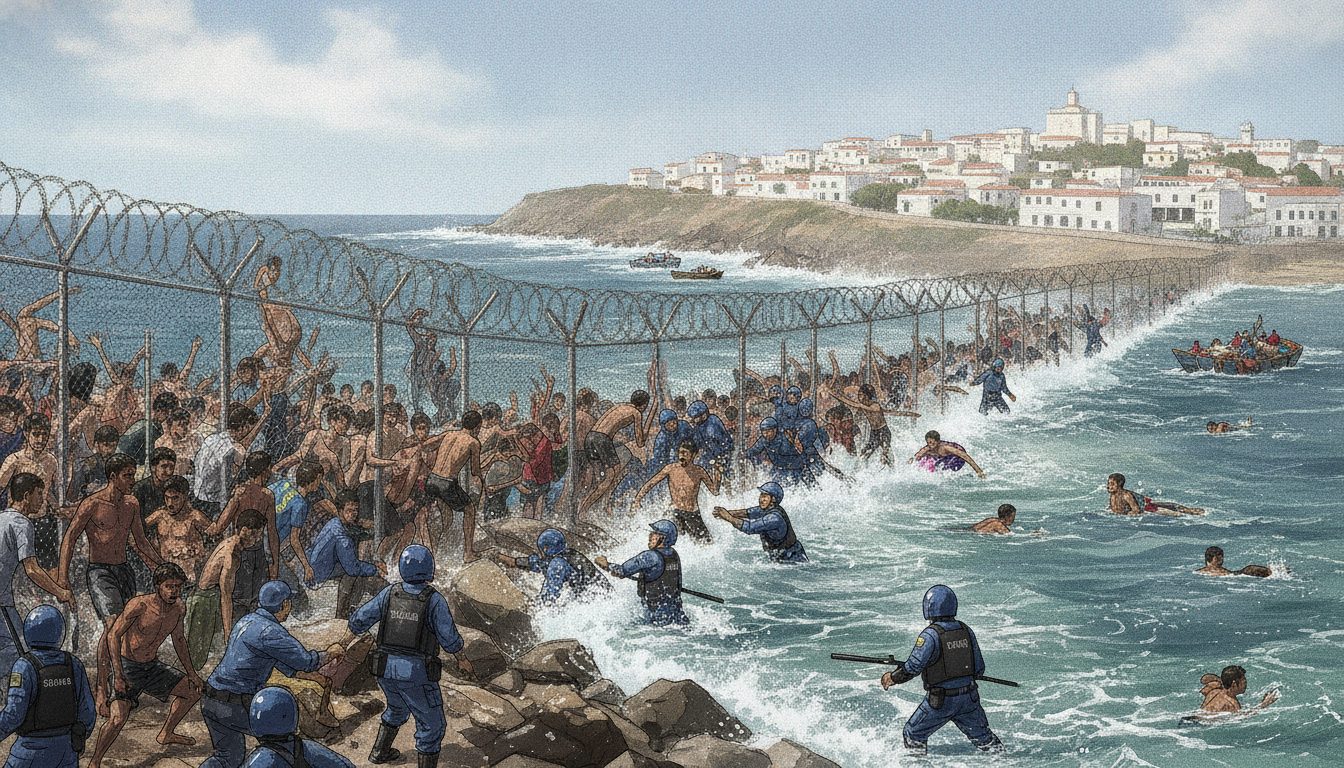
Border guards in Spain’s North African enclave of Ceuta were overwhelmed as crowds of young men rushed gates and swam around the coastal barrier, seeking entry into Europe. The dramatic scenes at the frontier with Morocco highlight renewed pressure on one of the European Union’s most sensitive external borders.
Witnesses described groups moving along the beach and breakwaters in the early hours. Many tried to avoid patrols as they entered the water. Others forced their way through crowded checkpoints. The episode raised urgent questions about security, humanitarian care, and cross-border cooperation.
What Happened at the Fence
Footage from the shoreline showed people entering the surf near the fence line and heading for Ceuta’s beaches. Local responders pulled several exhausted swimmers from the water. Authorities scrambled to move patrols to the busiest sections and to provide first aid to those in distress.
“Border guards in the tiny Spanish exclave of Ceuta on the Moroccan coast were overwhelmed as crowds of young men pushed through gates and swam around the border barrier, hoping to gain entry into Europe.”
Emergency teams set up triage points near the main crossing. Police dispersed groups that gathered at secondary gates. By late morning, officials reported reduced flows but kept extra units in place.
A Border Under Strain
Ceuta, along with nearby Melilla, marks the only land border between Africa and the European Union. The twin enclaves sit on the Moroccan coast, separated from Spain’s mainland by the Strait of Gibraltar. Their fences and breakwaters are frequent flashpoints during periods of regional tension or economic strain.
Spain experienced a sharp surge in May 2021, when authorities said about 8,000 people entered Ceuta in roughly 36 hours. That event reshaped border protocols, expanded patrols, and intensified talks with Rabat. Since then, cooperation has varied, with periodic spikes testing both police capacity and reception systems.
- Ceuta’s barrier includes dual fences, patrol roads, and coastal sensors.
- Crossings occur by sea, through official gates, or around breakwaters.
- Reception centers face pressure during sudden mass arrivals.
Motives and Risks
Those attempting the crossing often cite a mix of reasons. Some seek work and family ties in Europe. Others may plan to apply for asylum due to conflict or persecution at home. Many are young men, reflecting job shortages in parts of North and West Africa.
Sea routes carry severe risks. Swimmers face strong currents and cold water. Drownings have occurred on the Strait of Gibraltar and along the Atlantic coast. Aid groups warn that panic and crowding at gates can cause injuries and separation of family members.
Political and Human Impact
The incident is likely to renew debate in Madrid and Brussels over shared responsibility for border management and asylum processing. Spanish officials typically call for tighter coordination with Morocco and faster screening. European institutions often stress legal pathways and fair procedures to reduce irregular flows.
Moroccan authorities, balancing domestic concerns and regional ties, have worked with Spain in joint patrols and returns. Cooperation can be shaped by diplomatic issues, trade, and migration funding. When relations strain, enforcement may loosen, and crossings can rise.
Local residents in Ceuta face daily effects. Shops, schools, and clinics adjust when reception centers fill. Some welcome humanitarian efforts. Others worry about security and resources. Community leaders ask for transparent plans and more support from national agencies.
What Comes Next
Officials are expected to review patrol patterns, add coastal surveillance, and reinforce first-response teams. Aid organizations are likely to request more shelter space and medical staff. Legal experts will watch how fast authorities identify minors and assess claims for protection.
Regional trends suggest continued pressure during warm months, when sea attempts rise. Storms and shifting routes can change volumes within days. Coordinated action, clear information for migrants, and predictable legal channels may reduce dangerous crossings.
The latest scenes at Ceuta show how fragile the balance remains. The enclave sits at the meeting point of security needs and human urgency. The outcome will depend on steady cooperation, careful screening, and humane care at the water’s edge.

Senior Software Engineer with a passion for building practical, user-centric applications. He specializes in full-stack development with a strong focus on crafting elegant, performant interfaces and scalable backend solutions. With experience leading teams and delivering robust, end-to-end products, he thrives on solving complex problems through clean and efficient code.