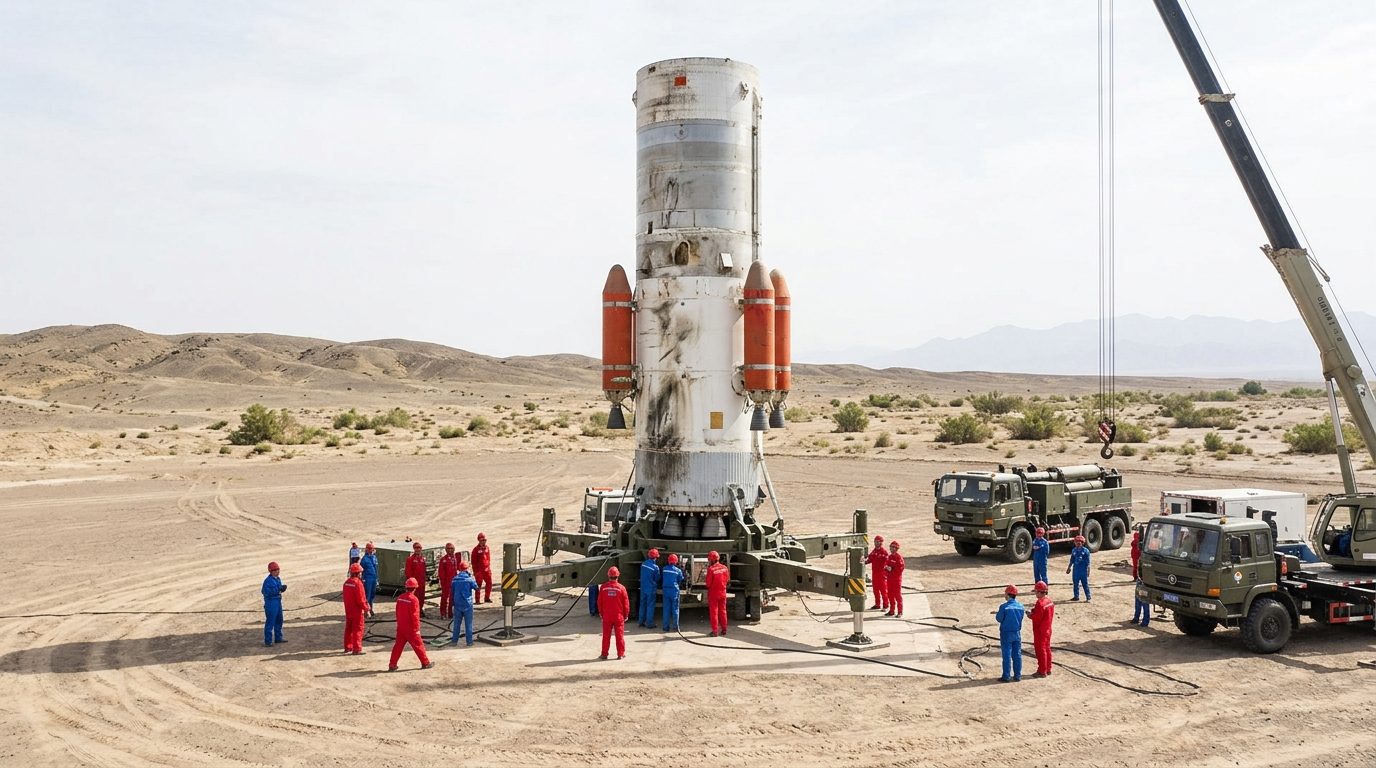
China has recovered a rocket’s first stage on land for the first time, according to state media, marking a new step in its expanding space program.
The reported success could help China reduce launch costs and prepare rockets for more frequent missions. However, key details remain unclear, including the rocket model, recovery method, landing site, and condition of the recovered stage.
A First for China’s Space Program
State media described the operation as China’s first successful land recapture of a rocket’s first stage. The stage provides most of the thrust needed during the opening minutes of flight.
China has “successfully recaptured the first stage of a rocket on land for the first time,” state media reported.
Most first stages are discarded after use. Some fall into the ocean, while others return through the atmosphere and land in designated zones. Recovering a stage under controlled conditions can limit debris risks and support future reuse.
The term recaptured does not, by itself, confirm that the stage is reusable. Engineers must inspect its engines, fuel systems, frame, and flight controls before another launch can be considered.
Why Rocket Recovery Matters
Launch providers have long treated rockets as single-use vehicles. That model requires a new booster for each mission, adding time and expense.
A recoverable first stage may offer several gains:
- Lower manufacturing costs if hardware can fly again
- Shorter periods between launches
- Less debris near launch corridors
- More flight data from returned equipment
Recovery alone does not guarantee savings. Landing equipment adds weight, while inspection and repairs can be costly. The economic benefit depends on how often a stage can fly and how much work it needs between missions.
China Joins a Wider Reuse Push
Reusable launch systems have reshaped commercial spaceflight. SpaceX made controlled first-stage landings a regular part of Falcon 9 missions, using both ground pads and offshore drone ships.
Other governments and companies are also testing reusable boosters or related systems. China’s reported recovery places it among programs seeking greater control over the most expensive sections of a launch vehicle.
China has steadily increased its activity in orbit and deep space. Its program has sent crews to the Tiangong space station and carried out lunar and planetary missions. A dependable recovery system could support that growth by increasing launch capacity.
Questions Remain About Reuse
The next test will be whether China can repeat the recovery under varied flight conditions. A single demonstration may prove that guidance and landing systems work, but routine operations require consistent results.
Officials will also need to show whether the recovered stage can be refurbished and flown again. That would separate a controlled recovery experiment from an operational reusable rocket program.
More technical information will be needed to assess the achievement independently. Confirmation of the vehicle, flight path, landing accuracy, and post-flight condition would clarify how close the system is to regular service.
For now, the recovery signals China’s intent to improve launch efficiency and compete more directly in reusable rocketry. Future flights will show whether the milestone leads to repeat landings, lower costs, and an operational booster capable of multiple missions.

Rashan is a seasoned technology journalist and visionary leader serving as the Editor-in-Chief of DevX.com, a leading online publication focused on software development, programming languages, and emerging technologies. With his deep expertise in the tech industry and her passion for empowering developers, Rashan has transformed DevX.com into a vibrant hub of knowledge and innovation. Reach out to Rashan at [email protected]