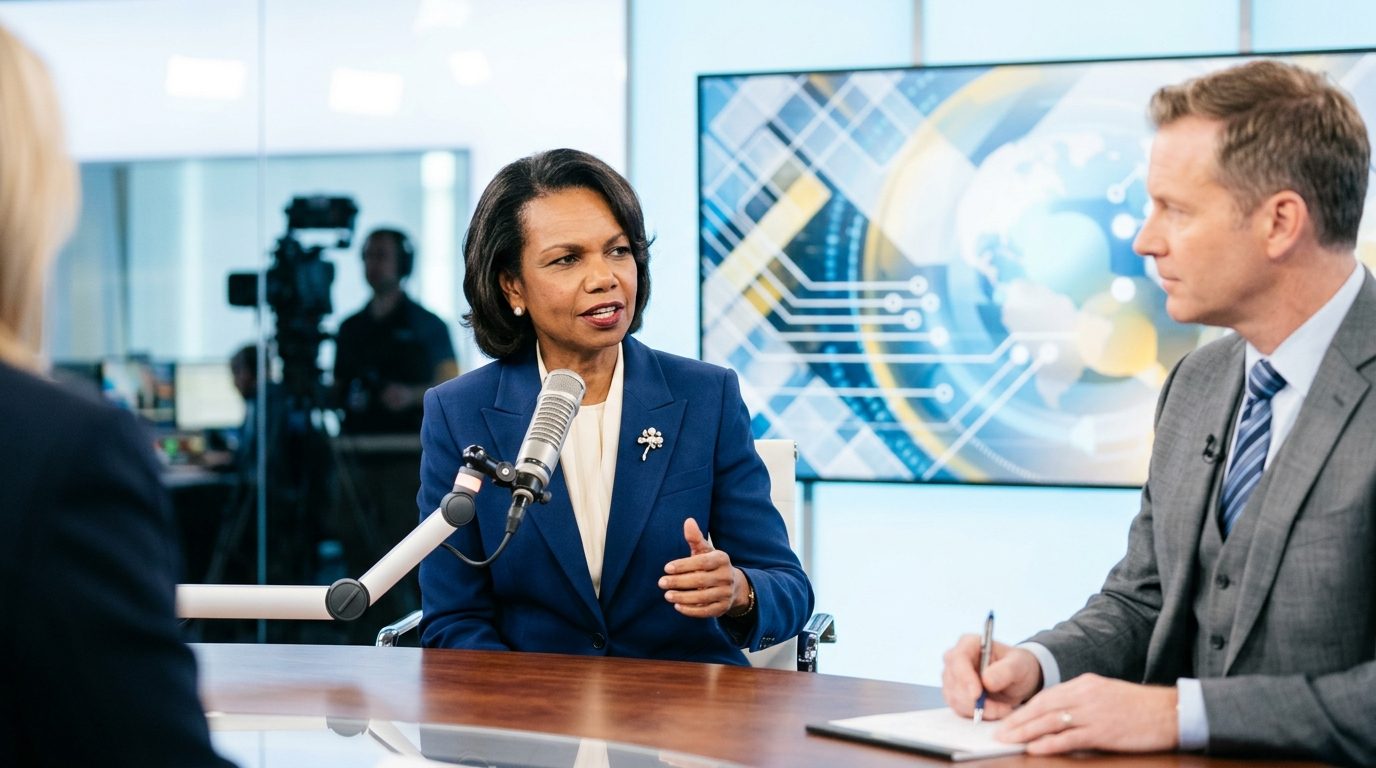
Former Secretary of State Condoleezza Rice has joined the public debate over artificial intelligence regulation, discussing the issue and wider global events on “The Will Cain Show.” Her appearance placed AI policy alongside national security and international affairs, areas where governments face pressure to act without blocking useful research.
Details of Rice’s policy recommendations were not provided. Still, her participation reflects the growing role of former national security officials in debates once led mainly by technology companies and researchers.
AI Policy Becomes a Security Issue
Artificial intelligence can support medical research, business operations and government services. It can also help produce false content, conduct cyberattacks or spread propaganda at greater speed.
Those competing uses have moved AI oversight higher on the political agenda. Officials must decide whether existing laws are enough or whether new rules are needed for advanced systems.
Several policy questions now shape that debate:
- Who should be responsible when an AI system causes harm?
- Should developers disclose how powerful models are tested?
- How can governments protect elections and critical infrastructure?
- Can national rules work when AI products cross borders?
Supporters of stronger regulation argue that voluntary company standards may not protect the public. They favor testing requirements, disclosure rules and limits on high-risk uses.
Critics warn that broad restrictions could slow research, burden smaller companies and shift development to countries with fewer safeguards. They often support rules focused on specific uses rather than the technology itself.
Rice Brings Foreign Policy Experience
Rice served as national security adviser from 2001 to 2005 and secretary of state from 2005 to 2009 under President George W. Bush. Her government experience included terrorism, military conflict and relations with major powers.
That background gives her a foreign policy frame for considering AI. Advanced computing has become part of economic competition, military planning and intelligence gathering. Countries are also debating export controls for powerful computer chips and equipment.
AI regulation therefore involves more than consumer protection. National rules can affect alliances, trade and the ability of governments to compete with strategic rivals.
Global Events Add Pressure
Rice also discussed other world events during the television appearance, although the specific subjects and her comments were not detailed. The pairing was relevant because conflicts and political disputes increasingly include a digital front.
AI tools can create convincing images, audio and video. During a crisis, such material may confuse the public or weaken trust in official information. Automated systems can also help analyze intelligence, identify targets or defend computer networks.
These uses create a difficult policy balance. Governments want access to systems that may improve security, but they must also guard against errors, abuse and rapid escalation.
What Policymakers Must Decide
The central dispute is not whether AI should have safeguards. It is how strict those safeguards should be, which agencies should enforce them and whether major countries can agree on shared standards.
Rice’s entry into the discussion signals that AI governance is now tied closely to diplomacy and national defense. Future debate will likely focus on testing rules, military applications and coordination among allied nations.
The next steps will depend on whether policymakers can set clear limits while preserving beneficial uses. Cooperation between governments may prove as important as domestic legislation, especially as AI systems and their risks move easily across national borders.

Senior Software Engineer with a passion for building practical, user-centric applications. He specializes in full-stack development with a strong focus on crafting elegant, performant interfaces and scalable backend solutions. With experience leading teams and delivering robust, end-to-end products, he thrives on solving complex problems through clean and efficient code.