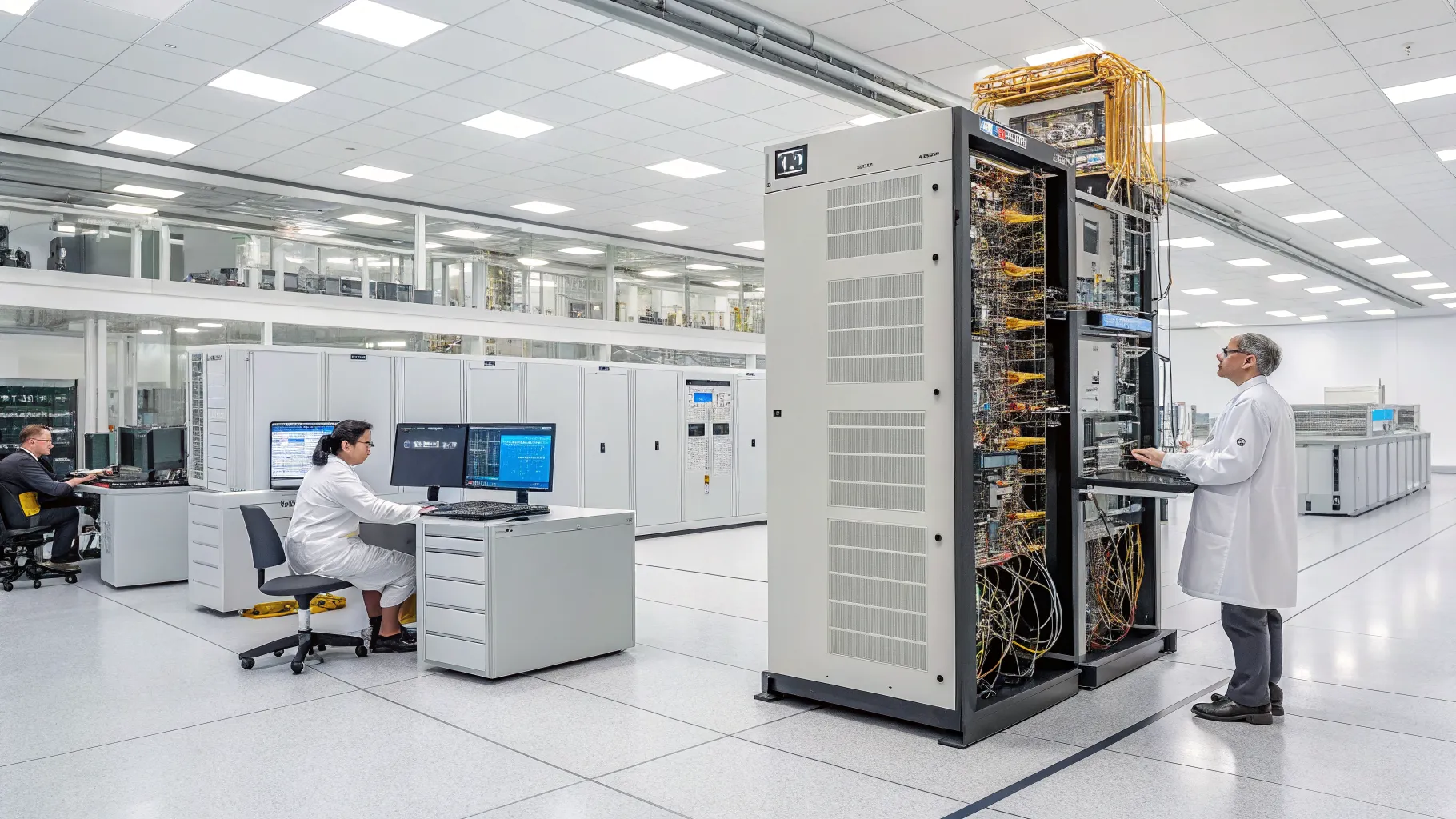
Google researchers say their Willow quantum computer has shown that a strange feature of quantum physics known as quantum contextuality may be key to its performance. The team conducted new experiments and analysis at Google’s quantum lab, aiming to explain why quantum devices can outperform classical machines on certain tasks. The work was carried out in the United States and adds momentum to a growing effort to connect quantum hardware behavior with the mathematical ideas that support it.
The study arrives as companies race to make quantum computing more reliable and useful. It also revisits a long-standing debate about which quantum effects truly enable speed-ups. While details of the Willow system remain limited, the claim points to a possible blueprint for designing faster and more efficient quantum processors.
What the Researchers Report
Researchers at Google have used their Willow quantum computer to demonstrate that “quantum contextuality” may be a crucial ingredient for its computational prowess.
The statement frames contextuality as more than a curiosity. It suggests that the effect is not only present, but that it could be the resource that helps quantum circuits solve certain problems faster. The team’s wording is careful. The result does not declare victory on every front. Instead, it argues for a direct link between a well-known quantum feature and observed performance.
The Physics Behind Contextuality
Quantum contextuality refers to the idea that the outcome of measuring a property can depend on which other measurements are made alongside it. This defies common sense from classical physics, where a property has a fixed value regardless of how it is tested.
For decades, theorists have explored contextuality through the Kochen–Specker framework and related tests. Over the past ten years, several groups have tied contextuality to the resources needed for quantum algorithms, especially those that use special “magic” states to go beyond basic operations. The new claim places Willow within that theory-driven view.
Why This Could Matter
If contextuality is a reliable marker of quantum performance, it could guide chip design and benchmarking. Engineers might target circuit patterns that amplify contextual behavior while suppressing noise. That could help companies make better use of limited qubits and error budgets.
It also offers a clearer way to compare machines. Instead of counting qubits alone, labs could track how much contextuality their devices can generate and preserve during a computation. That metric could complement existing figures like gate fidelity and circuit depth.
How This Fits With Prior Milestones
Google drew global attention in 2019 when its Sycamore processor executed a random circuit task that classical computers could not match in a practical time. The claim sparked debate, but it accelerated progress on both quantum hardware and classical simulation tools.
The Willow work differs. It does not focus on raw speed in a single test. It tries to connect performance to a specific quantum resource. That shift mirrors a broader trend in the field: moving from one-off demonstrations to frameworks that explain why some devices excel and how to repeat those wins across tasks.
Open Questions and Skepticism
Physicists will want details on the experiment, the models used, and the extent to which classical simulations can mimic the reported results. Some will ask whether noise or calibration artifacts could fake signs of contextuality. Others will look for independent replications on different hardware platforms.
There is also the question of scope. Contextuality may be essential for certain algorithms but less important for others, such as near-term optimization or sampling tasks. Clear mapping between resource and task will be needed to convert this insight into design rules.
What to Watch Next
- Independent tests of contextuality-linked performance on other quantum chips.
- New benchmarks that quantify contextuality alongside error rates and qubit counts.
- Algorithm studies that show when boosting contextuality improves outcomes.
The Willow result offers a fresh signpost for quantum hardware research. If follow-up studies confirm the link, chip makers could prioritize circuits and materials that sustain stronger contextual effects under noise. That might shorten the path to useful applications while full error correction remains out of reach.
For now, the claim adds structure to a field that often celebrates raw record-setting. It points attention to the specific physical features that may deliver real gains. The next phase will test whether those features can be engineered on demand and scaled without losing their edge.

Rashan is a seasoned technology journalist and visionary leader serving as the Editor-in-Chief of DevX.com, a leading online publication focused on software development, programming languages, and emerging technologies. With his deep expertise in the tech industry and her passion for empowering developers, Rashan has transformed DevX.com into a vibrant hub of knowledge and innovation. Reach out to Rashan at [email protected]