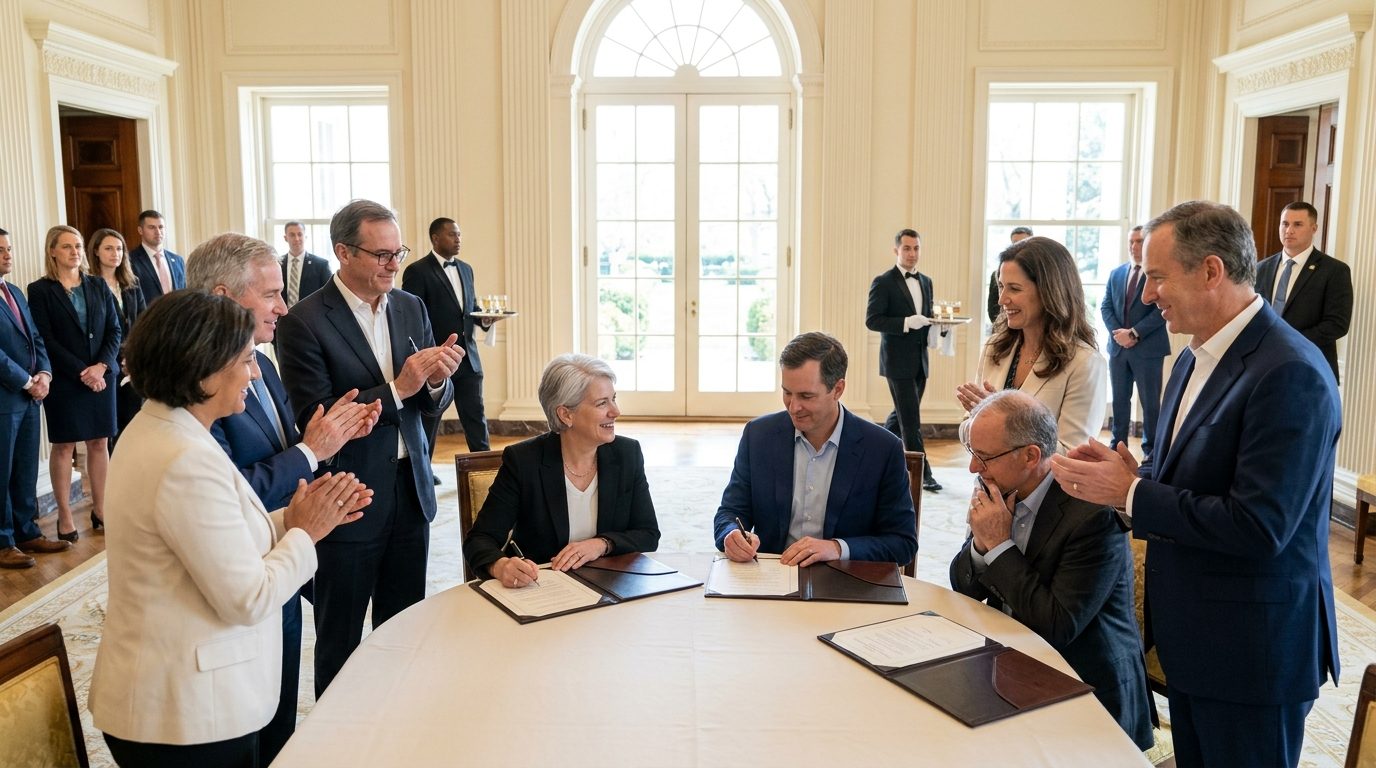
Technology industry leaders met at the White House on Monday to sign an accord focused on superintelligence, placing corporate responsibility at the center of advanced artificial intelligence development.
The White House Accord on Super Intelligence brings together companies working on systems that could exceed human performance across many tasks. Its announcement suggests that government officials and developers see an urgent need for shared rules before such systems are widely deployed.
“The principle is simple: the companies building this technology…”
The available statement ends before explaining the full principle. It also does not identify the companies, executives, government officials, or specific commitments involved. Those missing details will determine whether the accord changes industry practices or remains a broad voluntary pledge.
A Focus on Developer Responsibility
The announcement places responsibility on the companies creating advanced AI. That approach reflects a central policy question: Who should manage risks when a small number of private firms control powerful systems?
Developers make key decisions about training data, safety testing, product access, and security. They also decide when a model is ready for release. An accord could set common expectations in these areas, though its practical value depends on clear standards and enforcement.
The use of the term superintelligence also matters. It usually refers to a future system that performs better than humans across most intellectual work. No public evidence in the announcement shows that such a system has been created.
Still, rapid gains in generative AI have pushed long-term safety questions into current policy debates. Governments are weighing potential economic gains against concerns involving fraud, cyberattacks, misinformation, job disruption, and loss of human control.
Key Questions Remain Unanswered
The brief announcement leaves several issues open:
- Which companies signed the accord and what obligations did they accept?
- Will independent experts test advanced systems before release?
- How will companies report safety failures or security incidents?
- Does the agreement include penalties for noncompliance?
- Will the public receive progress reports or access to risk findings?
Voluntary agreements can move faster than legislation. They can also help companies develop shared practices while lawmakers study an unfamiliar technology.
However, critics often warn that voluntary commitments may lack accountability. Companies face commercial pressure to release stronger models quickly. Without audits, public reporting, or penalties, broad safety promises can be difficult to measure.
What the Accord Could Mean
A detailed accord could influence how advanced AI is built and released. Shared testing rules may reduce the chance that companies overlook known hazards. Security requirements could also limit theft of model designs or misuse by hostile actors.
The agreement may affect competition as well. Large developers can absorb the cost of extensive testing more easily than smaller firms. Policymakers will need to balance safety requirements with fair access and competition.
International coordination presents another challenge. AI development crosses national borders, while White House agreements apply most directly to participating organizations. Foreign developers may follow different standards unless governments align their policies.
The signing signals that superintelligence has moved from a largely theoretical debate into senior government discussions. Yet the accord’s importance cannot be judged from its title or stated principle alone.
The next test will be publication of its terms, signer list, review process, and enforcement plan. Clear duties and independent oversight would give the agreement weight. Without them, it may offer reassurance without providing measurable protection.

Kirstie a technology news reporter at DevX. She reports on emerging technologies and startups waiting to skyrocket.