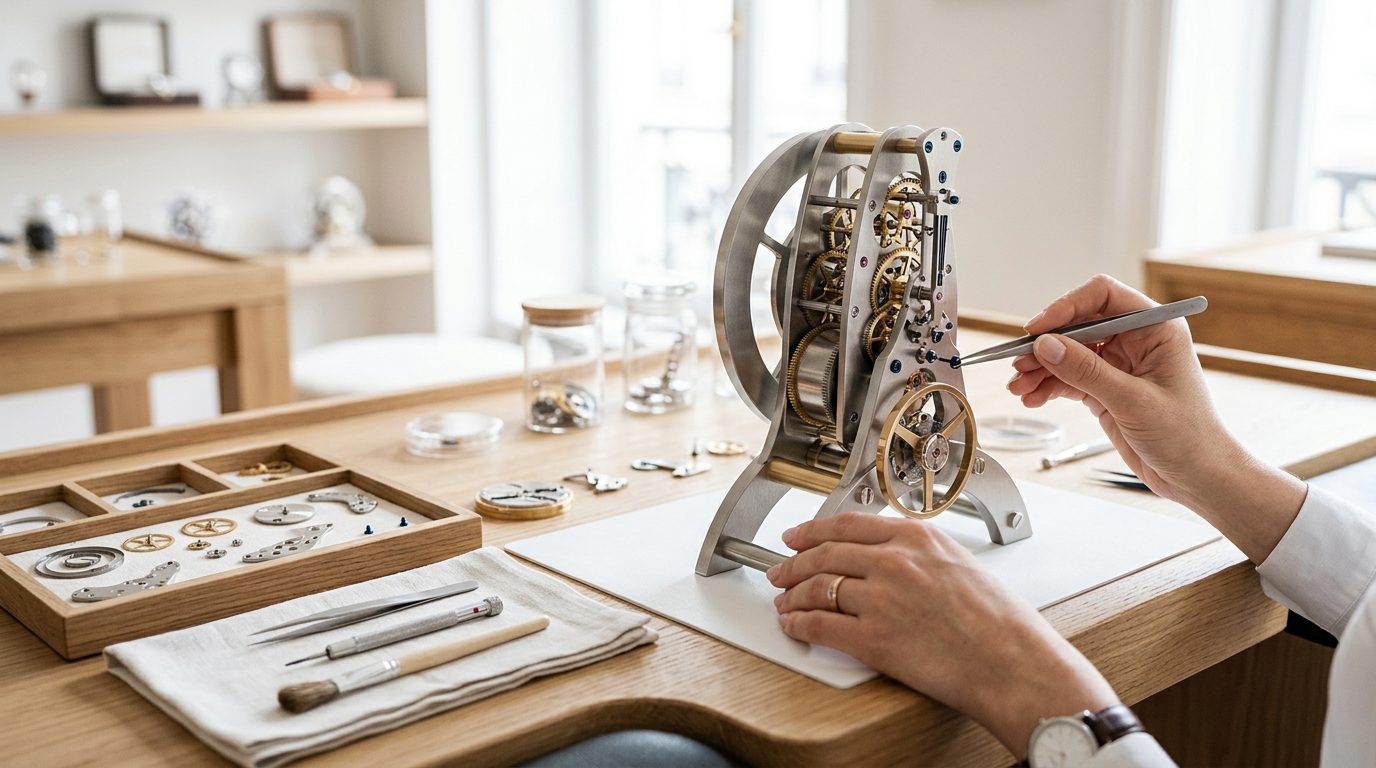
MB&F and Maison Alcée have introduced the Nostromo, a luxury clock that buyers assemble themselves. The unusual release pairs high-end watchmaking with a hands-on building process, offering collectors a more active role in completing an object priced for the luxury market.
The concept targets buyers accustomed to expensive mechanical timepieces. It also challenges a long-standing expectation: that a costly clock should arrive fully assembled and ready to display.
Luxury Meets Self-Assembly
The Nostromo is presented as a haute horlogerie clock, placing it within the tradition of highly skilled mechanical timekeeping. Yet its defining feature is not only its mechanism or design. The owner must put it together.
The launch description compares the experience to flatpack furniture, though the price and purpose sit in a very different category. It identifies a potential customer as someone who has bought “a clock worth north of US$15,000” and wants a closer connection to the finished piece.
“The result is the Nostromo, a haute horlogerie clock you put together yourself.”
That approach turns assembly into part of the purchase. Instead of paying only for a finished clock, the customer also pays for the process of building it.
A Different Kind of Ownership
Mechanical clocks are often valued for visible engineering, careful finishing, and the skill needed to create them. However, owners usually observe that work from a distance. The Nostromo narrows that gap by inviting the buyer to take part.
The core offer can be reduced to three features:
- A luxury mechanical clock developed by MB&F and Maison Alcée
- A self-assembly experience for the owner
- A product aimed at collectors comfortable with five-figure clock prices
This model may appeal to collectors who value participation as much as possession. Building the clock could also help owners better understand its construction and create a stronger personal attachment.
There is a clear tension, however. Self-assembly is usually linked with lower prices and mass production. Fine clockmaking depends on precision, so buyers may expect clear instructions, suitable tools, and safeguards against costly errors. Details about those measures were not provided in the initial description.
What the Collaboration Signals
MB&F is associated with unconventional mechanical objects, while Maison Alcée focuses on clocks designed as owner-built experiences. Their Nostromo collaboration brings those ideas together in a product that treats construction as part of luxury service.
The release also reflects a wider shift in collector goods. Some customers seek experiences that offer access to the craft, rather than another finished item. Workshops, customization programs, and behind-the-scenes access follow a similar principle.
The Nostromo will ultimately be judged on two standards. It must work as an accurate, well-made clock, and its assembly process must feel rewarding rather than burdensome. For buyers, the key question is whether participation adds enough value to justify a price above US$15,000.
For the luxury clock sector, the launch offers a practical test of experience-based ownership. If collectors respond well, more makers may invite customers into selected stages of construction. The challenge will be preserving precision while giving owners a meaningful role.

A seasoned technology executive with a proven record of developing and executing innovative strategies to scale high-growth SaaS platforms and enterprise solutions. As a hands-on CTO and systems architect, he combines technical excellence with visionary leadership to drive organizational success.