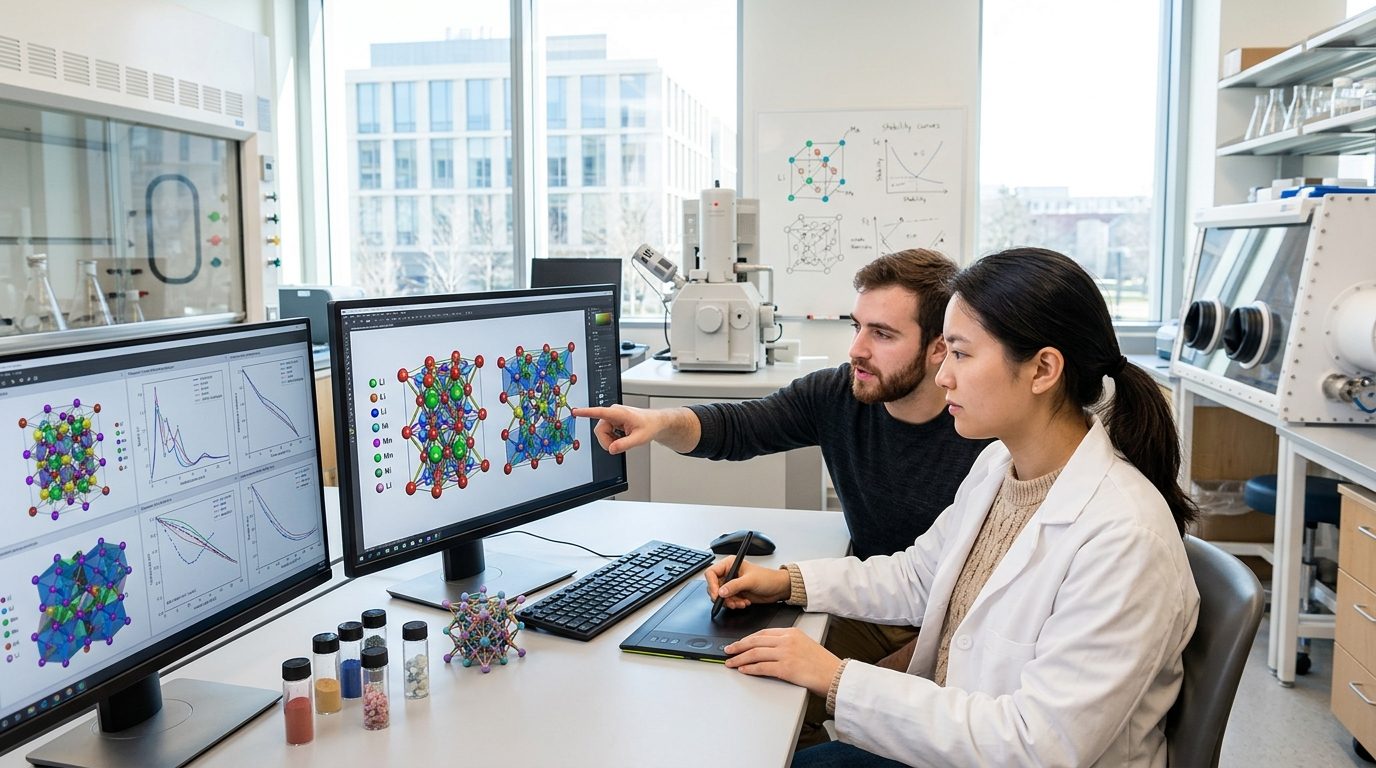
MIT researchers have developed an AI method that designs new materials while giving greater weight to stability and practical use. Called CrysVCD, the approach could reduce the time and money spent rejecting designs that cannot work outside a computer model.
The research addresses a central problem in AI-assisted materials discovery. A model can propose many crystal structures, but a mathematically valid design may still be unstable or difficult to produce. Researchers must then screen large numbers of candidates before laboratory testing can begin.
Stability Enters the Design Process
CrysVCD adds a new step to AI systems that generate materials. This step helps steer the model toward structures that are more likely to remain stable under real conditions.
That focus matters because stability affects whether a proposed material can retain its structure. An unstable candidate may break down, shift into another form, or require unrealistic production conditions.
The approach is designed to help ensure that a proposed material “will be stable and practical for real-world use,” according to the research description.
Traditional computer screening often separates creation from evaluation. One system produces possible structures, while later calculations identify designs with poor properties. CrysVCD seeks to account for practical limits earlier, reducing wasted work downstream.
Reducing Costly Screening
AI can generate candidates much faster than scientists can synthesize and test them. That speed creates a filtering problem. If too many suggestions are unusable, researchers gain volume without gaining useful options.
CrysVCD could improve that ratio by limiting weak candidates before they reach expensive stages. The expected benefits include:
- Fewer unstable material designs entering review.
- Lower computing costs for later screening.
- Less laboratory time spent on poor candidates.
- A shorter path from digital design to physical testing.
The method does not remove the need for experiments. Computer predictions cannot fully reproduce manufacturing conditions, impurities, temperature changes, or long-term wear. Laboratory validation will remain necessary before any proposed material reaches commercial use.
Potential Uses Across Major Industries
Materials discovery supports work in batteries, semiconductors, solar cells, construction, medicine, and industrial manufacturing. Each sector needs substances with specific combinations of strength, conductivity, weight, cost, and durability.
AI tools can search through chemical and structural options that would take researchers far longer to examine manually. Yet practical value depends on whether those suggestions can be made reliably. By emphasizing stability, CrysVCD may help connect rapid generation with the limits of physical production.
The approach also reflects a wider shift in scientific AI. Researchers are moving from systems that simply produce many answers to systems guided by physical rules and real-world constraints. This can make model outputs more useful without treating them as replacements for scientific judgment.
Evidence Will Determine Its Reach
The next test is whether CrysVCD consistently produces better candidates across different classes of materials. Researchers will need to compare its designs with established screening methods and confirm predicted structures in laboratories.
Questions also remain about computing demands, manufacturing feasibility, and performance at scale. A stable material may still be too costly, toxic, scarce, or difficult to manufacture.
CrysVCD offers a practical response to one of AI materials research’s largest bottlenecks: generating candidates is easy, but finding usable ones is hard. If laboratory results support the method, it could cut early-stage waste and help scientists focus on designs with a stronger chance of real-world success.

Rashan is a seasoned technology journalist and visionary leader serving as the Editor-in-Chief of DevX.com, a leading online publication focused on software development, programming languages, and emerging technologies. With his deep expertise in the tech industry and her passion for empowering developers, Rashan has transformed DevX.com into a vibrant hub of knowledge and innovation. Reach out to Rashan at [email protected]