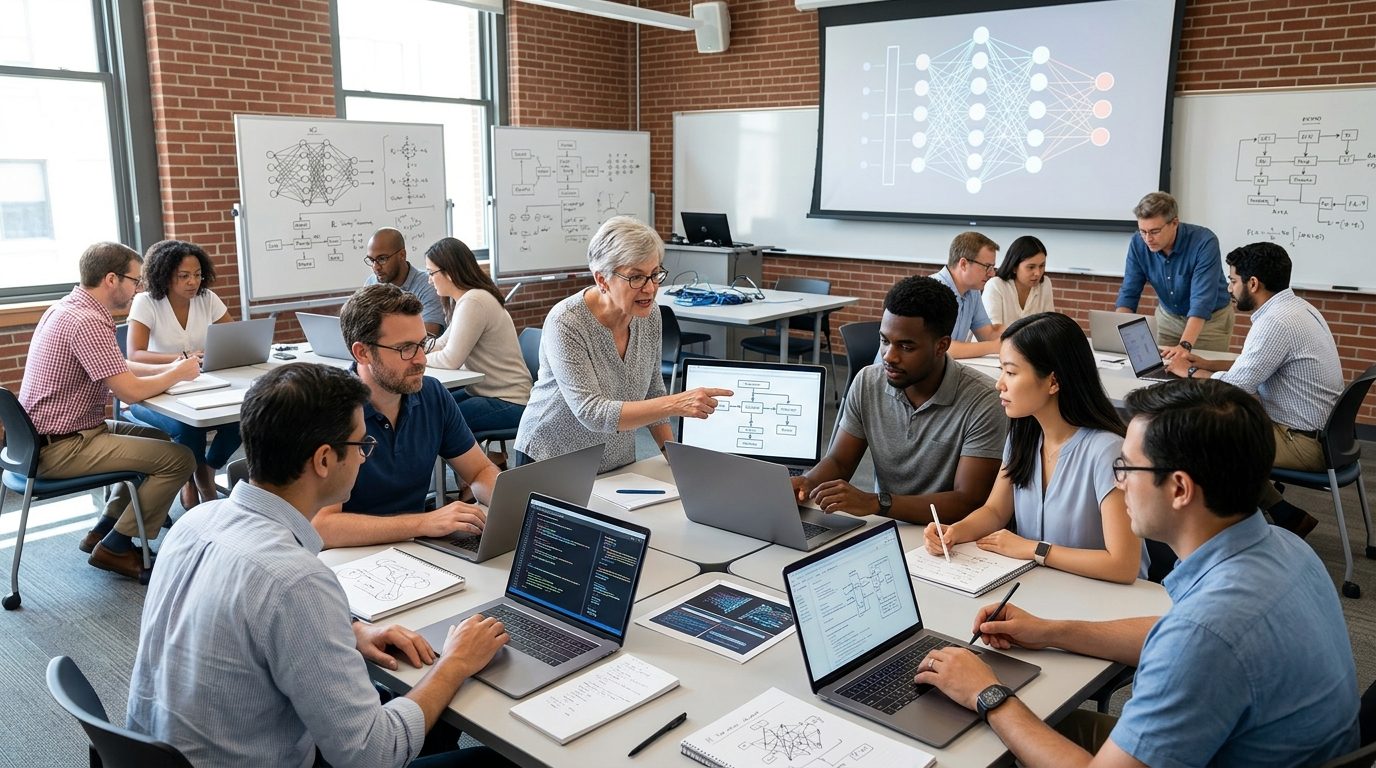
A weeklong summer workshop at MIT brought higher-education faculty together to adapt artificial intelligence and machine learning materials for college classrooms.
The campus program focused on a growing academic need. Colleges are under pressure to teach AI concepts as the technology reaches more industries and areas of study. The workshop gave instructors time to examine course materials and consider how those resources could fit their own students, subjects, and institutions.
Turning Technical Material Into Classroom Lessons
Artificial intelligence courses often require knowledge of mathematics, statistics, and computer programming. That can make existing materials difficult to use across schools with different programs and student needs.
The MIT workshop addressed that issue through adaptation rather than simple adoption. Faculty could assess how lessons designed in one academic setting might work elsewhere. An instructor may need to change the pace, examples, assignments, or technical depth before using a resource.
A week on campus also offered participants a focused setting for that work. Faculty members often have limited time during the academic year to redesign courses or learn unfamiliar tools.
The program’s central areas included:
- Reviewing educational materials on AI and machine learning
- Considering changes for different courses and student skill levels
- Planning how lessons could be introduced at participants’ home institutions
- Connecting classroom teaching with a rapidly developing field
Demand for AI Education Grows
AI is no longer limited to computer science departments. Its methods now affect research, business, health care, engineering, media, and public policy. Colleges must decide which students need technical training and which need a broader understanding of AI systems.
Machine learning education also presents practical questions. Institutions vary in computing resources, faculty experience, class size, and curriculum rules. Materials developed at MIT may therefore require major changes before they can serve students at another college.
That makes faculty development an important part of AI education. New course content cannot reach students effectively unless instructors have time to study it, test it, and connect it to clear learning goals.
Local Adaptation Remains Key
The workshop model recognizes that no single AI curriculum will suit every institution. A research university may offer advanced programming courses, while a smaller college may place AI topics inside general education or career-focused programs.
Faculty must also judge what their students already know. Introductory learners may need basic explanations of data and algorithms. Advanced students may be ready to build models, compare results, and examine system limits.
Responsible instruction is another concern. AI lessons can include questions about accuracy, bias, privacy, and appropriate use. Those topics help students evaluate technology instead of treating automated output as reliable by default.
What Comes Next
The workshop’s longer-term value will depend on how participants use the materials after leaving MIT. Course revisions, new assignments, and lessons shared with colleagues could extend the program’s reach.
Further details about participating institutions, specific materials, and planned classroom projects were not provided. Those outcomes would help measure whether the weeklong effort leads to lasting curriculum changes.
Still, the gathering reflects a clear shift in higher education. Colleges are moving from asking whether AI belongs in the curriculum to deciding how it should be taught. Faculty training and flexible materials will shape how quickly, and how responsibly, that transition occurs.

Senior Software Engineer with a passion for building practical, user-centric applications. He specializes in full-stack development with a strong focus on crafting elegant, performant interfaces and scalable backend solutions. With experience leading teams and delivering robust, end-to-end products, he thrives on solving complex problems through clean and efficient code.