Nvidia, the world’s largest maker of artificial intelligence chips, brought robots together as part of its annual developer conference in San Jose, Calif. The event, known as Nvidia GTC, has become the Super Bowl of AI. The weeklong showcase of robots, large language models, and autonomous cars drew more than 25,000 attendees. They gathered to learn about the latest AI technologies and hear Jensen Huang, Nvidia’s chief executive, discuss AI’s future.
“Every single year, more people come because A.I. can solve more interesting problems for more industries,” Mr. Huang said during his keynote address. Some notable demonstrations included Digit, from Agility Robotics, recognized as the world’s first commercially deployed humanoid robot.
Amazon and other companies use it in warehouses for repetitive tasks such as loading and unloading totes. The event showcased robots that could work in warehouses, pedal like “Star Wars” droids, and manipulate surgical equipment. Nvidia’s influence in the industry is undeniable.
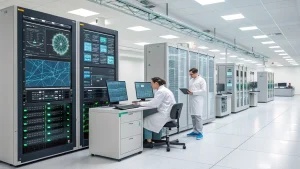
It has become one of the world’s three most valuable companies by selling chips and machines, such as the Nvidia DGX system, which is used to build A.I. systems. The convention center was filled with technology demonstrations, including Nvidia’s DGX system, highlighting how AI is currently applied across various sectors. About 12,000 people packed into San Jose’s National Hockey League arena to witness Mr.
Huang’s speech showcased the profound interest and growing community around A.I.
This year’s GTC conference underscored the potential of A.I. technologies to revolutionize numerous industries and illustrated Nvidia’s central role in driving forward these innovations. Today, NVIDIA announced a portfolio of technologies to supercharge humanoid robot development, including Isaac GR00T N1, the world’s first open, fully customizable foundation model for generalized humanoid reasoning and skills. The GR00T N1 foundation model features a dual-system architecture inspired by human cognition.
“System 1” mimics human reflexes with fast-thinking actions, while “System 2” handles deliberate, methodical decision-making. Powered by a vision language model, System 2 plans actions that System 1 subsequently translates into precise robot movements. The model is trained on extensive human demonstration data and synthetic data generated by the NVIDIA Omniverse™.
Isaac GR00T N1 can generalize common tasks such as grasping, moving objects, and multistep operations, making it applicable in material handling, packaging, and inspection. Developers can further customize GR00T N1 with real or synthetic data for specific robots or tasks. In his GTC keynote, NVIDIA founder and CEO Jensen Huang showcased 1X’s humanoid robot performing domestic tasks using policies built on GR00T N1.
Bernt Børnich, CEO of 1X Technologies, highlighted the significance of NVIDIA’s technology in boosting robot reasoning and skills, furthering the development of companion robots. Leading robotics developers, including Agility Robotics, Boston Dynamics, and NEURA Robotics, have early access to GR00T N1, emphasizing its growing importance in the industry. NVIDIA also announced a collaboration with Google DeepMind and Disney Research to develop Newton, an open-source physics engine built on the NVIDIA Warp framework.
Newton is designed to enhance robots’ ability to handle complex tasks with precision. The engine will be part of Google DeepMind’s MJX open-source library and optimized for rapid robotics machine learning workloads. Disney Research is set to use Newton for its robotic character platform, enhancing next-generation entertainment robots like the expressive BDX droids unveiled during Huang’s keynote.
Kyle Laughlin, senior vice president at Walt Disney Imagineering Research & Development, expressed excitement about creating more expressive and engaging robotic characters through this collaboration. NVIDIA introduced the Isaac GR00T Blueprint for synthetic manipulation motion generation to address the challenge of limited real-world human demonstration data. Built on Omniverse, this blueprint enables developers to generate large amounts of synthetic motion data for various tasks.
NVIDIA generated 780,000 synthetic trajectories using this blueprint in just 11 hours, equivalent to 6,500 hours of real human demonstration data. Combining synthetic and real data improved GR00T N1’s performance by 40%.
Nvidia’s vision for physical AI
The GR00T N1 dataset is now available on Hugging Face as part of a broader open-source physical AI dataset. GR00T N1 training data and task evaluation scenarios can be downloaded from Hugging Face. The Isaac GR00T Blueprint for synthetic manipulation motion generation is available as an interactive demo on build.nvidia.com.
The Newton physics engine is expected to be released later this year. Nvidia continues to ride the AI wave as cloud giants Amazon, Google, and Microsoft snatch up as many of its data center chips as possible. While shares of the chip company are off 10% year to date, they’re still up 27% over the past 12 months and more than 700% since 2023.
Revenue is also soaring, jumping from $27 billion during the company’s fiscal 2023 to $130 billion in fiscal 2025. CEO Jensen Huang repeatedly made the case for the company’s next major AI innovation: robotics. Huang is looking to use Nvidia’s digital AI prowess to grow what he calls physical AI, including self-driving cars and humanoid robots.
“We are world-class with robotic safety. I believe this expertise will pay off big someday,” the CEO said during a press briefing at the conference. “We’ve been investing in this area for 10 years now.
It’s a multibillion-dollar business for us already, and I think this will be one of the largest businesses for the company long term,” Huang added. A quick tour of Nvidia’s GTC showcase at the San Jose McEnery Convention Center offered a glimpse of Nvidia’s robotics ambitions, with exhibits ranging from robotic arms to human-size bipedal robots. On one side of the large hall, the company displayed its own prototype of a robotic ultrasound machine as an example of how businesses can take advantage of its technologies.
Agility Robotics showed off its Digit robot at GTC 2025. The voice-activated bot included a single mechanical arm with a camera and scanner. When instructed to perform a liver scan, it quickly located the organ on a dummy torso and performed the procedure.
A display mounted behind the setup showed the live results. In another exhibit, a robot repeatedly grabbed items off a faux store shelf and put them into a shopping basket. The event also featured various robotic arms and a Boston Dynamics Spot.
Huang is banking on robot makers relying on a three-computer system that Nvidia has developed to train and run the machines. The first system includes Nvidia’s DGX AI systems, which customers use to develop AI robot models. The second is the Nvidia Omniverse system, which customers use to train their robotic models to navigate the real world in a virtual setting.
The idea is to ensure customers can subject their robots’ AI models to various potential scenarios, from falling down stairs to crashing into walls, without putting the robots or people in real-world danger. “You want to simulate millions of miles of [a car] driving, test it out beforehand, and then deploy it,” explained Rev Lebaredian, Nvidia Vice President of Omniverse and Simulation Technology. “And it’s the same for all robots.”
The final component is Nvidia’s Jetson Thor onboard computer, which runs those trained AI models.
Vehicles would use Nvidia’s AGX Thor. Nvidia faces stiff competition from companies like Amazon, Apple, Google, Meta, Microsoft, and Tesla, each pursuing their own robotics innovations. Additionally, practical hurdles remain, such as the high cost of humanoid robots and limitations in battery life.
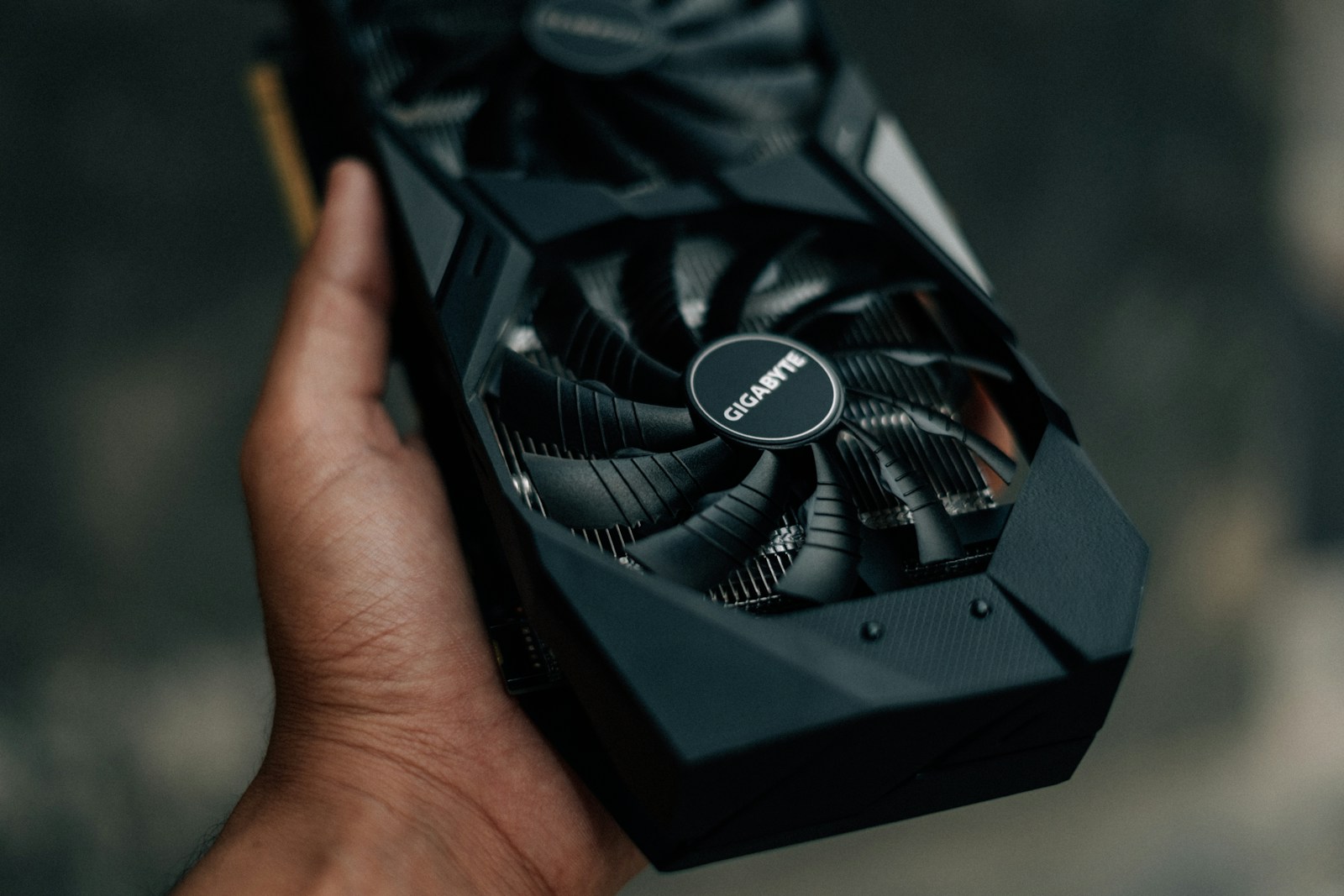
Despite these challenges, Nvidia has a history of developing technologies until they break into the market, as demonstrated by its graphics card software and AI capabilities. If Nvidia can do the same with robotics, it could open a whole new opportunity for the chip giant.
Image Credits: Photo by Sumeet Singh on Unsplash

Johannah Lopez is a versatile professional who seamlessly navigates two worlds. By day, she excels as a SaaS freelance writer, crafting informative and persuasive content for tech companies. By night, she showcases her vibrant personality and customer service skills as a part-time bartender. Johannah's ability to blend her writing expertise with her social finesse makes her a well-rounded and engaging storyteller in any setting.