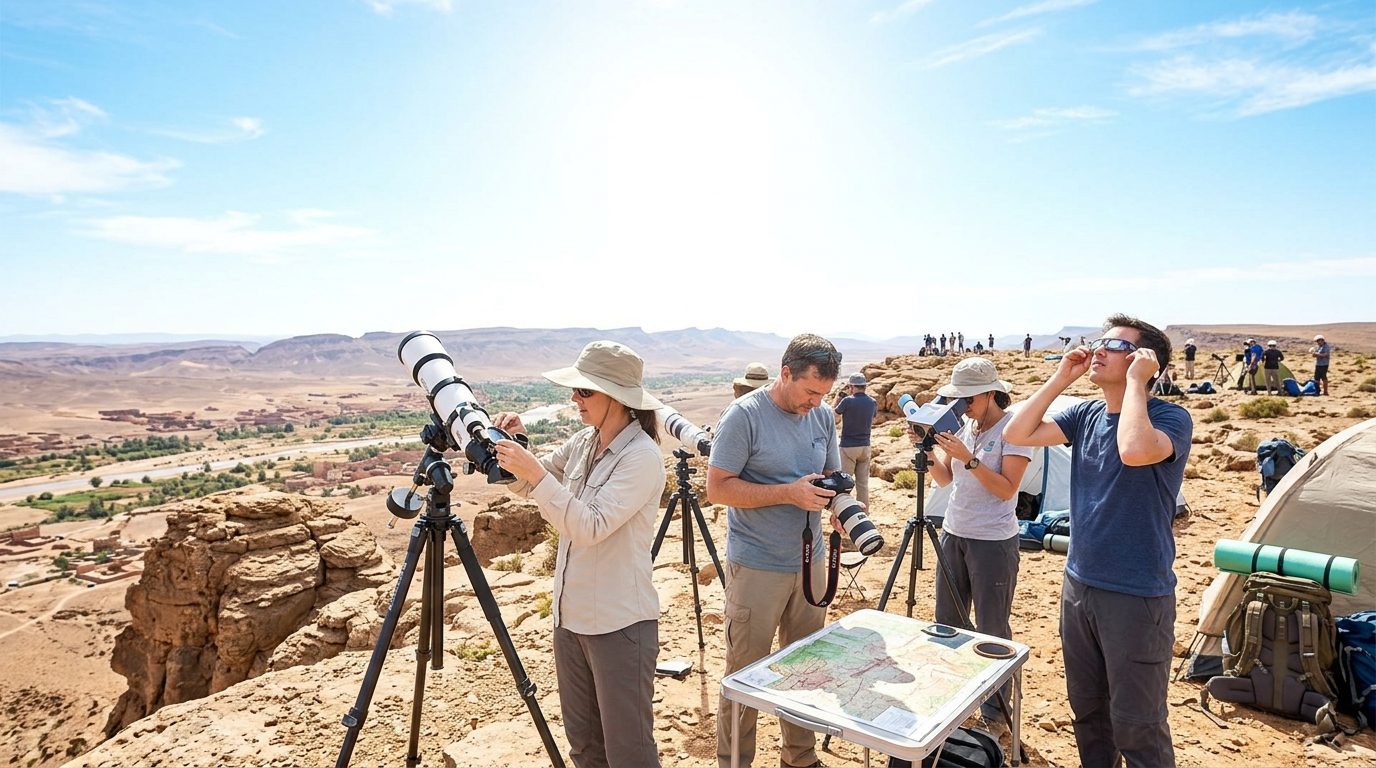
Two unusually long total solar eclipses will cross parts of the world in 2027 and 2028, giving millions of people rare viewing opportunities. The events will reward careful planning, but weather, travel demand and eye safety could shape each experience.
The first eclipse will occur on Aug. 2, 2027. Totality could last about 6 minutes and 23 seconds near the center of its path. Another total eclipse will follow on July 22, 2028, with a maximum duration of about 5 minutes and 10 seconds.
“In 2027 and 2028, there will be two spectacular, long-duration solar eclipses.”
Those durations make both events stand out. Most total solar eclipses offer observers only a few minutes in the Moon’s shadow. The 2027 event will be among the longest total eclipses visible from land during this century.
The 2027 Eclipse Crosses Three Continents
The 2027 path of totality will begin over the Atlantic Ocean. It will cross southern Spain and parts of North Africa before continuing through the Middle East and into the Indian Ocean.
Countries along the route include Morocco, Algeria, Tunisia, Libya, Egypt, Saudi Arabia, Yemen and Somalia. Locations outside the narrow totality path will see a partial eclipse instead.
Southern Egypt, including areas near Luxor, is expected to attract strong interest. The region lies close to the point of greatest eclipse and often has dry summer weather. High August temperatures, however, could pose health risks for visitors standing outdoors.
The eclipse also has historical appeal. Its shadow will pass near major archaeological sites in Egypt. That combination may place unusual pressure on transportation, lodging and local services.
Australia Takes Center Stage in 2028
The 2028 eclipse will travel largely across ocean before reaching Australia. Its path will cross parts of Western Australia, the Northern Territory, Queensland and New South Wales.
Sydney is expected to experience totality, making the event accessible to a large urban population. The timing and the Sun’s position will vary by location, so observers will need local forecasts and precise viewing information.
New Zealand will also receive totality in parts of the South Island near sunset. A low Sun can create striking views, but hills, buildings and clouds near the horizon may block the eclipse.
The two events offer different planning choices:
- 2027 provides longer totality and several dry-climate viewing areas.
- 2028 brings totality to major Australian population centers.
- Both require certified eye protection during every partial phase.
- Cloud cover can prevent viewing even inside the totality path.
Safety and Planning Remain Essential
Looking directly at the Sun without proper protection can damage the retina. Ordinary sunglasses, camera filters and improvised materials do not provide safe protection.
Viewers should use eclipse glasses that meet the ISO 12312-2 safety standard. Solar filters must be placed over the front of cameras, telescopes and binoculars. Optical equipment can concentrate sunlight and cause immediate injury.
Glasses may be removed only during totality, when the Moon completely covers the Sun. They must go back on as soon as the bright solar surface begins to reappear. Areas seeing only a partial eclipse require protection throughout the event.
Travelers should confirm the exact path before booking. Prices and crowd levels are likely to rise near favorable viewing sites. Flexible transport and backup locations can reduce the risk from local clouds.
The 2027 and 2028 eclipses will offer long periods of darkness, visible solar corona and dramatic changes in temperature and light. Their value, however, will depend on preparation. Observers should watch official path updates, weather forecasts and local safety guidance as each date approaches.

Rashan is a seasoned technology journalist and visionary leader serving as the Editor-in-Chief of DevX.com, a leading online publication focused on software development, programming languages, and emerging technologies. With his deep expertise in the tech industry and her passion for empowering developers, Rashan has transformed DevX.com into a vibrant hub of knowledge and innovation. Reach out to Rashan at [email protected]