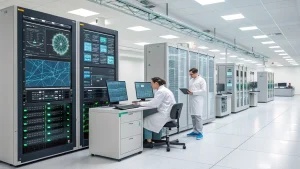
At a major Silicon Valley gathering, quantum computing leaders said progress toward practical machines is accelerating, even as big technical and market challenges persist. Scientists and executives at the Q2B conference described rapid gains in hardware stability, software tools, and early pilot projects. They also warned that error correction, scaling, and real-world use cases still need work before broad commercial value arrives.
The meeting drew researchers, startup founders, and corporate buyers looking for signs that quantum systems will move from labs into business workflows. The message was hopeful but measured. Early adopters are testing specific problems in chemistry, logistics, and finance. But companies continue to hedge timelines and budgets while they wait for stronger performance and clearer returns.
Why Quantum Momentum Is Building
Hardware makers said qubit counts are growing and device quality is improving. Toolchains are maturing, with more stable programming interfaces and better simulators. Cloud access has lowered costs for experimentation. These steps are bringing more developers and domain experts into the field, which creates a feedback loop for improvement.
Conference speakers linked today’s momentum to a decade of steady investment by governments and industry. National programs in the United States, Europe, and Asia have expanded. Major tech firms and venture-backed startups have continued funding, even through tighter capital markets. Attendees described stronger university-industry ties that help train needed talent.
Industry and scientific leaders hailed “spectacular” progress being made toward practical devices — while stressing that challenges remain.
Early Use Cases Show Promise
Several speakers pointed to pilot projects as signs of practical value emerging. In materials science, teams are exploring molecular modeling tasks that strain classical methods. In logistics, trial runs aim to improve routing and scheduling under uncertainty. Financial institutions are testing risk sampling and portfolio construction techniques that map to quantum-friendly formulations.
These projects are still exploratory. Yet they help define problem shapes, data needs, and performance thresholds. That, in turn, guides hardware roadmaps and software optimizations. Participants said small, high-impact wins will likely appear first in narrow domains with clear metrics.
The Obstacles: Error, Scale, And Cost
Progress aside, experts stressed the core blockers that stand between prototypes and routine deployment. Many systems remain noisy, limiting circuit depth. Error correction consumes significant resources and is not yet practical at full scale. Scaling hardware while maintaining fidelity remains hard across platforms.
- Error rates restrict useful workloads and circuit sizes.
- Full error correction demands far more qubits and control.
- Scaling increases manufacturing and calibration complexity.
- Costs remain high for specialized teams and long experiments.
Speakers argued that steady engineering work, not sudden breakthroughs, will address these limits. Better fabrication, improved gates, new qubit types, and smarter compilers could deliver incremental gains that compound over time.
Market Signals: Cautious Investment, Targeted Timelines
Enterprises are writing smaller, staged contracts tied to milestones. Buyers want proof points with clear benchmarks, not open-ended research budgets. Startups reported stronger interest from sectors with heavy compute needs, including pharma, chemicals, automotive, and energy. Government grants and procurement remain a crucial bridge for high-risk efforts.
Vendors avoided hard promises on dates for fault-tolerant machines. Instead, they outlined nearer goals: higher-quality mid-scale devices, more stable runtimes, and application-specific accelerators that combine quantum and classical methods. The consensus: near-term value will come from hybrid workflows and problem reformulation, not from universal quantum advantage across tasks.
What To Watch Next
Attendees pointed to several signposts for the next year. These include reproducible demonstrations that beat top classical baselines on narrow tasks, open datasets and benchmarks that allow apples-to-apples comparison, and clearer cost models for cloud-based access. Progress in error mitigation techniques may widen the set of useful experiments even without full error correction.
Standardization is another focus. Common interfaces and portable code would help projects survive hardware changes. Education also remains key, with demand rising for engineers who can bridge physics, computer science, and domain knowledge.
By the event’s close, the mood was measured optimism. Leaders see a path from today’s noisy devices to systems that solve targeted, valuable problems. They also acknowledge that engineering rigor and patient capital will determine the pace.
The takeaway: momentum is real, hype is tempered, and practical steps matter most. Watch for validated benchmarks, hybrid wins in specific industries, and sustained improvements in error rates. If those arrive, quantum computing could start to earn a place in production workflows, one narrow use case at a time.

Rashan is a seasoned technology journalist and visionary leader serving as the Editor-in-Chief of DevX.com, a leading online publication focused on software development, programming languages, and emerging technologies. With his deep expertise in the tech industry and her passion for empowering developers, Rashan has transformed DevX.com into a vibrant hub of knowledge and innovation. Reach out to Rashan at [email protected]