
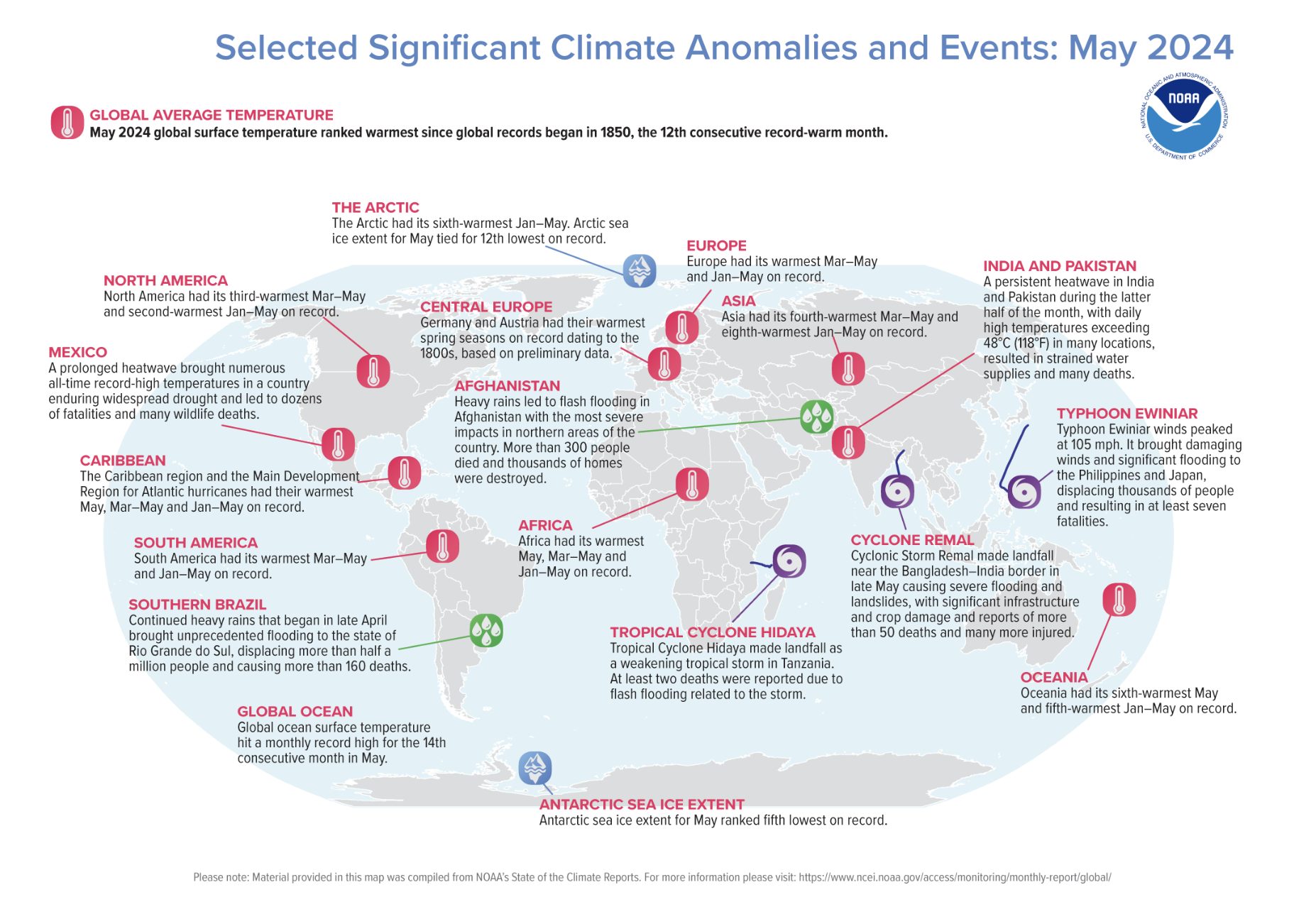
May 2024 was the world’s warmest May on record. This marks a full year of record-breaking global temperatures.
Earth’s ocean temperatures also set a record high for the 14th month in a row.
Unsurprisingly, the last three months globally were the warmest March-May in our records…
[(Preliminary) data/info: https://t.co/Y7TeMNSvIJ] pic.twitter.com/4X7BhTO5HZ
— Zack Labe (@ZLabe) June 17, 2024
Like a broken record, another monthly record for the average sea surface temperature in the northern half of the Atlantic Ocean…
Data available from @NOAA ERSSTv5 (https://t.co/V8F2MhaASY). pic.twitter.com/knpslPCqE5
— Zack Labe (@ZLabe) June 16, 2024
The average global temperature for May 2024 was 2.12 degrees F (1.18 degrees C) above the 20th-century average of 58.6 degrees F (14.8 degrees C). This makes it the warmest May in the 175-year global record. It is also the 12th month in a row of record-high temperatures for the planet.
Global land temperatures were above average in most regions. Notable exceptions were western North America, Greenland, southern South America, western Russia, and parts of eastern Antarctica. Africa had its warmest May on record.
We're nearing the hottest time of the year when looking at 1991-2020 normals. pic.twitter.com/0lcHG8vYNA
— Brian Brettschneider (@Climatologist49) June 17, 2024
May 2024 was the 14th month in a row of record-warm ocean temperatures. This trend started in April 2023. Most ocean areas had above-average temperatures, especially the tropical Atlantic.
Parts of the Southern Ocean, southeastern Pacific, and southern Indian Ocean were below average. The period from March to May 2024 was the warmest on record. It was 2.32 degrees F (1.29 degrees C) above average.
May temperatures continue record trend
The global surface temperature from January through May 2024 was also the warmest on record. It was 2.38 degrees F (1.32 degrees C) above average.
Africa, Europe, and South America all had their warmest year-to-date period. North America ranked as the second warmest. There is a 50% chance that 2024 will be the warmest year on record.
There is a 100% chance it will be in the top five. Global sea ice extent was much below average in May 2024. It ranked as the seventh smallest in the 46-year record at 8.51 million square miles.
This is 460,000 square miles below the 1991–2020 average. Arctic sea ice was 60,000 square miles below average. Antarctic sea ice was 390,000 square miles below average.
May 2024 had slightly more tropical activity than average. There were five named storms globally, which is more than the 1991–2020 average of four. Two of these storms became tropical cyclones.
Tropical Cyclone Hidaya affected coastal Tanzania in the South Indian Ocean. Typhoon Ewiniar caused flooding and wind damage in the Philippines and Japan.

Cameron is a highly regarded contributor in the rapidly evolving fields of artificial intelligence (AI) and machine learning. His articles delve into the theoretical underpinnings of AI, the practical applications of machine learning across industries, ethical considerations of autonomous systems, and the societal impacts of these disruptive technologies.