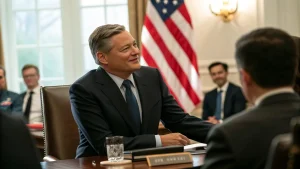
"Zuckerberg also expressed regret for essentially hiding content related to coverage by the New York Post about Hunter Biden ahead of the 2020 election."
Zuckerberg says he regrets caving to White House pressure on content https://t.co/UODGpxnHys via @politico
— Anvar Samost (@anvarsamost) August 27, 2024
In a surprising turn of events, Elon Musk has publicly responded to Mark Zuckerberg’s recent remarks regarding handling COVID-19 information on social media platforms. The Meta CEO regretted how his company managed COVID-19 content, suggesting there was undue government pressure to censor certain information. I regret …,” Zuckerberg stated, acknowledging that his platform may not have correctly balanced public safety and free speech.
His comments have ignited a conversation about the government’s influence on private companies. Elon Musk was quick to chime in, saying, “Yell at me, if …”
Facebook admitted what we’ve all known, they censored Americans at the behest of the Biden-Harris Admin. This was blatant election interference, & every American should be angry that Joe Biden & Kamala Harris interfered w/ their First Amendment rights.https://t.co/UW2LbSdcLO
— Ann Wagner (@RepAnnWagner) August 27, 2024
Although his statement was enigmatic, it hinted at his belief in less restrictive moderation policies, contrasting sharply with Zuckerberg’s approach during the pandemic.
Look, there are some nuances on this particular story, but I really dislike the rhetorical mode of "pshsh, old news!" when an inconvenient truth has been perhaps perfunctorily acknowledged, but very much backgrounded and certainly not "owned".https://t.co/vWraPWoiT5 pic.twitter.com/fuaEjQu3oV
— Nate Silver (@NateSilver538) August 28, 2024
Former President Donald Trump also weighed in, criticizing social media platforms for shaping public opinion during elections. Specifically, he suggested that the platforms’ decisions to censor content could have significantly impacted election outcomes. The debate over content moderation and censorship is ongoing, particularly concerning its potential implications for future elections and public discourse.
Funding decisions, platform adjustments, and the overall approach to managing information are central to this issue. Zuckerberg’s admissions and Musk’s reaction are likely to fuel further discussion about the role of tech giants in democratic processes. As both companies continue to evolve their policies, the impact on upcoming elections remains a significant concern for policymakers, the public, and the tech industry itself.
In a notable move ahead of the upcoming elections, Mark Zuckerberg, CEO of Meta, has taken several actions that appear to favor Republicans, stirring much political conversation. Recently, Zuckerberg has made public statements that seem to support right-wing narratives about censorship. He praised Donald Trump as “badass” while claiming a stance of neutrality.
On Monday, Zuckerberg sent a letter to the House Judiciary Committee, asserting that the Biden administration had pressured Meta to censor content during the COVID-19 pandemic. “In 2021, senior officials from the Biden Administration, including the White House, repeatedly pressured our teams for months to censor certain COVID-19 content, including humor and satire, and expressed frustration with our teams when we didn’t agree,” Zuckerberg wrote. He added that he regretted Meta was not more outspoken against this pressure.
Trump quickly leveraged Zuckerberg’s letter to bolster his claim that the 2020 election was stolen. “Zuckerberg admits that the White House pushed to SUPPRESS HUNTER BIDEN LAPTOP STORY (& much more!) IN OTHER WORDS, THE 2020 PRESIDENTIAL ELECTION WAS RIGGED,” Trump posted on his Truth Social platform. The House Judiciary Committee, led by Republicans, also capitalized on Zuckerberg’s letter, sharing it on social media to criticize President Biden and Vice President Kamala Harris.
The Committee is investigating the content moderation policies of major social media networks.
Musk vs. Zuckerberg: social media regrets
“Mark Zuckerberg just admitted three things:
- Biden-Harris Admin ‘pressured’ Facebook (now Meta) to censor Americans.
- Facebook censored Americans.
- Facebook throttled the Hunter Biden laptop story. Big win for free speech,” the committee wrote on X.
Zuckerberg’s decision to frame the White House’s efforts to address COVID misinformation as coercion comes despite a Supreme Court ruling that the federal government had not overstepped by asking platforms to manage potential misinformation. Platforms like Meta and those run by Elon Musk have recently reduced measures designed to curb misinformation, including allowing Trump back on social media after his ban following the January 6 Capitol riot.
Zuckerberg, who donated over $400 million to support voting access in the US, also told the committee he would not contribute similarly in future elections after criticism from Republicans claiming his funds favored Democrats.
As the COVID-19 pandemic depleted local resources during the 2020 election, private companies like Facebook stepped in to fill the coffers of election offices with these grants,” Zuckerberg explained. “But my goal is to be neutral, and I don’t plan on making a similar contribution this cycle.”
Hunter Biden’s laptop
Furthermore, Zuckerberg reflected critically on Meta’s handling of the New York Post’s controversial October 2020 story regarding Hunter Biden’s laptop, admitting that limiting the story’s dissemination was a mistake. He reiterated that the reporting was later deemed not Russian disinformation and acknowledged an overreach in demoting the story.
Zuckerberg’s recent comments, including calling Trump’s reaction to an alleged assassination attempt “badass” in a Bloomberg interview, suggest he may be extending an olive branch to Republicans. “Seeing Donald Trump get up after getting shot in the face and pump his fist in the air with the American flag is one of the most badass things I’ve ever seen in my life.”
Combined, these actions indicate Zuckerberg may be aligning Meta closer with Republican viewpoints as elections approach, potentially shaping how the platform influences public discourse. In the Bloomberg interview, Zuckerberg emphasized changes at Meta aimed at reducing political content on its platforms, though it remains unclear what content this will affect.
“I think you’re going to see our services play less of a role in this election than they have in the past,” he stated. Rep. Greg Murphy, R-N.C., has raised concerns about what he describes as a repeated pattern of government censorship.
These concerns came to the forefront following an admission by Meta CEO Mark Zuckerberg. Murphy’s comments also come in the context of broader discussions about the implications of a potential Harris administration on the country’s foreign policy. He touched on various political dynamics, including the role of Minnesota Governor Tim Walz in supporting Vice President Kamala Harris in her first interview.
Highlighting his stance, Murphy pointed to what he perceives as the Democrats’ strategies, which he controversially termed a “coup.”
The debate around government censorship and the political moves ahead of the 2024 elections continue to generate significant discussion among policymakers and the public.

Cameron is a highly regarded contributor in the rapidly evolving fields of artificial intelligence (AI) and machine learning. His articles delve into the theoretical underpinnings of AI, the practical applications of machine learning across industries, ethical considerations of autonomous systems, and the societal impacts of these disruptive technologies.