“AI will take our jobs!” has become a classic joke nowadays. While many don’t take it seriously, some industries are already approaching this technology with caution. In sales, where trust, connections, and organization might seem the only things that matter, AI already manages CRM, analytics, call recordings, and a host of other tasks. In 2025, 56% of sales professionals were effectively using AI daily.
Many AI-based solutions have indeed simplified a number of tasks. But should sales professionals be worried about running out of time? We spoke with software engineer Danylo Liakhovetskyi, founder of his own company, Naratta, and a specialist with extensive experience developing technology products and ML models. He explained why automation doesn’t always solve key sales problems and how AI can actually help people.
The Challenge: Data Overload and the Human Blind Spot
Interviewer: Many companies use AI in sales today, but the results are mixed. Why do you think the industry is struggling to find the right balance?
Danylo: I think the main problem is that teams are literally drowning in data. It comes from various sources: CRM, call recordings, etc. And it’s overwhelming. How do you make decisions based on all this? It’s not always obvious.
I’ve worked on various projects, and in my experience, such large amounts of data don’t actually help sales. With all this data collection and analytics, people begin to forget that sales is a human interaction. AI can help with this: prompts, microtasks, and monitoring, but it shouldn’t completely replace humans or become the primary sales tool.
Naratta: Turning AI into a Partner, Not a Replacement
Interviewer: Was this the moment you decided to create Naratta?
Danylo: The idea for Naratta didn’t strike the team right away. We tried several tools: a feature for structuring work meetings, and later, an AI-powered call moderator. But as I said earlier, sales is ultimately about working directly with clients, so my team and I decided to develop in this “human” direction.
Work began on the future project that would grow into Naratta. We studied what determines call success, tone, question phrasing, salesperson engagement, and so on. These are all purely human behaviors that AI can never replace. But it can learn this behavior and help sales professionals.
Interviewer: Many AI tools completely automate messages and calls. But you decided not to replace the salesperson entirely. Why?
Danylo: Sales is a dialogue between two people, even online. Few people like AI assistants, no matter how smart they are. That’s why Naratta doesn’t want to replace sales professionals. We give salespeople a smart assistant that will always be there and prompt them at the right moment, reminding them to ask questions or take notes. It’s like a good colleague: they’ll always tell you how to do things better, but they won’t do it for you.
How Naratta’s Human-Centric AI Works
Interviewer: What about the technology behind Naratta? How does it actually work?
Danylo: At a high level, the system does four things. First, it transcribes the conversation in real time and analyzes what’s happening: the topic of the conversation, the buyer’s intent, and how far the dialogue is moving toward the original goal of the call. Key feature here is that it tracks emotions, context, and overall tone, metrics not typically found in AI.
Next, Naratta analyzes the conversation, compares it to successful examples, and provides the salesperson with advice: give the client more time to speak, clarify key points, or write down the important details. This is, in general, how the model undergoes constant training.
The Human Side: Leadership, Mentorship, and Vision
Interviewer: Besides the development, you’ve spent years mentoring young engineers. How has that experience influenced the way you build products?
Danylo: Mentorship has changed my approach to work. As a mentor, I can’t say, “Just write good code.” To help my team understand what I want from them, I’ve learned to view the product as a business leader, a developer, and an end user. All of these roles have different goals and paths, but we’ll always converge on the end user, because the user is the one we’re all aiming for.
Interviewer: How do you balance technical excellence with supporting your team’s growth and creativity?
Danylo: I guess it’s all about balancing high development standards with creative space for engineers. I feel a special responsibility for creating AI that will work with people. But I don’t want this responsibility to weigh on the engineers. They have the right to experiment, make mistakes, and be creative. After all, that’s how each of us learned.
Real-World Results: Turning Insights into Partnerships
Interviewer: What results have you seen with early users of Naratta?
Danylo: I think we have a lot to be proud of. Even when we launched the demo, we received positive feedback from ItalLux SRL. They liked how AI made meetings more effective. The company’s CEO, Gregory Sheheda, highlighted the value of real-time moderation and post-meeting analytics for cross-functional meetings across time zones and languages. Their team was also interested in the Google Meet integration and beta access.
The first real users also provided valuable feedback on the product: they noted that training new professionals has become faster thanks to Naratta. On average, the onboarding time for new specialists accelerated by 40%. The overall performance of teams using Naratta improved because each member could receive prompts directly during the conversation.
Other companies later expressed interest in Naratta: Unicorn Universe and ONBOARD Software wanted to implement our solutions and test the product. I’m glad that what we’re doing is producing real results.
Lessons from the Founder: Redefining the Future of Work
Interviewer: Based on everything you’ve seen, what do you think the future of sales looks like?
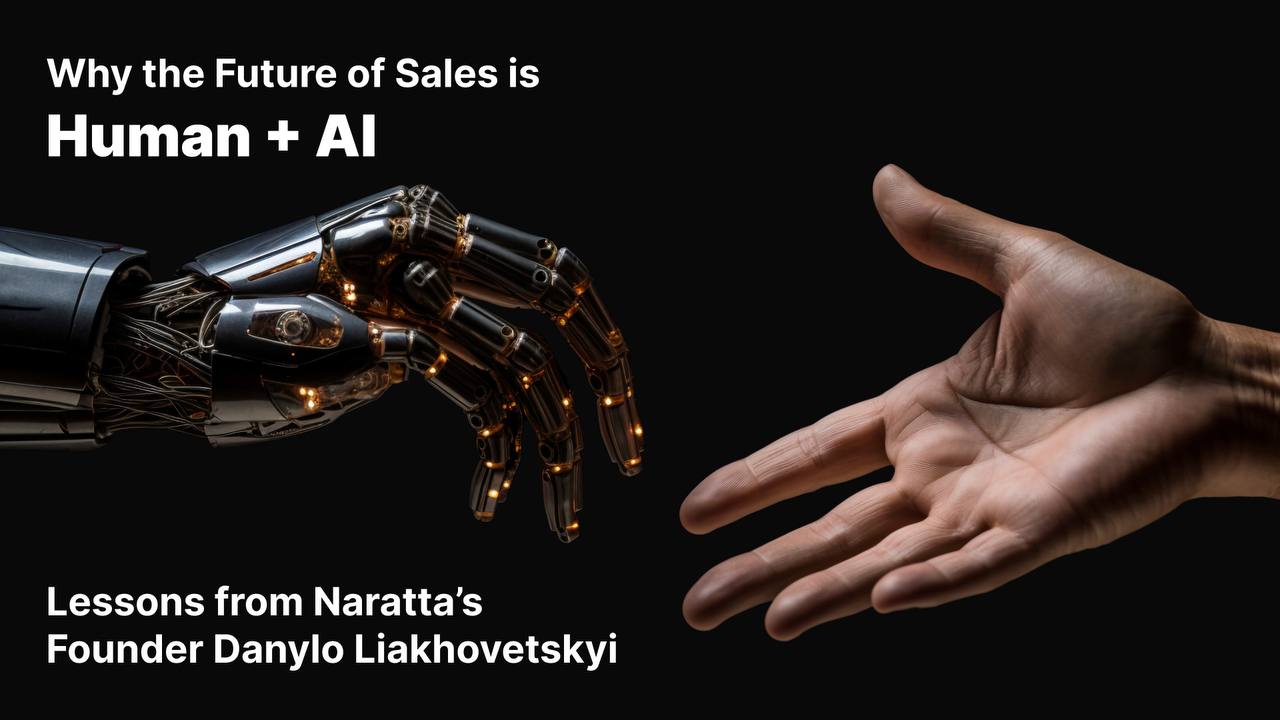
Danylo: Teams that view AI as an assistant, a “collaborator,” rather than a competitor or substitute, will definitely benefit in the future. This won’t eliminate good sales professionals; rather, they’ll have even more time to spend on quality customer interactions.
I also think this is affecting our perception of AI technologies, which are still too sensitive for people. Perhaps we’ll move away from the “AI vs. people” paradigm and toward developing “AI + people” solutions.
Interviewer: In your view, what skills will define the next generation of sales professionals?
Danylo: A combination of empathy, analytical thinking, and adaptability. All the same traditional sales skills, but strengthened with new technologies.
A More Human Future, Powered by Intelligence
Interviewer: And finally, what would you say to leaders who are unsure about using AI in their sales processes?
Danylo: I would advise against viewing AI as a shortcut or an easy path. It’s a tool that will “clear” that path and help you see what’s unnecessary. Naratta, for example, already helps us and our clients notice certain details we might have previously missed in sales. I believe all AI technologies created to optimize business processes should be viewed from this supportive perspective.

Rashan is a seasoned technology journalist and visionary leader serving as the Editor-in-Chief of DevX.com, a leading online publication focused on software development, programming languages, and emerging technologies. With his deep expertise in the tech industry and her passion for empowering developers, Rashan has transformed DevX.com into a vibrant hub of knowledge and innovation. Reach out to Rashan at [email protected]