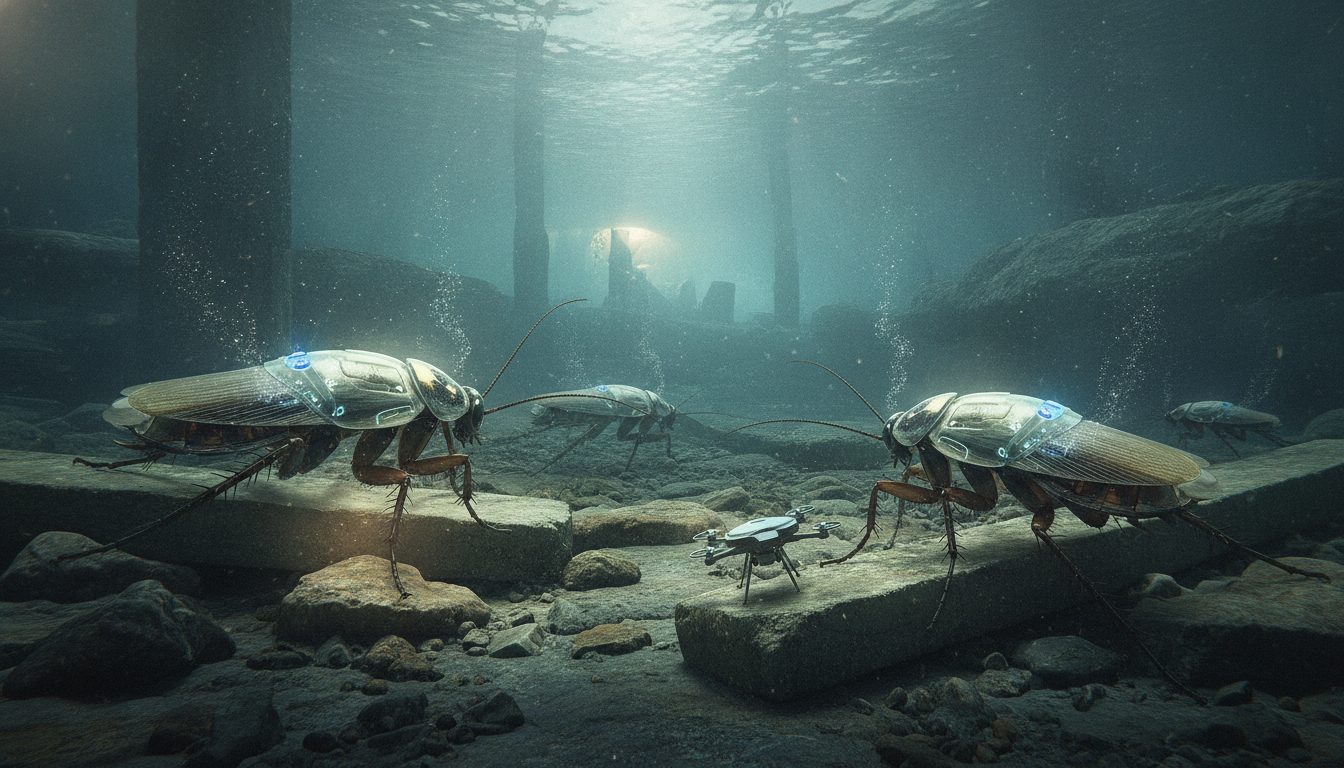
A research team has built tiny 3D-printed diving suits that let cockroaches walk underwater for up to three hours with no harm, raising new ideas for search-and-rescue and off-world scouting. The demonstration, shared this week, points to a low-cost way to send semi-autonomous insects into flooded buildings, collapsed tunnels, or even harsh extraterrestrial sites where robots struggle.
Tiny 3D-printed diving suits allow cockroaches to walk underwater for up to 3 hours with no ill effects, which could enable a cyborg insect swarm to explore disaster zones and perhaps even Mars.
Why This Matters Now
Floods, quakes, and industrial accidents often trap people in tight spaces that defeat robots and risk human rescuers. Cockroaches already squeeze through narrow gaps and survive in rough conditions. Adding water-ready gear expands where they can go. Pairing these insects with lightweight sensors and control packs could turn them into a mobile network that maps hazards in real time.
Background on Cyborg Insects
Scientists have experimented for years with steering insects using tiny electrodes, backpacks, and microcontrollers. Projects with beetles and roaches have shown that modest electrical signals can nudge direction, while payloads can carry cameras, microphones, and gas sensors. The new advance focuses on water, a hard barrier for earlier insect platforms that short out electronics and limit range.
Cockroaches are hardy test subjects. They are small, cheap to raise, and easy to outfit. Their simple needs and strong bodies let them carry miniature gear while still moving naturally. Underwater mobility further widens their reach into basements, drains, and submerged debris fields where victims or leaks might be found.
How the Diving Suits Expand Capability
The suits appear to seal key body parts and shield electronics while allowing legs to move. Walking, not swimming, keeps energy demands low. That matters for missions that may last hours with tiny batteries. The reported three-hour window suggests enough time to scout a site and relay data to a base station or drone overhead.
Researchers highlighted two possible fronts. One is disaster response, where a swarm could fan out to map voids, detect gas, or locate sounds. The other is space exploration. If insects can tolerate low pressure, dust, and cold with protective shells and life support, they could test materials and traverse cracks that wheeled rovers cannot reach.
Expert Views and Open Questions
Supporters say insect swarms are cheap, expendable, and adaptable. A small team can deploy hundreds, then let software combine their readings into a clear picture of threats.
Critics raise concerns over control, ethics, and biosafety. They ask how to prevent escape into sensitive habitats and how to secure command links against tampering. They also want proof that the animals suffer no lasting harm during tests or field work.
- Reported performance: up to three hours walking underwater.
- Key claim: no ill effects observed on the insects.
- Proposed uses: disaster zones and possible Mars scouting.
- Enabling tools: 3D printing, microelectronics, and swarm control.
Potential Impact on Search and Rescue
If proven at scale, underwater-capable cyborg insects could join a toolkit that now includes drones, ground robots, and canine units. In waterlogged tunnels or basements, they could slip under doors, walk along floors, and flag hazards. Their low cost makes high numbers practical, improving coverage and redundancy when links fail.
Case studies from past floods show responders often wait hours to enter submerged structures. A pre-staged swarm could start mapping within minutes, giving teams a live view of blocked exits, trapped survivors, or chemical spills before anyone wades in.
Looking to Mars and Harsh Environments
Mars offers cold, dust, and thin air that challenge complex machines. Small, protected organisms with minimal needs might scout cracks, caves, or lava tubes. Any off-world plan would need strict containment and planetary protection steps. Still, the idea signals interest in hybrid systems that mix biology with engineered shells and sensors.
The next steps include independent validation, longer trials in muddy or fast-moving water, and demonstrations with sensor payloads. Clear protocols on animal welfare and mission shutdowns will be key. If results hold, underwater-capable insect swarms could add a nimble, low-cost layer to rescue work on Earth and early-stage scouting on Mars. Watch for scaled field tests, better battery life, and proven methods to manage and retrieve swarms after missions.

A seasoned technology executive with a proven record of developing and executing innovative strategies to scale high-growth SaaS platforms and enterprise solutions. As a hands-on CTO and systems architect, he combines technical excellence with visionary leadership to drive organizational success.