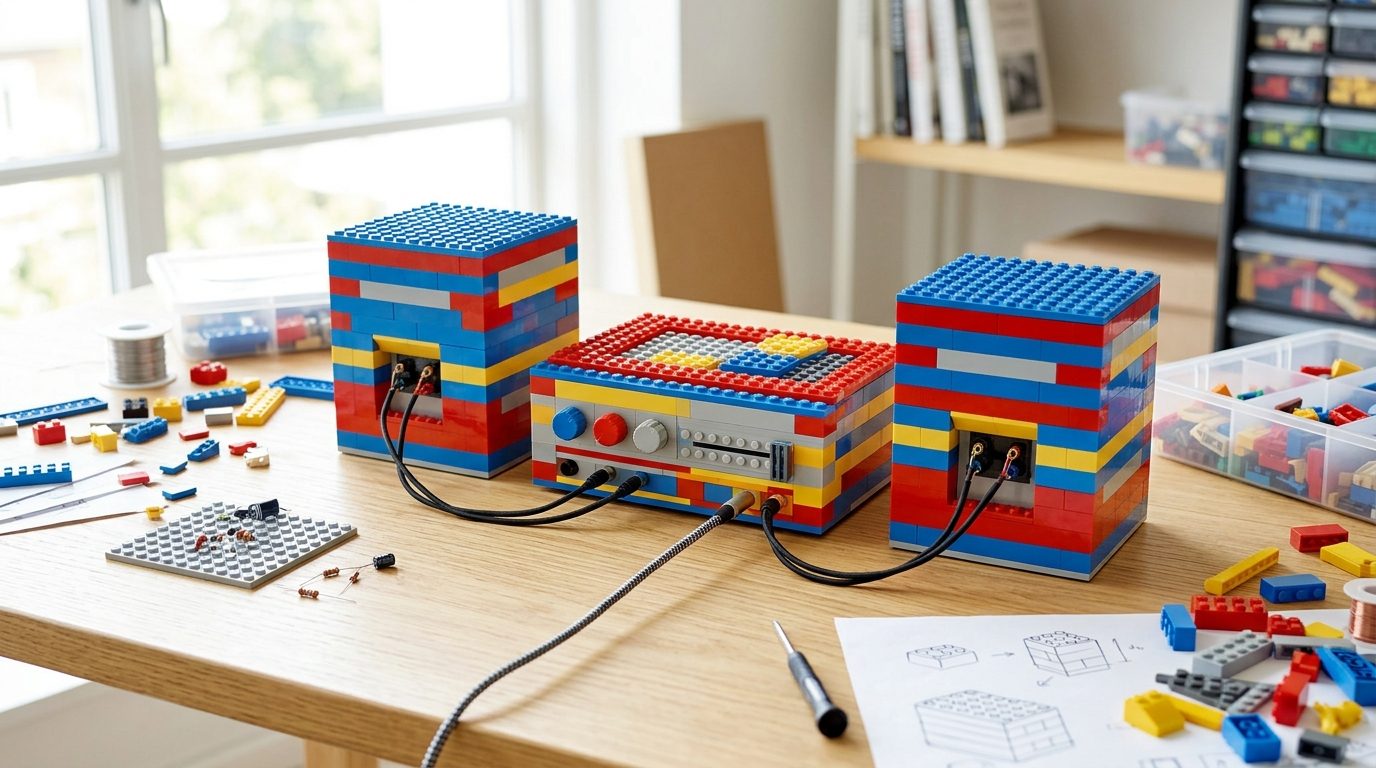
Italian designer Paolo Caviglia has created Audio Bricks, a project that uses Lego-style building pieces to assemble a working audio system. The concept gives brick creations a practical role after construction, rather than leaving them untouched as decorative models.
The project began with a simple observation. People often use building bricks to make castles, spaceships, and racing cars. Once those models are finished, however, they may spend most of their time sitting on a shelf.
Caviglia saw an opportunity to connect creative play with an everyday product. Audio Bricks applies the familiar process of assembling toy structures to equipment designed for listening to sound.
Moving From Display to Daily Use
Building bricks are usually valued for the construction experience. Their reusable pieces let people test ideas, change designs, and rebuild models. Finished projects can also become personal objects that reflect the builder’s interests.
Audio Bricks extends that appeal by making the completed structure useful. Instead of producing another static model, the builder creates a real audio system.
The central idea can be summarized through three features:
- The system uses recognizable, Lego-style bricks as its building material.
- Assembly remains part of the product experience.
- The finished creation provides an audio function rather than serving only as decoration.
This approach links play, product design, and consumer electronics. It may also encourage users to keep interacting with what they have built.
A Different View of Product Design
Most consumer audio products arrive in a fixed enclosure. Their shape, controls, and appearance are largely decided before purchase. Caviglia’s project presents a different relationship between the user and the object.
With a brick-based system, construction becomes part of ownership. That can give the finished product more personal meaning because the user has taken part in creating its physical form.
The project also reflects a wider interest in modular design. Products assembled from separate pieces can make experimentation easier. Users may be able to reconsider the structure or appearance without discarding the full object.
However, the available project description does not explain the system’s technical specifications. It gives no details about sound quality, power, connectivity, price, or commercial availability. Those factors would determine whether Audio Bricks can compete with standard speakers or remain mainly a design study.
Practical Questions Remain
Turning plastic building pieces into an audio enclosure presents possible design challenges. Speakers depend on stable construction and controlled vibration. Loose sections could affect durability or performance.
Safety and compatibility would also matter if the project reached consumers. Any product combining electronic parts with toy-like materials would need clear guidance about assembly, electrical use, and suitable age groups.
There is also a distinction between Lego-branded pieces and generic compatible bricks. The project is described through Lego-style construction, but no formal relationship with the Lego Group has been identified.
Audio Bricks remains a clear example of how designers can rethink familiar materials. Caviglia’s concept does not treat construction as the final goal. It uses building play as a route to a functional object.
The next steps to watch include technical testing, public availability, and evidence of how the system performs. If those questions are addressed, Audio Bricks could show how modular creativity can give finished brick models a longer and more useful life.

Senior Software Engineer with a passion for building practical, user-centric applications. He specializes in full-stack development with a strong focus on crafting elegant, performant interfaces and scalable backend solutions. With experience leading teams and delivering robust, end-to-end products, he thrives on solving complex problems through clean and efficient code.