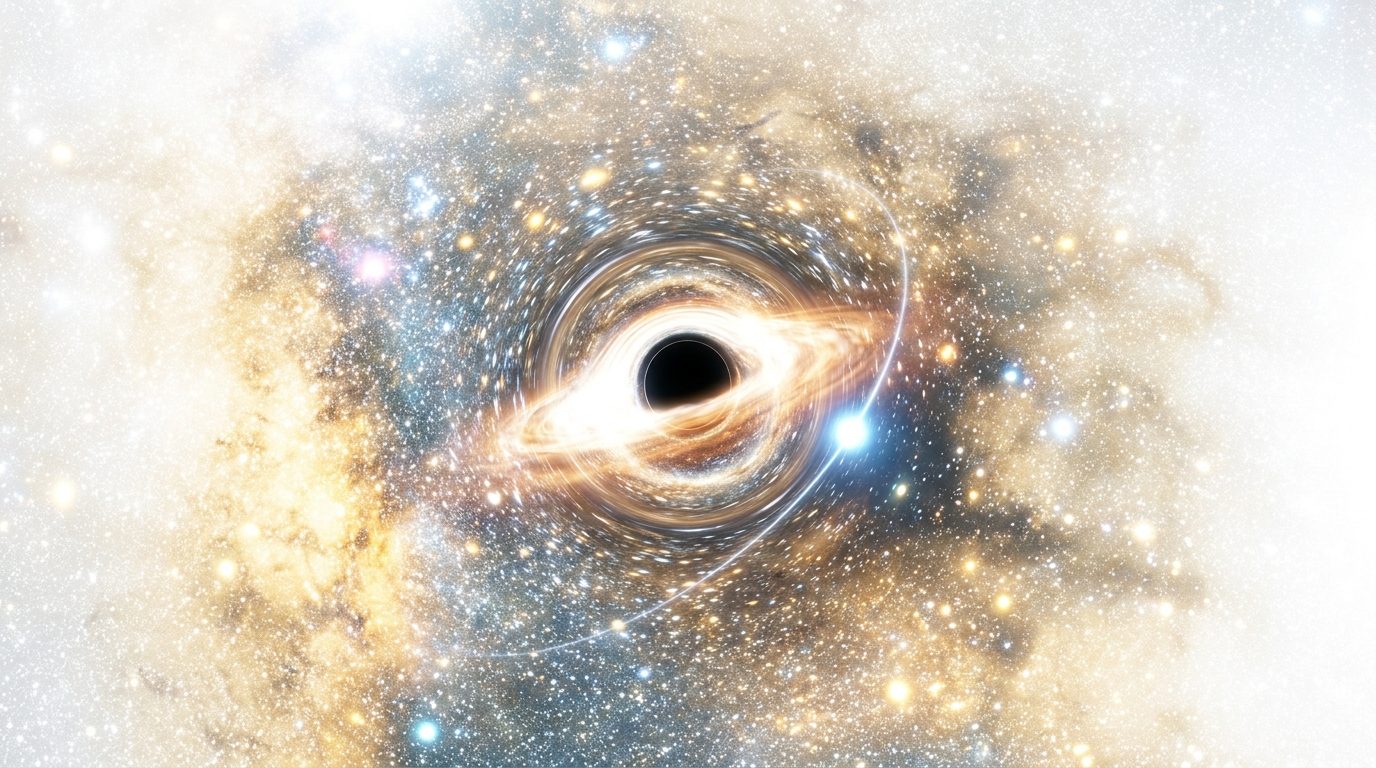
A star called S301 passes so close to Sagittarius A* that its orbit could expose how the black hole’s rotation distorts nearby spacetime. The opportunity places the star among the most useful natural probes near the center of the Milky Way.
Sagittarius A* is the supermassive black hole at the heart of the galaxy. Tracking S301 over time may help astronomers test gravity under conditions that cannot be reproduced on Earth.
A Natural Test of Einstein’s Theory
Albert Einstein’s general theory of relativity describes gravity as the curvature of spacetime. Massive objects bend that spacetime, changing how stars and light move around them.
A rotating black hole should produce an additional effect. Its spin is expected to drag nearby spacetime in the direction of rotation. Physicists call this frame dragging.
“S301 passes close to Sagittarius A*, so close that its orbit could reveal how the black hole’s rotation warps the spacetime around it.”
The effect should cause small changes in the orientation of S301’s orbit. Those shifts would build over repeated passages, giving researchers a possible way to estimate the black hole’s spin.
Detecting that signal would require precise measurements. Astronomers must separate frame dragging from other influences, including nearby stars, unseen objects, and ordinary relativistic effects caused by the black hole’s mass.
Why Close Orbits Matter
Stars near Sagittarius A* travel through an extreme gravitational environment. The closer a star comes, the stronger the relativistic effects on its path should become.
Previous observations of stars near the galactic center have supported general relativity. Their orbits have also helped scientists estimate the central object’s mass and confirm that it behaves like a supermassive black hole.
S301 may offer a different type of measurement because its close approach could make spin-related distortions easier to identify. Key evidence would include:
- A gradual shift in the orbital plane.
- Changes that match predictions for frame dragging.
- A signal that cannot be explained by nearby matter.
Such measurements are difficult because the galactic center is crowded and hidden behind dust. Infrared telescopes can see through much of that material, but separating faint stars remains demanding.
The Challenge of Measuring Spin
A black hole’s mass has a strong effect on nearby motion. Its spin usually leaves a weaker signature, making the result more sensitive to measurement errors and incomplete models.
Researchers would need repeated observations covering enough of S301’s orbit. They would also need accurate estimates for the positions and masses of neighboring objects. Otherwise, gravitational pulls from those bodies could imitate part of the expected signal.
Independent observations would add confidence. Measurements from several instruments could reduce the chance that calibration problems or image-processing choices produce a false detection.
What Scientists Could Learn
A reliable spin estimate would help describe how Sagittarius A* formed and evolved. Black holes can gain angular momentum through mergers and by consuming surrounding material. Spin therefore carries information about their history.
The measurement could also test whether spacetime near Sagittarius A* follows general relativity’s predictions. Any persistent mismatch would demand careful study, although ordinary sources of error would need to be ruled out first.
S301’s scientific value will depend on the precision and duration of future monitoring. If its path reveals frame dragging, the star could provide a rare direct test of rotating spacetime. For now, its orbit offers a promising target, while the strength and detectability of the signal remain open questions.

A seasoned technology executive with a proven record of developing and executing innovative strategies to scale high-growth SaaS platforms and enterprise solutions. As a hands-on CTO and systems architect, he combines technical excellence with visionary leadership to drive organizational success.