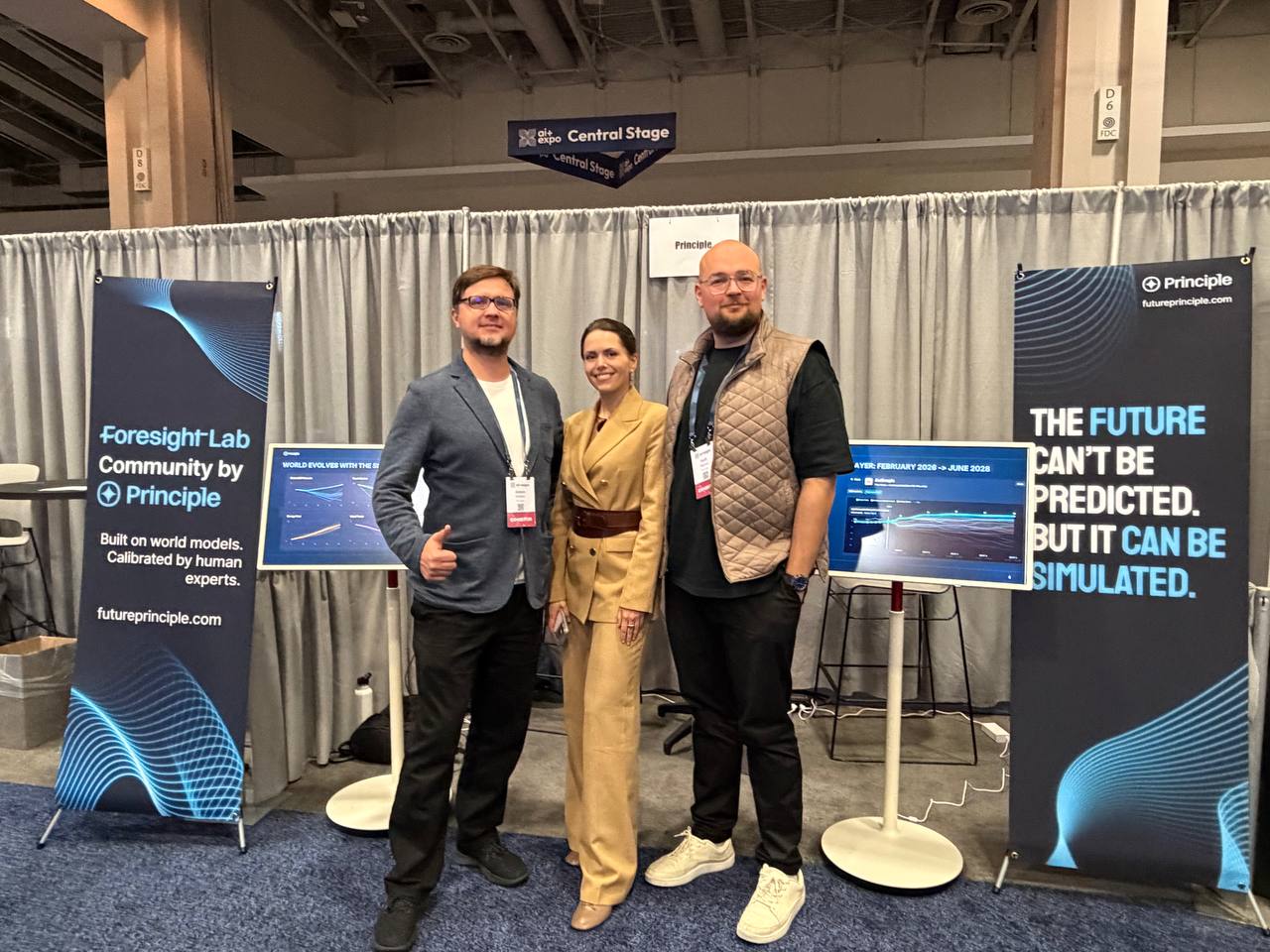
Corporate strategy is a multi-billion-dollar industry. Most Fortune 500 companies still rely on three consulting scenarios and spreadsheets. When a competitor lowers prices, a regulator changes the rules, or some other shock hits, that kind of strategy falls apart.
Yurii Filipchuk, co-founder and Chief GTM Officer of the San Francisco company Principle, believes this is one of the biggest blind spots in corporate strategy today. Principle builds world models of companies, competitors, regulators, and markets, then runs hundreds of simulations on top of them so executives can stress-test decisions before committing capital. The company was a finalist at SXSW Pitch 2026 in the Enterprise and Future of Work track, selected from more than 600 applicants, and won the Enterprise Innovation Award, presented by KPMG, at the same event.
Principle announced its $2 million round in January 2026, led by SMRK VC and SMOK VC, with participation from a16z Scout and Bain Capital Scout programs and angel investors from Groq, DeepMind and Anthropic. The round was covered across Yahoo Finance, GamesBeat, PR Newswire and Intelligence360, with the lead angle: Pentagon wargaming methodology applied to the corporate boardroom.
In this interview, Yurii explains why traditional strategy keeps failing, what a trip to Dubai revealed about how real foresight works, and what it actually takes to put frontier AI research in front of Fortune 500 executives.
Interviewer: Yurii, thank you for joining us! Tell us when you realized that a project like Principle needed to appear on the market?
Perhaps the initial point was a trip to Dubai. The Dubai Health Authority selected us from more than 1,300 startups for its innovation program, and it became our first government decision-making pilot. In that ecosystem, I rethought corporate strategy.
The Dubai Future Foundation, the sovereigns, and the Fortune 10 companies they work with all own the capability to practice real foresight. They run scenario planning as a core discipline. They design their future instead of reacting to whatever hits them. Everyone else is flying blind. That’s the gap Principle was built to close. The Dubai Future Foundation and DCAI, the Dubai Center for AI, are our forward-looking partners there.
Interviewer: You call yourself a co-founder and Chief GTM Officer, but your background isn’t in AI research. How do you fit into a company like this?
Yurii Filipchuk: Principle has a unique scientific team. Three PhDs, including our lead scientist, a Breakthrough Prize-winning physicist. One of our scientists built user simulations at YouTube. We also collaborate with leading research institutions and neolabs. They’re the ones pushing the frontier, turning the emerging capabilities of large language models into world models for business and strategy.
My job is the other half. I talk with chief strategy officers and heads of corporate development, study their real-world scenarios, the M&A deals they’re testing, the market expansions they’re weighing, their competitors’ moves, and turn them into simulation experiments our team can run. Thanks to AI programming tools, we can answer client questions and build working prototypes in a matter of days.
Personally, I initiated over 90% of our pipeline. I closed my first annual corporate deal, with the potential to grow 20x from a pilot into a full-scale contract. We’re in negotiations with a global bank, a major energy company, and two leading consulting firms.
Interviewer: What exactly does Principle do that a strategy team or a consulting report cannot?
Yurii Filipchuk: Principle is a world model for strategy. We don’t just treat large language models as world models; we train our own on AWS Nova. We simulate your company, your competitors, your regulators, and the entire market. Then we stress-test your next move across hundreds of futures. M&A. Market entry. Price war. Black swan. AI disruption.
Most companies are playing one move ahead. Principle runs ten moves deep and tracks every piece on the board. Traditional consulting firms deliver three static scenarios over six months for millions of dollars. Our simulations update in real time. Every time the world moves, so do they.
Here’s the simple version: large language models are secretly world models. They can describe and simulate complex scenarios. They’re undertrained for strategy, but we figured out how to fix that. Once you build representations of competitors, regulators, supply chains, and markets that behave like the real thing, you can run Monte Carlo AI simulations where every coin flip is a new universe. Run it a thousand times, and you get a distribution of plausible futures, not a single forecast.
We don’t have a prediction system; that would be an inaccurate description. We show clients that if event X occurs, the system behaves in a certain way, and through experimentation we surface options that hold true across most scenarios. We published our first step toward changing the field, a piece called “The Belief Cost of Information,” on how unaudited world models are ruining corporate strategy. We’re also opening a research fellowship for people working in our field. Principle runs as both an applied AI startup with clients and a research lab, and we bring on one strategic partner from each industry.
Interviewer: The company has scaled pretty fast. What achievements stand out most to you?
Yurii Filipchuk: I believe our success comes from a mix of good timing and good people. Over the past few months, we’ve grown from 10 people to more than 30. We announced our $2 million round in January 2026 across Yahoo Finance, GamesBeat, and PR Newswire.
We were selected as an SXSW Pitch 2026 finalist and won the Enterprise Innovation Award from KPMG at that event. We also got into The Residency’s flagship batch for companies with traction, an accelerator advised by Sam Altman and founded by Nick Linck, selected from 4,000 applications. AWS partnered with us and featured our custom model built on Nova architecture. In December 2025, we were selected for the Defense Innovation Unit’s OnRamp Hub in Hawai’i. We presented at the Stakeholder Summit and Defense Collider in Honolulu. There, we met INDOPACOM wargaming and exercise planners and discussed how our technology could support defense applications. The Dubai Health Authority was our first government decision-making pilot, and the Dubai Future Foundation and DCAI are our forward-looking partners. MacPaw, our first public case study, was presented at Forbes AI Day.
Interviewer: Before Principle, you led Party.Space, working with Spotify, Google, Zapier, Grammarly, and UC Berkeley. What did you carry forward?
Yurii Filipchuk: At Party. Space, I learned how big companies make buying decisions. I raised $2 million from European venture funds, worked with over 65 clients in 50 countries, and grew revenue four times in a year. The biggest lesson was that enterprises want clear solutions to specific problems, with as little risk as possible. That approach guides everything we do at Principle.
I also spent years as a partner at CYFRD Frontech Investments, backing early-stage founders, and lecturing at UC Berkeley Haas on early-stage growth. Years of picking apart other people’s companies sharpens an instinct. You get fast at telling what’s real from what’s theater. That’s still how I run discovery calls today.
Interviewer: You’re also visibly active in the San Francisco founder community. Why invest time there alongside a growing startup?
Yurii Filipchuk: Community started as my way of building a local network when I moved to San Francisco without one. Now it’s the best way to pay it back. I help run Techstars Startup Weekend SF and Catalyst Bay. I judge hackathons, mentor teams, and curate who’s in the room. Across our events, from Techstars to AI Papers and Wine to AI for Good, we’ve gathered more than 10,000 people.
When you bring together talented builders and experienced operators, then watch a few of them raise rounds, ship products, or hire each other, that’s when community compounds. It also keeps my ear to the ground on what early-stage founders are actually building, which feeds directly into what we build at Principle.
Interviewer: And one last question. You’ve said you read science fiction before going to sleep. Why?
Yurii Filipchuk: I believe we already live in a singularity. Sci-fi is how I decompress and think bigger at the same time, and it’s directly connected to the work. Asimov’s Foundation captures it so well: a civilization using models to read and shape its own future. Multiverse stories and alternative timelines are the same idea, and that’s close to what we do. The books clear my head, and then, once I close my eyes, things start surfacing. Simulation scenarios we haven’t tried, edge cases we should be running, ways to make the model behave more like reality.
When I want a quick experiment, Claude writes the code for me. For the real thing, I have an amazing team that makes the ideas come true. I bring these ideas to our PhDs; we talk them through together, and sometimes they become new features. Science fiction is coming true.

Priya Nandakumar covers enterprise technology and AI infrastructure for DevX, with a focus on the systems decisions that look fine until they don't. Caching layers, message queues, fault tolerance. She spent seven years as a backend engineer at two Series C startups before moving into technical journalism, and she still reads changelogs for fun.