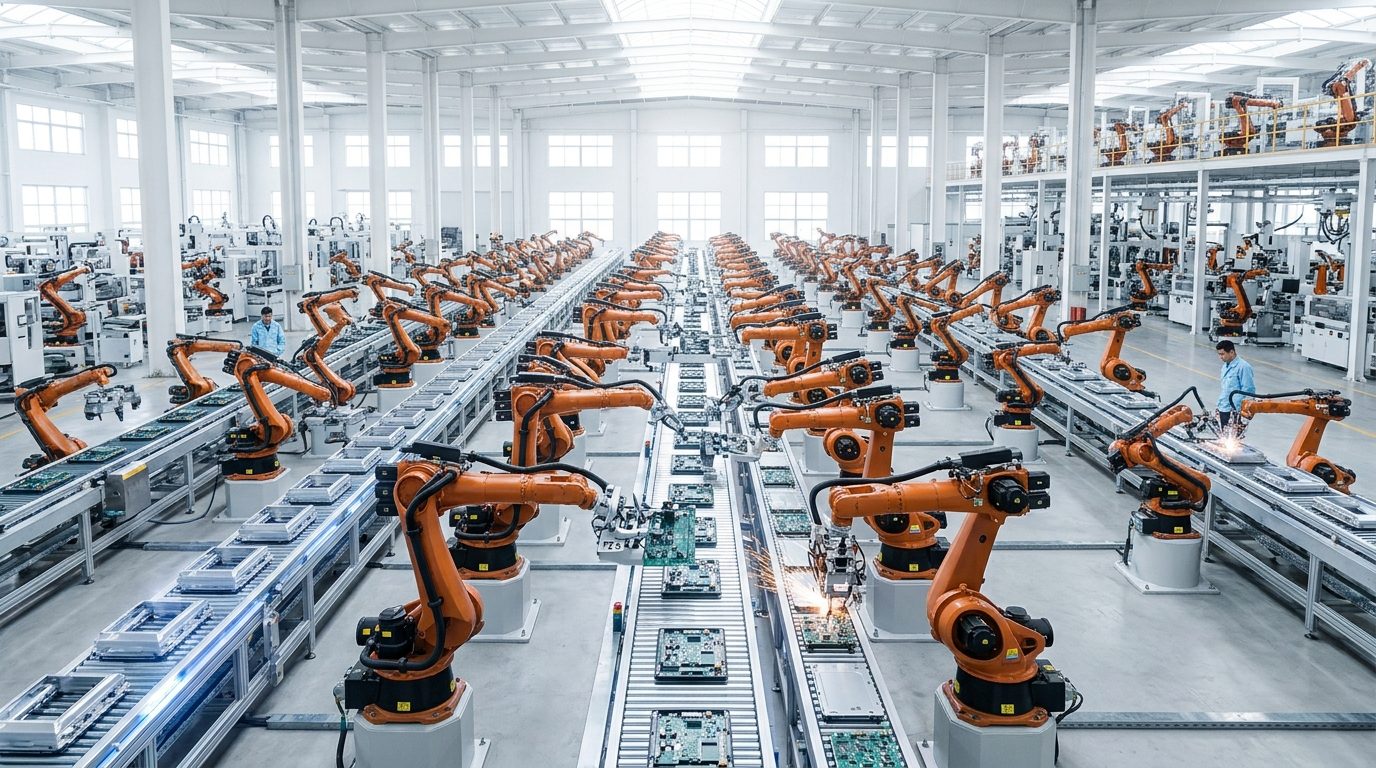
More than two million robots are working in China’s factories, signaling a rapid expansion of automation across the country’s vast manufacturing sector. The growing fleet is changing how goods are produced and how companies plan for labor, costs, and global competition.
The reported total covers factories across China, though no industry breakdown or measurement date was provided. Even so, the scale points to heavy investment in machines that can weld, assemble, paint, package, and move products.
Automation Reaches Massive Scale
China has spent decades building its role as a major manufacturing center. Its factories produce products ranging from consumer electronics and appliances to vehicles and industrial equipment.
That production base gives manufacturers many possible uses for robots. Large plants may deploy automated arms on assembly lines, while warehouses can use mobile machines to transport materials.
“There are more than two million robots working in China’s factories, and they are scaling up fast.”
The phrase scaling up fast suggests that the current total is not a fixed peak. Manufacturers appear set to install more machines as automation becomes available for additional production tasks.
However, the figure alone does not show how the robots are distributed. Some factories may operate highly automated lines, while smaller producers could still depend heavily on workers.
Why Factories Are Adding Robots
Industrial robots can perform repeated tasks with steady speed and precision. They can also handle dangerous work involving heat, heavy materials, sharp tools, or harmful substances.
Manufacturers may adopt automation for several reasons:
- To increase output and maintain consistent production.
- To reduce worker exposure to hazardous tasks.
- To improve accuracy and limit material waste.
- To address labor shortages or rising employment costs.
Robots also require major spending. Companies must buy equipment, redesign production lines, install safety systems, and employ technicians. Maintenance failures can interrupt an entire process, making skilled support essential.
Workers Face a Mixed Outlook
The effect on employment is unlikely to be uniform. Robots can replace some repetitive roles, especially where tasks follow predictable steps. That shift may place pressure on workers whose jobs center on manual assembly or material handling.
Automation can also create demand for different skills. Factories need employees who can program machines, inspect automated work, repair equipment, and manage production data.
This creates a training challenge. Workers may need access to technical education before they can move into new roles. Without effective retraining, the gains from automation could be unevenly shared.
Global Manufacturers Will Watch Closely
China’s robot fleet may affect producers outside the country. Greater output and lower unit costs could strengthen Chinese factories in export markets. Competitors may respond by increasing their own automation spending.
Yet robot numbers do not provide a complete measure of productivity. Results also depend on machine quality, worker skills, energy costs, supply chains, and how well equipment is integrated into factory operations.
The two-million figure shows that factory automation in China is already operating at immense scale. The next questions concern where new robots will be installed, how quickly deployment will grow, and whether workers can gain the skills required by more automated plants.
Future reporting will need detailed figures by industry, region, and task. Those data will help show whether rapid robot growth produces broad productivity gains or sharper disruption across China’s manufacturing workforce.

Deanna Ritchie is a managing editor at DevX. She has a degree in English Literature. She has written 2000+ articles on getting out of debt and mastering your finances. She has edited over 60,000 articles in her life. She has a passion for helping writers inspire others through their words. Deanna has also been an editor at Entrepreneur Magazine and ReadWrite.