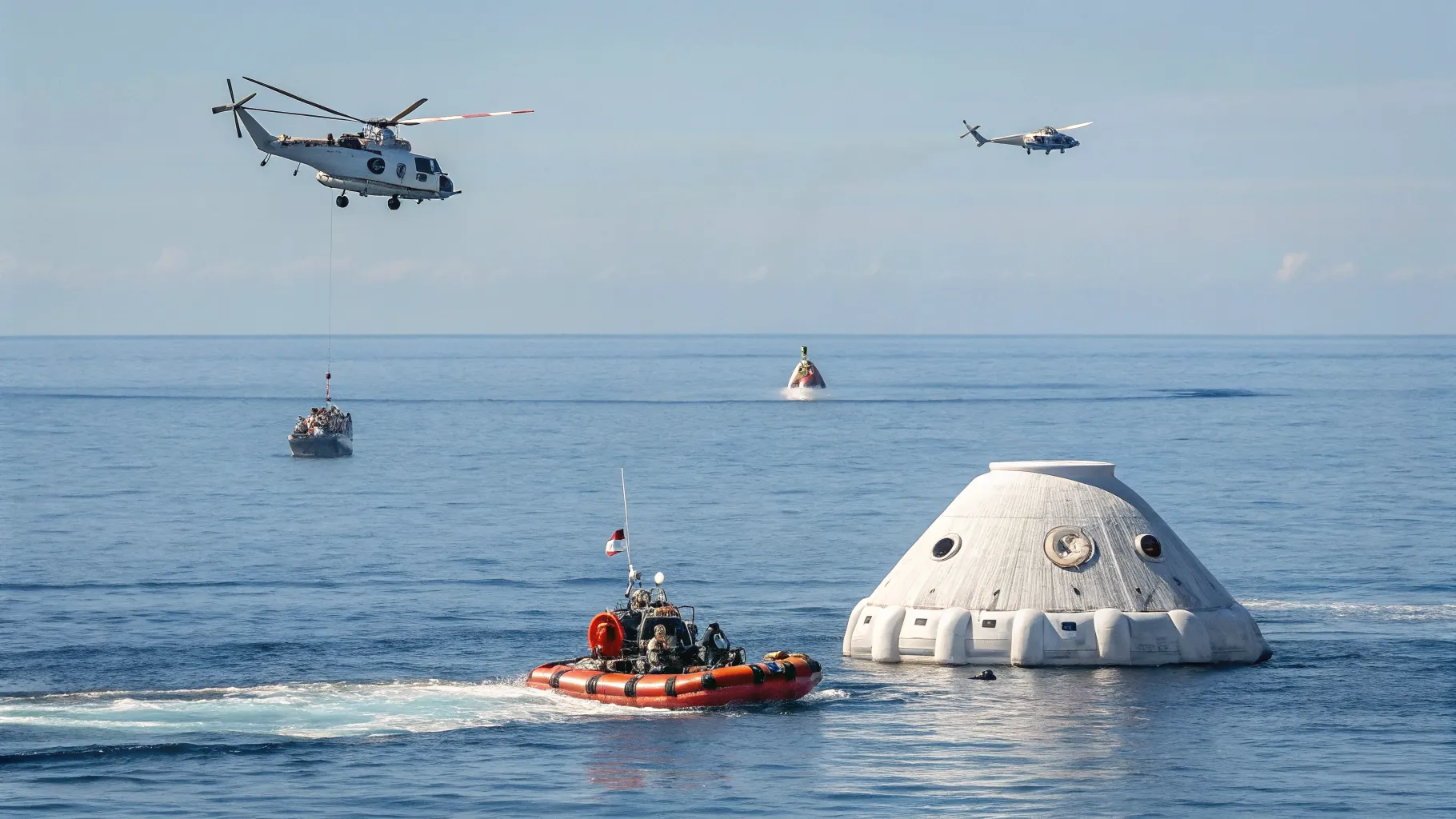
Four astronauts returned safely to Earth after their Orion capsule splashed down in the Pacific Ocean, completing the first crewed trip around the moon since 1972. The landing capped a high-stakes test of NASA’s deep space system and marked a new turn for human spaceflight. Recovery crews moved in after splashdown as mission teams began post-flight checks.
Why This Flight Matters
The mission marked the first time in more than five decades that people traveled to lunar distance. The last crew to venture that far was Apollo 17 in December 1972. Since then, human spaceflight has stayed in low-Earth orbit, centered on the Space Shuttle and the International Space Station.
NASA has aimed to send crews back toward the moon to test new hardware and operations. The Orion spacecraft is designed for long-duration deep space travel, including high-speed re-entry and ocean recovery. This flight’s goals included proving life-support systems, communication links at lunar distance, and navigation near the moon.
“Four astronauts and their Orion space capsule splashed down in the Pacific Ocean, ending the first crewed trip around the moon since 1972.”
What We Know About Splashdown
Orion returned at high speed and re-entered Earth’s atmosphere using a heat shield built for deep space conditions. The parachute system deployed to slow the capsule before it hit the water. Recovery teams then secured the spacecraft and began standard safety checks for the crew.
Such water landings are designed to give crews a stable, predictable end to a long mission. The Pacific recovery zone offers favorable weather windows and room for tracking ships and aircraft.
Historical Context and Program Goals
The Apollo program sent 24 astronauts to lunar distance between 1968 and 1972. Twelve walked on the moon. When Apollo ended, budgets shifted and focus moved to reusable spacecraft and orbital research. Deep space flight faded from routine operations.
The current program seeks to build a repeatable path to lunar missions. That includes testing new rockets, Orion, and ground systems. The long-term plan involves sustained operations near the moon, possible surface expeditions, and partnerships with other space agencies and companies.
- First crewed lunar-distance flight since Apollo 17 (1972).
- Ocean landing using parachutes and recovery teams.
- Key objectives: life support, communications, navigation, and re-entry.
What Experts Are Watching
Aerospace analysts point to three questions after splashdown. First, did the capsule’s heat shield and parachutes perform as designed during high-speed re-entry. Second, how did life-support and cabin systems hold up over the full flight near the moon. Third, what telemetry reveals about navigation and communications during the far-side phases, where radio blackouts can occur.
Engineers will study every phase from launch through landing. Any issues found in sensors, valves, thermal protection, or software could lead to design updates before future flights. This loop—fly, inspect, and improve—has long guided crewed spaceflight safety.
Costs, Risks, and Public Interest
Supporters argue crewed missions inspire study in science and engineering and help develop new technology for power, propulsion, and materials. They also say a return to the moon could build skills needed for missions to Mars one day.
Critics question the expense and argue that robots can collect data at lower cost and risk. They also urge transparent reporting on test results and future schedules. Safety advocates stress that even proven systems carry risk at lunar re-entry speeds, which are higher than returns from low-Earth orbit.
What Comes Next
Post-flight inspections will guide planning for the next mission in the sequence. If systems performed as expected, teams can move ahead with more complex objectives. That could include longer missions at lunar distance and integrated tests with landers or lunar-orbit platforms.
Program leaders will likely brief the public after a detailed data review. Schedules may shift depending on what engineers find. Procurement for hardware, training for crews, and coordination with international partners will follow the technical decisions.
The safe splashdown closes a key chapter for deep space travel. The mission restored human presence to lunar distance and provided data that will shape the next steps. The focus now turns to what the inspection reveals, how fast teams can address any issues, and when the next flight will aim for the moon. For a new generation, the path to deep space is open again, with careful testing guiding each move.

Senior Software Engineer with a passion for building practical, user-centric applications. He specializes in full-stack development with a strong focus on crafting elegant, performant interfaces and scalable backend solutions. With experience leading teams and delivering robust, end-to-end products, he thrives on solving complex problems through clean and efficient code.