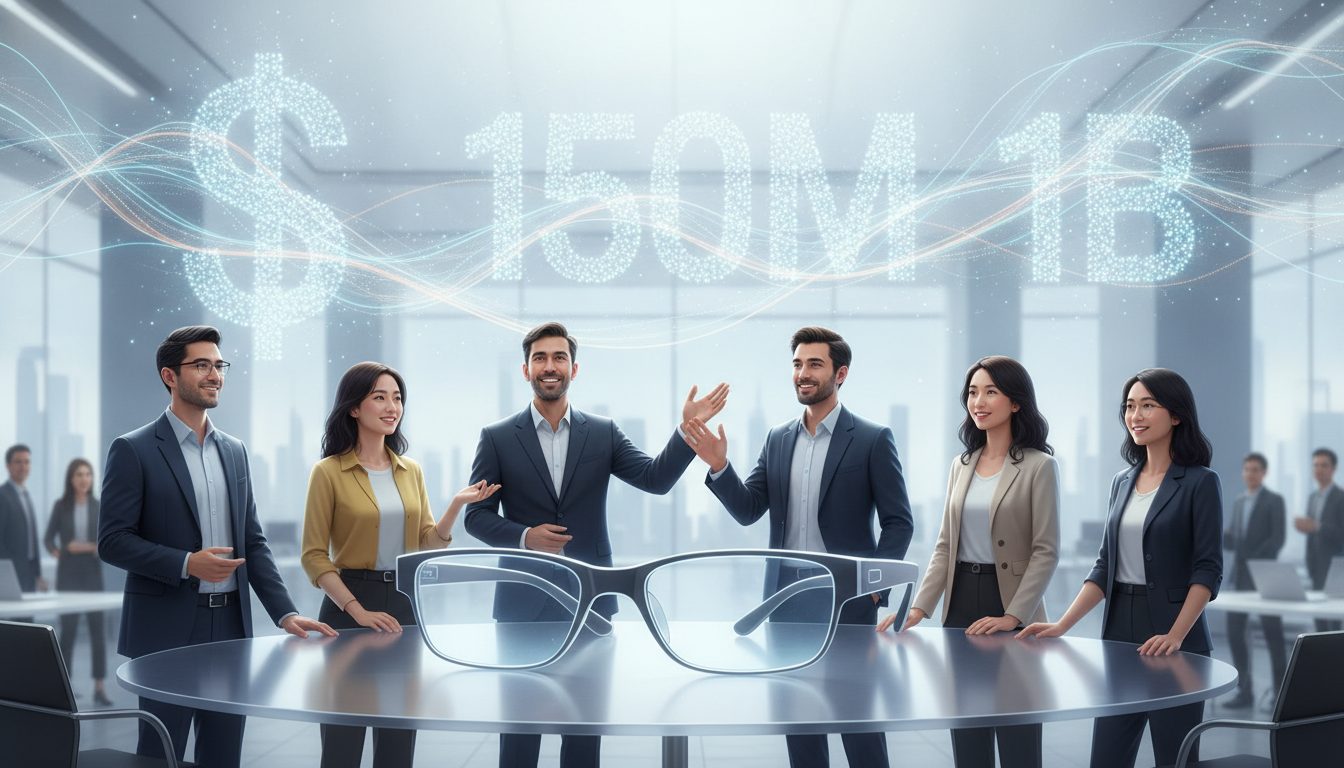
A startup formed by former Apple employees has secured $150 million to build camera-free smart glasses, reaching a $1 billion valuation with backing from Meituan and Tencent. The funding signals fresh momentum in wearable computing as the company pursues a privacy-first design for everyday use.
The deal brings two of China’s largest internet firms into the project, suggesting a push for consumer-scale services that work on the face, not the phone. The company, Even Realities, did not share a launch date, but the round positions it as a new entrant in a category long seen as promising yet difficult to crack.
Funding Round and Valuation
Even Realities raised $150 million in new capital. The round sets the company’s valuation at $1 billion. That level places the startup among the latest “unicorns” in hardware and consumer tech.
Investment from Meituan and Tencent brings both capital and access to large ecosystems. The funds will likely go to product development, software, and go-to-market planning. It also reflects investor confidence that a fresh approach to smart glasses can reach mainstream users.
Product Vision: Camera-Free Smart Glasses
Even Realities is focused on glasses without a camera. That choice is unusual in a field where many devices lean on built-in cameras for computer vision and media capture. A camera-free approach could help with comfort in public spaces, where recording concerns have slowed adoption of earlier products.
The design suggests the team may emphasize displays, audio, sensors, and on-device intelligence while leaving out a visible lens. That could reduce social friction and improve battery life. It also challenges the company to deliver useful features without live video capture.
Strategic Backing From Chinese Tech Giants
Meituan and Tencent operate massive platforms for commerce, social, and entertainment. Their involvement hints at potential services for navigation, local discovery, messaging, and payments designed for quick, heads-up interactions.
Partnerships of this type can speed content and developer support. They could also ease market entry in Asia if the product scales globally. The trade-offs include aligning hardware choices with large service ecosystems while keeping the device simple and private.
Market Context and Challenges
Smart glasses have had false starts. Earlier products struggled with bulk, limited battery life, and social pushback over recording. Recent consumer models focus on style and audio, while mixed reality headsets target high-end experiences but remain heavy and costly.
Even Realities is betting that removing the camera may solve one of the category’s biggest hurdles: trust in shared spaces. But the company must still deliver clear value for daily use. Navigation, quick answers, discreet prompts, and hands-free access to services are likely candidates.
- Opportunity: Everyday utility without privacy concerns tied to cameras.
- Risk: Fewer features if video capture and computer vision are off the table.
- Key test: Comfort, battery life, and software that feels helpful, not distracting.
What to Watch
Execution will matter. Hardware fit and finish, lightweight frames, and reliable connectivity are essential. So are voice, gesture, or subtle inputs that feel natural. Pricing and retail strategy will shape demand at launch.
The investors’ reach could help with content and distribution. If Even Realities can ship a stylish pair that delivers quick, private, and useful moments, it could move the needle for wearables. If not, it risks joining a long list of ambitious attempts that never found daily use.
For now, the funding and valuation point to strong belief in a privacy-forward path for smart glasses. The next milestones to track are product reveals, developer tools, and early pilot programs. Those signals will show whether camera-free can unlock a new wave of face-worn computing.

A seasoned technology executive with a proven record of developing and executing innovative strategies to scale high-growth SaaS platforms and enterprise solutions. As a hands-on CTO and systems architect, he combines technical excellence with visionary leadership to drive organizational success.