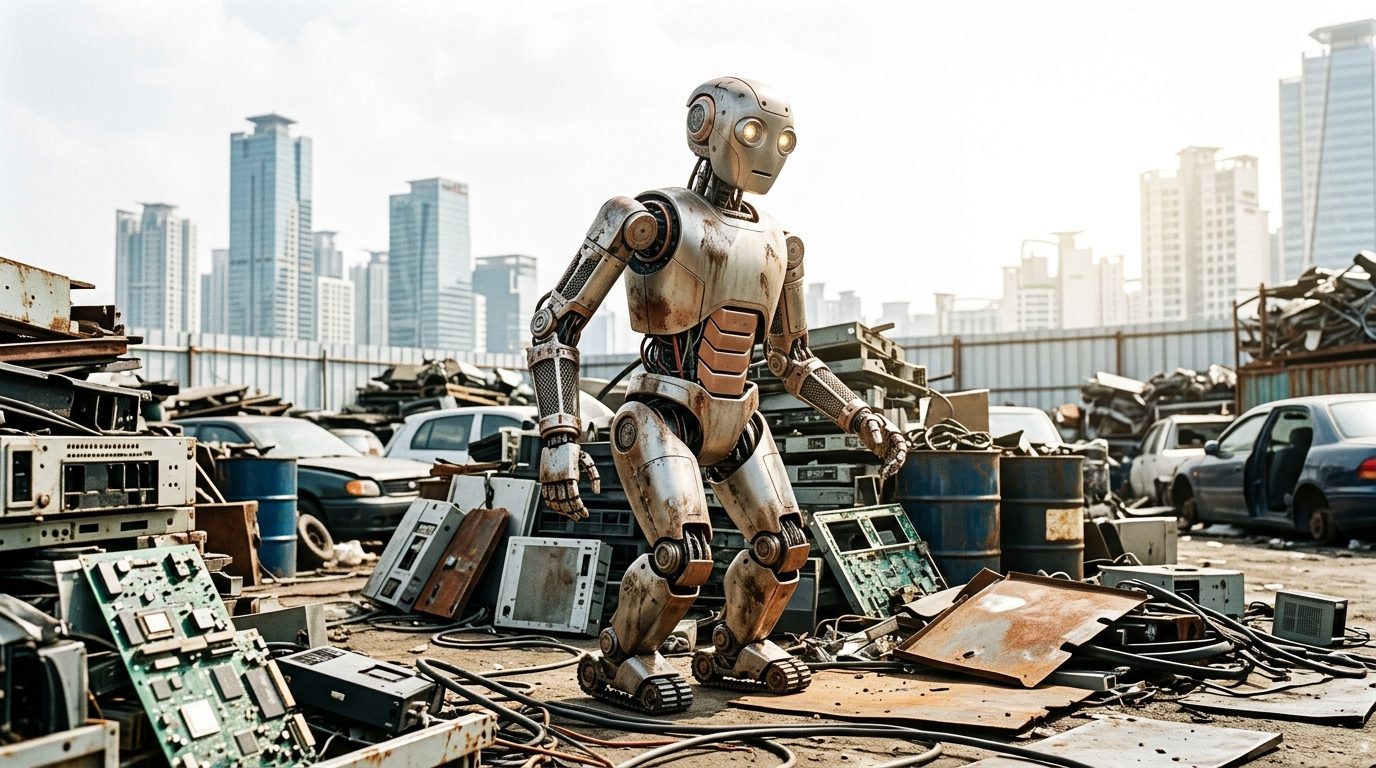
A mysterious robot found in a Seoul salvage yard takes center stage in Luminous, the May selection for the New Scientist Book Club.
The featured extract places readers in a future reunified Korea. Its opening premise mixes science fiction, political imagination and questions about discarded technology. Few plot details have been disclosed, leaving the robot’s origin and purpose unresolved.
A Discovery Among Discarded Machines
The salvage yard setting frames the robot as both valuable and unwanted. Such locations hold machines that society has judged obsolete, damaged or unprofitable. Finding an unusual robot there raises an immediate question: Was it abandoned, hidden or simply misunderstood?
“We meet a mysterious robot discovered in a salvage yard in Seoul, in a future reunified Korea.”
That brief description gives the discovery two layers. The first concerns the machine itself. The second concerns the society surrounding it, including how that society uses and disposes of advanced technology.
The extract’s focus on a robot also connects with current public debates about artificial intelligence and automation. Machines now perform more workplace tasks, while AI systems influence education, media and business. Fiction can test the social effects of those changes without claiming to predict them.
Reunification Shapes the Fictional Setting
The choice of a reunified Korea adds political weight to the story. The Korean Peninsula has remained divided since the Korean War armistice of 1953. South Korea and North Korea developed under sharply different political and economic systems.
Reunification has long appeared in diplomacy, public debate and Korean fiction. Yet the book’s future setting should be read as a fictional device, not a forecast. It allows the story to consider how Seoul and the wider peninsula might change after a major political shift.
A reunified state could face difficult questions involving identity, infrastructure, security and unequal access to technology. Placing a robot in a salvage yard may reflect those pressures. Old systems could exist beside advanced machines, while people decide what should be preserved or replaced.
Science Fiction Tests Human Choices
Robot stories often ask whether intelligence depends on biology, programming or lived experience. A discarded machine can sharpen that debate because its social status may not match its abilities.
The premise points readers to several core questions:
- Who built the robot, and why was it discarded?
- Does the machine possess memory, agency or legal rights?
- How has reunification changed Seoul’s technology and social order?
The salvage-yard discovery may also examine the economic cost of rapid innovation. New products can make working devices seem outdated. That cycle produces waste and can hide the labor, materials and data built into each machine.
A Book Club Choice With Timely Themes
New Scientist’s selection positions Luminous for discussion at a moment of intense interest in intelligent machines. The extract offers no firm answers about the robot, but its setting creates room to discuss responsibility, identity and political change.
The next details to watch are the robot’s history and the meaning of reunification within the novel. Together, those elements will show whether the machine is a relic, a threat or evidence of a society still deciding what progress should mean.

A seasoned technology executive with a proven record of developing and executing innovative strategies to scale high-growth SaaS platforms and enterprise solutions. As a hands-on CTO and systems architect, he combines technical excellence with visionary leadership to drive organizational success.