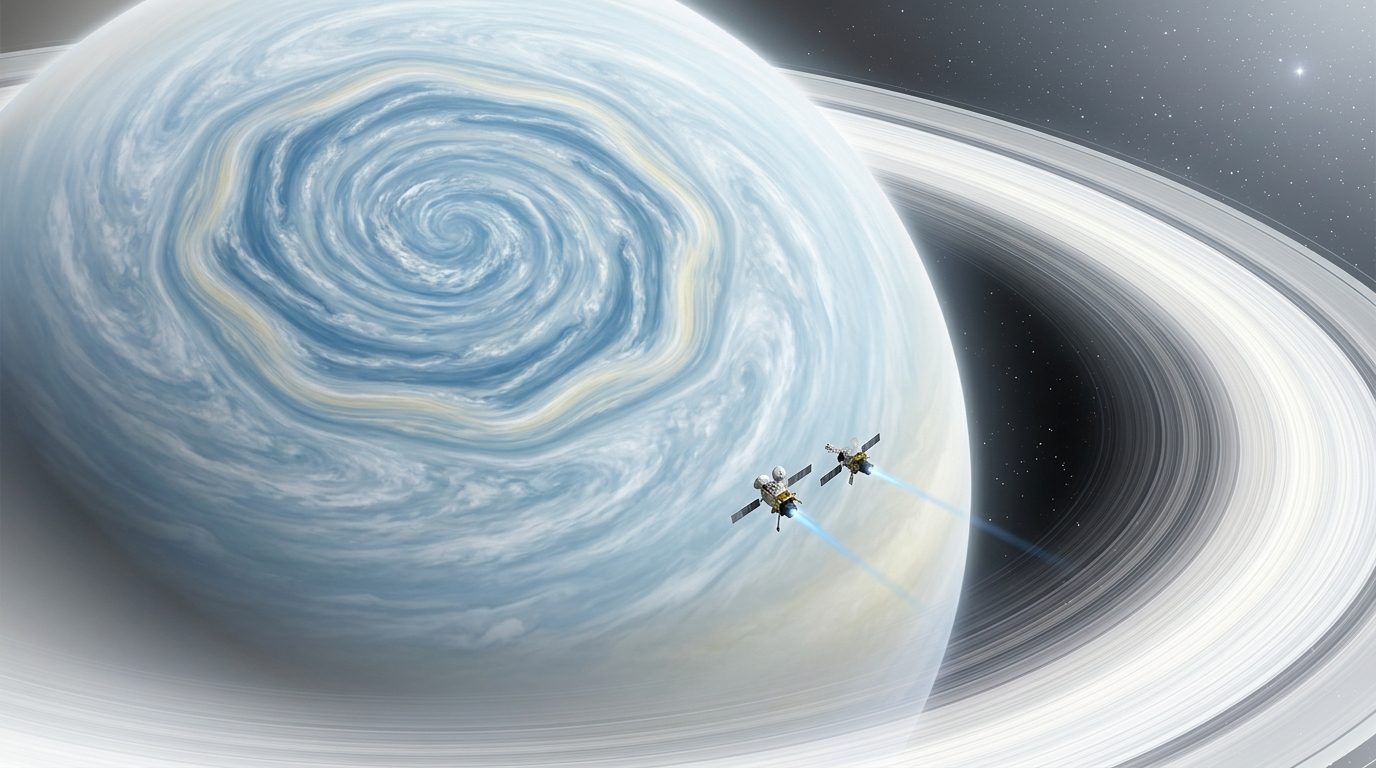
Scientists have identified an enormous 10-sided wave pattern in Saturn’s icy ammonia clouds, adding an unexpected feature to the planet’s turbulent south pole.
The reported formation resembles a decagon when viewed from above. Its discovery may help researchers study how Saturn’s winds, clouds, and polar storms interact within the giant planet’s atmosphere.
A New Shape at Saturn’s South Pole
The pattern appears in clouds containing frozen ammonia, a common material in Saturn’s upper atmosphere. Scientists described it as an “enormous 10-sided wave pattern”, although its exact size and stability were not specified.
Polygon-shaped atmospheric waves can form when fast-moving winds encounter slower air. The difference in speed may organize clouds into repeating bends. Scientists will need more observations to determine whether this process produced the newly reported decagon.
Several basic questions remain open:
- How large is the 10-sided structure?
- How quickly does it rotate around the pole?
- Is it stable or temporary?
- Does it extend deep into Saturn’s atmosphere?
Answers could show whether the formation is a lasting feature or a brief result of changing weather. Saturn’s seasons last far longer than Earth’s because the planet takes about 29 years to orbit the Sun.
Comparison With Saturn’s Northern Hexagon
Saturn is already known for a geometric cloud formation at its north pole. That six-sided jet stream, called the northern hexagon, was first observed by NASA’s Voyager spacecraft in the early 1980s.
NASA’s Cassini mission later studied the hexagon in greater detail. Cassini orbited Saturn from 2004 until 2017 and recorded changes in the feature’s clouds, colors, and surrounding winds.
The northern hexagon is generally understood as a wave within a powerful eastward-flowing jet. Laboratory experiments and computer models have shown that rotating fluids can produce polygonal patterns under certain conditions.
A southern decagon would present an important comparison. Ten sides could point to different wind speeds, atmospheric depths, or pressure conditions at the opposite pole. It may also test whether one theory can explain both formations.
Why Polar Weather Matters
Saturn’s south pole has long been associated with a large vortex. Earlier spacecraft observations showed a storm system with a distinct central eye and tall surrounding clouds.
That region receives changing amounts of sunlight as Saturn moves through its long seasons. Shifts in solar heating can alter temperatures and winds, which may affect the shape and strength of polar waves.
Researchers can use cloud movement to estimate wind speeds and track atmospheric circulation. Infrared measurements can also reveal temperatures and structures hidden beneath visible cloud layers.
Still, images alone may not establish how the decagonal pattern formed. Scientists would need observations taken over time, along with atmospheric models, to rule out viewing effects or a short-lived disturbance.
Future Observations Could Test Its Stability
The end of the Cassini mission left scientists without a dedicated spacecraft at Saturn. Current research often relies on archived Cassini data and observations from powerful telescopes near Earth or in space.
Repeated imaging will be important. If the 10-sided wave remains fixed around the south pole, it could represent a stable jet-stream pattern. If it changes quickly, it may instead reflect temporary turbulence.
The discovery offers a new test for models of giant-planet weather. It may also support comparisons with Jupiter, Neptune, and rotating atmospheric systems outside the solar system.
For now, the reported decagon adds a fresh mystery to Saturn’s poles. Its duration, motion, and depth will determine whether it joins the northern hexagon as one of the solar system’s most distinctive atmospheric structures.

Deanna Ritchie is a managing editor at DevX. She has a degree in English Literature. She has written 2000+ articles on getting out of debt and mastering your finances. She has edited over 60,000 articles in her life. She has a passion for helping writers inspire others through their words. Deanna has also been an editor at Entrepreneur Magazine and ReadWrite.