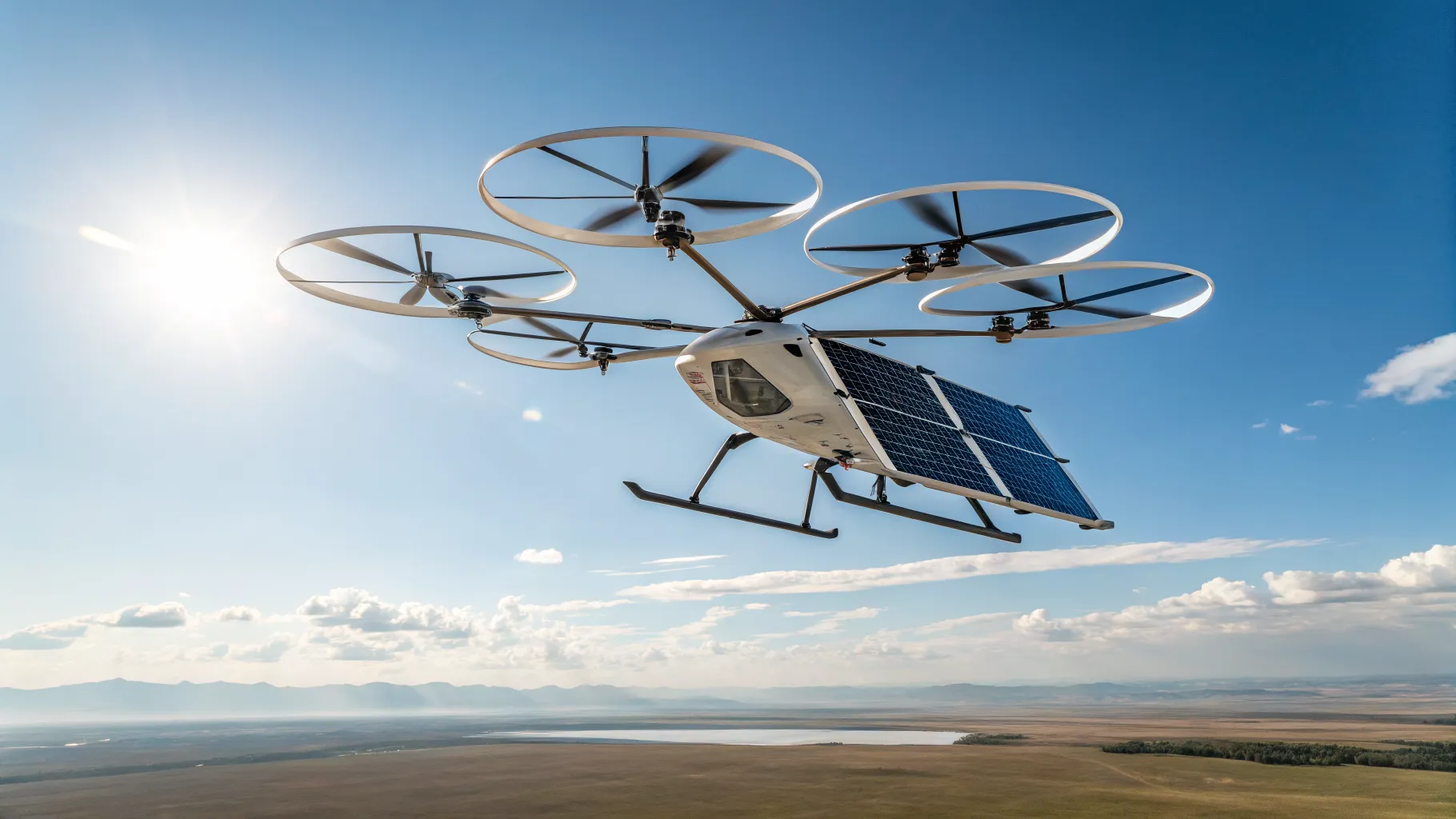
A homebuilt solar-powered drone has pushed the limits of electric multirotors, staying aloft for more than five hours on a sunny day before its pilot decided to bring it down. South African creator Luke Bell, working with his father Mike, reported a flight time of 5 hours, 2 minutes, and 21 seconds, a duration that would place their craft among the longest-flying multirotors to date.
The test took place under clear skies, using sunlight as the main energy source for propulsion. The record remains unofficial, but the claim has drawn attention because most consumer multirotors fly for about half an hour on a single battery. This result hints at new possibilities for long-duration electric flight without swapping packs or landing to recharge.
“Their new solar-powered drone – running on sunlight and almost nothing else – just claimed an unofficial endurance record for electric multirotors, flying for 5 hours, 2 minutes, and 21 seconds before Luke simply got tired and landed it.”
A Sun-Powered Flight That Lasted Hours
Bell’s approach focuses on harvesting steady solar input while minimizing weight and power draw. Multirotors consume more energy than fixed-wing aircraft because they must constantly generate lift. That makes long flights difficult without large batteries, which add weight and reduce efficiency. By feeding sunlight directly into the power system, the Bells lowered the battery burden during peak daylight.
The team did not disclose all technical details. Still, the core idea is clear: large, lightweight solar panels, high-efficiency motors, careful propeller selection, and a tuned power controller. The result is a drone that can hover or cruise gently while panels offset much of the energy demand when the sun is high.
How Solar Changes Multirotor Limits
Solar has been a proven aid for fixed-wing unmanned aircraft, which glide and need less power. Doing the same on a multirotor is harder. Even small inefficiencies add up. Weight from panels and wiring can erase any gains. The Bells’ flight suggests a careful balance can pay off.
Typical consumer craft fly 20–40 minutes. Professional inspection drones could reach an hour with larger packs. Crossing the five-hour mark, even once, shows how direct solar input can extend endurance far beyond common expectations for hovering platforms.
Verification and Missing Details
The claim is not yet recognized by any record body, and the flight conditions were not independently verified. Endurance can depend on:
- Sun angle and cloud cover during the test.
- Wind speed and flight profile, such as hover or slow cruise.
- Payload weight and airframe size.
- Panel efficiency and power electronics losses.
Without a third-party log, exact comparisons are tricky. Data from onboard telemetry, a continuous video record, and a witnessed start and stop would help confirm the result. Even so, the flight offers a proof of concept that others can test and refine.
Why Endurance Matters
Longer flight time can change how drones are used. Survey teams can map larger areas in one shift. Conservation groups can watch wildlife or coastlines without frequent landings. First responders could keep a camera in the sky during extended operations, as long as weather allows.
There are trade-offs. Solar drones rely on clear skies and midday light. Night missions still need batteries. Panels can be fragile. Safety rules also limit where and how long small drones can fly, regardless of energy source. Any move to field use would need rugged hardware and compliance with local aviation rules.
What Comes Next
If other builders reproduce the five-hour flight, interest in solar-assisted multirotors will grow. The next steps include controlled trials that log position, altitude, current draw, and solar input. A standard test protocol would allow fair comparisons between designs and weather conditions.
Manufacturers may watch closely. Even modest solar gains could help in daylight patrols and static overwatch. The Bells’ project shows that a careful, efficient build can squeeze more time from the sky. Whether it becomes a common feature will depend on panel durability, cost, and how well systems handle variable light.
For now, the message is simple. With a clear day and a well-tuned airframe, a multirotor can stay up far longer than many thought possible. The claim is unofficial, but it points to a path worth testing. Expect more experiments, more data, and a push to see how far sunlight alone can take a hovering drone.

Senior Software Engineer with a passion for building practical, user-centric applications. He specializes in full-stack development with a strong focus on crafting elegant, performant interfaces and scalable backend solutions. With experience leading teams and delivering robust, end-to-end products, he thrives on solving complex problems through clean and efficient code.