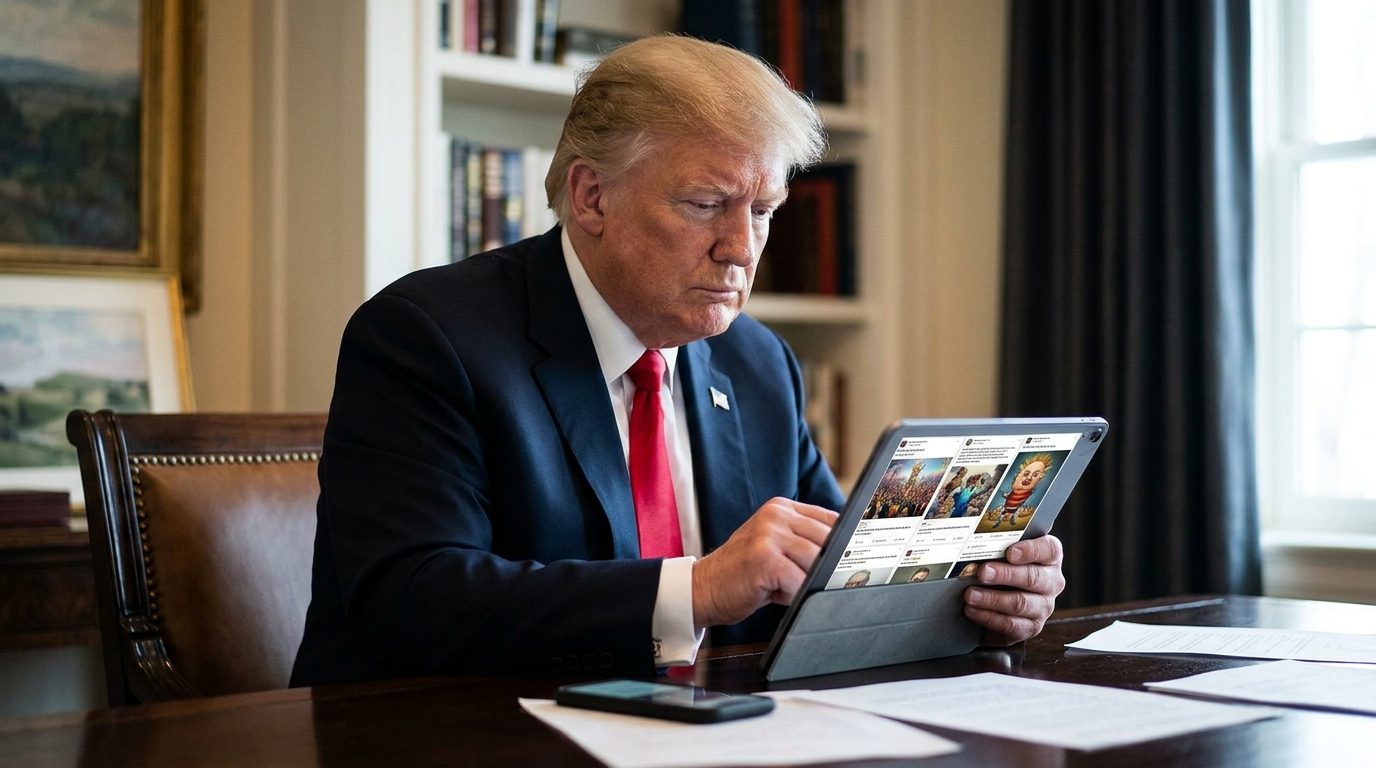
U.S. President Donald Trump posted a stream of AI-generated images and broad, unverified claims on Truth Social on Sunday, raising fresh questions about political misinformation and synthetic media.
The posts mixed computer-generated visuals with assertions that lacked public verification. Their subjects and supporting evidence were not detailed. That limits any independent assessment of the individual claims.
Still, the episode carries wider importance. A president’s social media account can shape public debate, influence news coverage, and reach supporters before fact-checkers respond.
AI Images Complicate Political Communication
Artificial intelligence can produce realistic images within seconds. Such material may be humorous or clearly fictional, but it can also confuse viewers if labels and context are missing.
Political figures have long used edited photographs, cartoons, and dramatic graphics. AI tools make production cheaper and faster. They also make altered scenes harder to identify at a glance.
The Sunday posts were described as “a stream of AI-generated images”. That wording suggests repeated use rather than one isolated picture. No information was provided about whether each image carried an AI label.
Several basic questions affect how audiences should judge synthetic political content:
- Was the image clearly marked as AI-generated?
- Could a reasonable viewer mistake it for a real event?
- Did the post link the image to a factual claim?
- Was evidence offered for the accompanying statement?
Unverified Claims Demand Separate Review
The accompanying assertions were characterized as “sweeping and unverified claims.” An unverified claim is not automatically false. It means available evidence has not established that it is accurate.
That distinction matters in responsible reporting. News organizations generally seek documents, named sources, official records, direct observations, or other evidence before presenting a disputed statement as fact.
The lack of detail about Trump’s specific claims prevents a claim-by-claim review. It also prevents a fair account of possible responses from people or institutions mentioned in the posts.
Readers should therefore avoid drawing conclusions about each assertion without seeing its wording and evidence. The strongest confirmed point is that the president used AI imagery while publishing claims that had not been substantiated.
Truth Social Gives Trump Direct Reach
Truth Social is Trump’s preferred platform for direct public communication. Posts there can quickly move into television coverage, online commentary, and wider political discussion.
That reach can compress the time available for verification. A striking image may circulate through screenshots before journalists establish its origin or before platforms add context.
The issue also creates competing concerns. Political leaders retain broad freedom to express opinions and share satire. At the same time, their official status gives their statements unusual weight.
Platforms face similar pressures. Labels can help users recognize synthetic media, but labels may be inconsistent or removed when content is copied elsewhere. Aggressive moderation can also prompt claims of political bias.
What Comes Next
The immediate need is greater transparency about the Sunday posts. Clear AI labels, links to evidence, and prompt corrections would help the public separate fabricated scenes from documented events.
Journalists and readers will also need to examine each claim on its own merits. Visual impact should not substitute for proof, and an AI image should not be treated as evidence merely because a senior official shared it.
The episode shows how presidential communication and synthetic media are becoming closely linked. What matters next is whether the claims are supported, whether the images were clearly identified, and how widely the material spreads before verification catches up.

Deanna Ritchie is a managing editor at DevX. She has a degree in English Literature. She has written 2000+ articles on getting out of debt and mastering your finances. She has edited over 60,000 articles in her life. She has a passion for helping writers inspire others through their words. Deanna has also been an editor at Entrepreneur Magazine and ReadWrite.