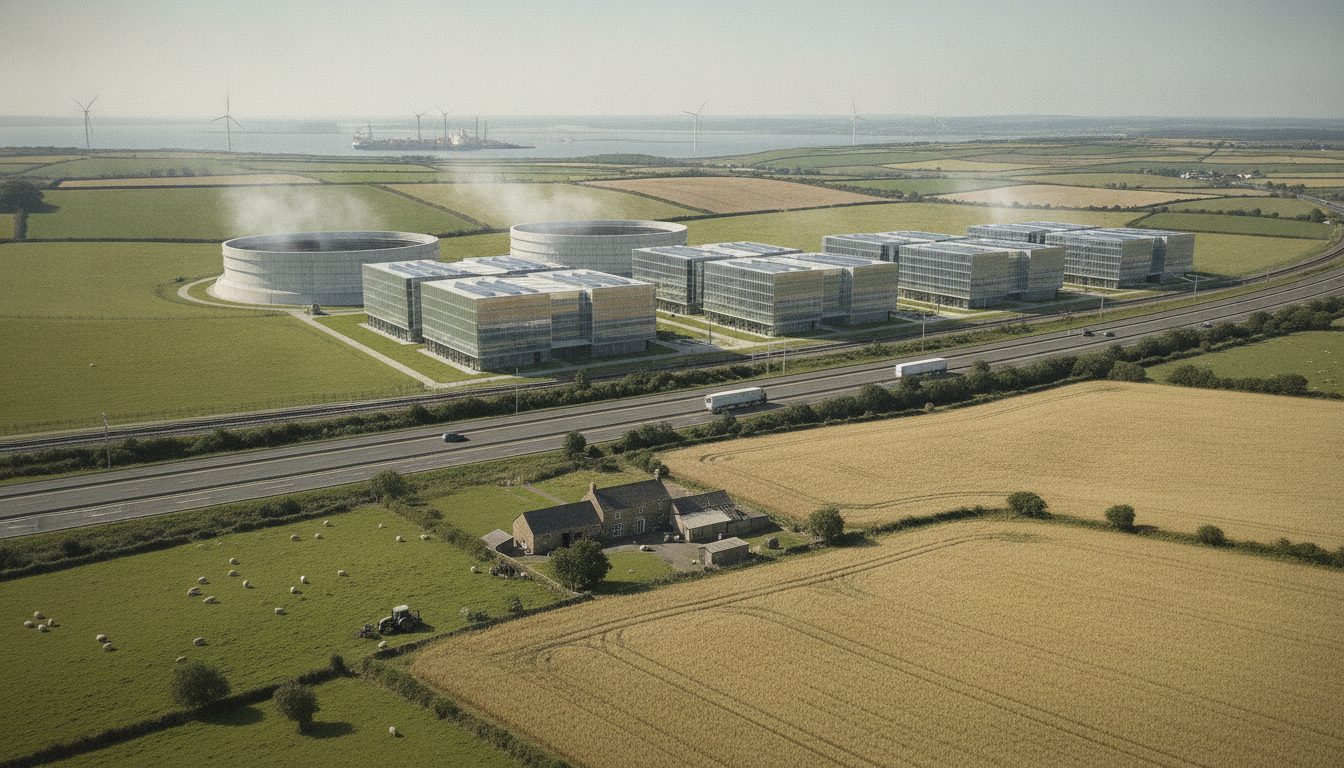
A private firm is seeking to build a data center on agricultural land at West Sleekburn in Northumberland, setting up a test of growth, food security, and rural policy. The site sits near the estuary and transport links serving South East Northumberland. The plan would need local approval and could face close scrutiny over power use, water demand, and the loss of farmland.
A firm wants to build a data centre on agricultural land at West Sleekburn in Northumberland.
The bid comes as demand for digital storage and computing rises across the UK. Local leaders have pushed to attract investment to former industrial areas near Blyth and Cambois. Residents and farmers are likely to ask how such a project fits with local plans and national rules on land use.
The Site and the Pitch
West Sleekburn lies close to energy and port projects on the Northumberland coast. That corridor has seen new interest due to offshore wind assembly, battery plants, and cable links. A data center would tie into that trend by seeking strong grid access and fast fiber routes.
Building on farmland is sensitive. Agricultural plots help local growers and keep open space between villages. Converting fields to a large, secure campus would change views and daily traffic. The firm has not been named, and no design details are public. But such sites often include server halls, switchgear, water or air cooling, high-security fencing, and backup generators.
Planning Rules and the Loss of Farmland
The project would require planning permission from Northumberland County Council. National policy encourages using previously developed sites where possible. It also protects the best and most versatile farmland. Officers will weigh if this field is lower-grade land, and whether no suitable brownfield plot exists nearby.
Key tests in the planning process typically include visual impact, noise, flood risk, traffic, ecology, and heritage. If the scheme is large, an environmental assessment may be needed. The council will also examine energy sources, carbon impact, and how the design reduces heat and emissions.
- Is there a proven need at this location?
- Can it connect safely to the grid and fiber?
- Are water and drainage plans sustainable?
- Are there alternatives on industrial land?
Power, Water, and Connectivity
Data centers run 24 hours a day and need steady power. Northumberland’s coast hosts substations and renewable projects, which may help grid access. But connection queues are tight in parts of the UK. The developer will have to show a firm plan for electricity, backup systems, and noise control.
Cooling can require large volumes of water or efficient air systems. That raises questions about local supply, discharge, and river health. Planners will look for closed-loop cooling, reuse of waste heat, and limits on generator testing to protect air quality.
Economic Promise and Local Concerns
Supporters will point to construction jobs, supply contracts, and long-term technical roles. They argue that digital services need capacity outside the South East, and that the North East can host secure infrastructure. They also say a modern facility can run on cleaner power and offer heat to nearby buildings.
Opponents may stress the loss of productive fields and the risk to food resilience. They worry about noise, light spill, and diesel use during outages. Some residents fear traffic during construction and round-the-clock operations. Farmers and environmental groups often ask that such projects go to brownfield plots first.
Independent analysts note that local tax receipts can rise with large sites. But they also warn that long-term employment at data centers can be modest once the build is complete. The balance between regional growth and land protection will be central to the debate.
What to Watch
The next step is a formal planning application, public notices, and consultation. Parish councils, residents, and statutory bodies will submit views. The council may ask for design changes, stronger mitigation, or proof of site selection work.
Points that could decide the outcome include the quality of the farmland, the availability of brownfield alternatives, and the strength of the energy and water plans. Clear benefits, such as heat reuse or local training, could carry weight. Weak evidence on site choice or environmental controls could stall the bid.
The proposal in West Sleekburn signals growing pressure to place digital infrastructure in rural settings. The decision will show how Northumberland weighs farmland, climate targets, and new industry. Residents should watch for the application filing, consultation dates, and any revised plans that respond to early feedback.

Kirstie a technology news reporter at DevX. She reports on emerging technologies and startups waiting to skyrocket.