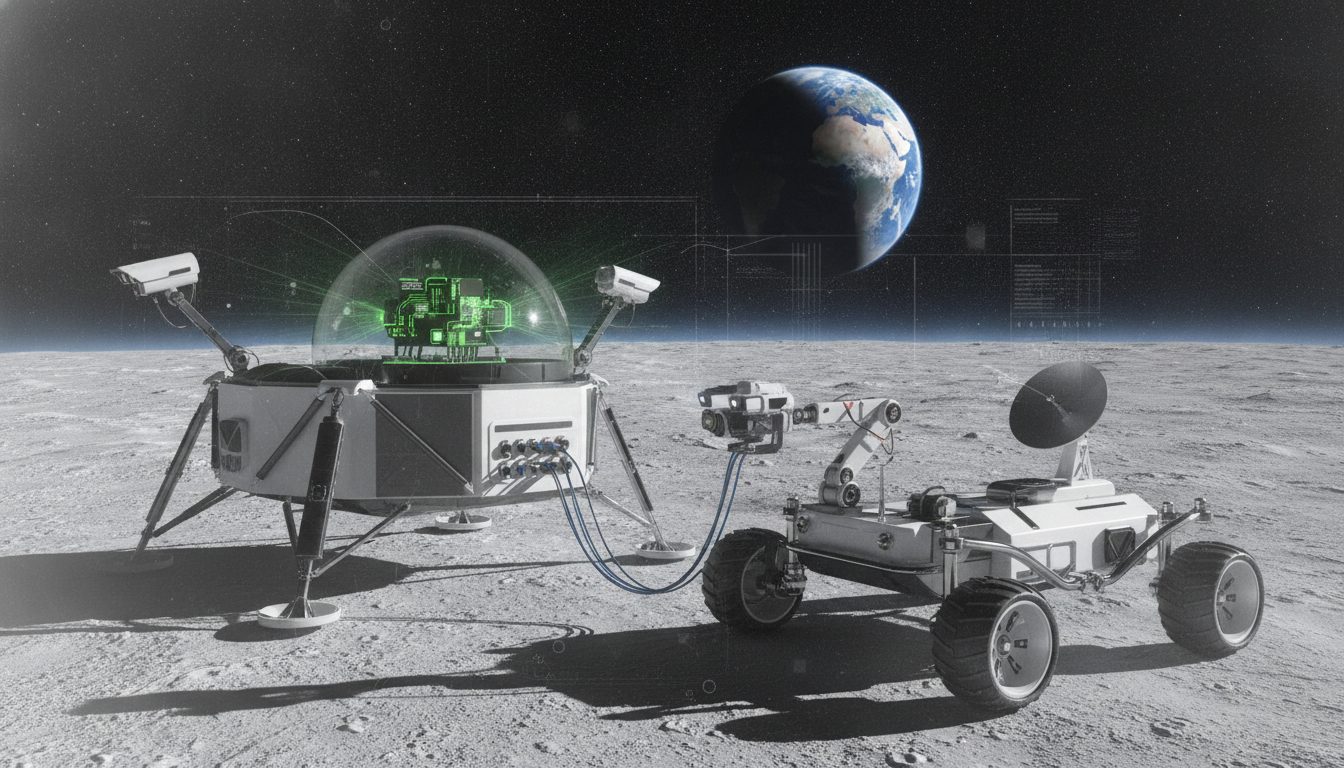
A new moon imaging service called Ocula plans to run artificial intelligence directly in space, using NVIDIA’s Jetson platform to process data at the edge instead of sending everything to Earth. The NVIDIA Inception startup says the approach will speed up analysis and reduce costly downlinks for lunar missions, signaling a shift in how spaceborne sensors turn raw pixels into timely insights.
The NVIDIA Inception member’s Ocula moon imaging service will harness the NVIDIA Jetson platform for edge AI, running inference directly in space to significantly accelerate insights compared with downlinking all data back down to Earth.
Why Process Data in Space
Spacecraft gather far more data than they can transmit. Imaging payloads can capture gigabytes in minutes, but radio links are constrained by power, antenna size, and limited ground station time. For lunar missions, the round-trip signal delay is short, but bandwidth is still a choke point. Compressing, filtering, and labeling data before transmission helps mission teams focus on the frames that matter.
Onboard AI adds another layer. Models can detect features, rank image quality, and flag anomalies without human input. This cuts the number of files that need to be sent and speeds decision-making. For a commercial imaging service, that can mean faster delivery to researchers, space agencies, and industry customers.
How Jetson Enables Edge AI Off-Earth
NVIDIA’s Jetson line is widely used for edge computing on Earth, from drones to industrial cameras. In orbit or on deep-space paths, the same idea applies: put compute power next to the sensor. Ocula plans to use Jetson to run inference, which means executing trained models to classify scenes, detect objects, and select data to keep or discard.
Running inference in space reduces the need for constant contact with ground networks. It also allows near-real-time responses, such as retasking a camera, adjusting exposure, or queuing a higher-resolution pass over a promising site.
- Less data to downlink, saving time and resources.
- Faster insights for mission control and end users.
- Greater autonomy for spacecraft operations.
Industry Momentum and Comparisons
Edge AI in orbit has moved from pilot to practice. Earth-observation satellites already use onboard models to filter clouds and prioritize clear shots. The same logic extends to lunar missions, where targets can be more specific and imaging windows tighter. Ocula’s plan aligns with a wider push to make spacecraft smarter, not just better connected.
The model is simple: treat communications as a scarce resource and push intelligence to the source of data. Compared with traditional workflows that send everything to Earth for processing, AI triage can lift the value of every minute of contact time. It also supports smaller, lower-cost spacecraft that cannot carry high-rate radios.
Technical Hurdles and Risk
Space is a harsh place for electronics. Radiation can upset memory and cause faults. Power budgets are tight, and thermal control is hard. Any edge platform must be tested for resilience and safeguarded with error-correction and watchdog systems. Updating AI models over the air adds flexibility, but it also requires careful validation.
There are trade-offs. Aggressive filtering could discard data that later proves useful. Transparent thresholds, audit logs, and the option to store raw frames for brief periods can help. The goal is to screen noise without losing signal.
Implications for Science and Commerce
Lunar exploration is shifting from sporadic missions to more regular flights by agencies and private firms. Imaging supports landing site selection, resource scouting, and environmental tracking. Faster analysis can tighten feedback loops, guide follow-on observations, and reduce mission costs.
Commercial users may seek change detection, surface classification, or rapid alerts for events such as dust plumes or hardware performance on the lunar surface. With in-space inference, those results can arrive sooner, even when downlink windows are short.
What to Watch Next
Key milestones will include on-orbit or lunar orbit demonstrations, published performance metrics, and evidence of reliable operations over weeks and months. Observers will look for quantifiable gains, such as the percentage reduction in downlinked volume and the time saved from capture to insight.
Partnerships with payload integrators, lunar landers, and relay networks will matter. Standardized interfaces and model update pipelines can make edge AI a routine part of mission planning rather than a custom add-on.
Ocula’s plan to use NVIDIA Jetson for lunar imaging highlights a practical shift: do more with data where it is created. If the system proves reliable, missions could move faster, send less, and learn more. The next phase is real-world validation, where performance, reliability, and smart safeguards will decide how widely this model spreads across lunar and deep-space projects.

A seasoned technology executive with a proven record of developing and executing innovative strategies to scale high-growth SaaS platforms and enterprise solutions. As a hands-on CTO and systems architect, he combines technical excellence with visionary leadership to drive organizational success.