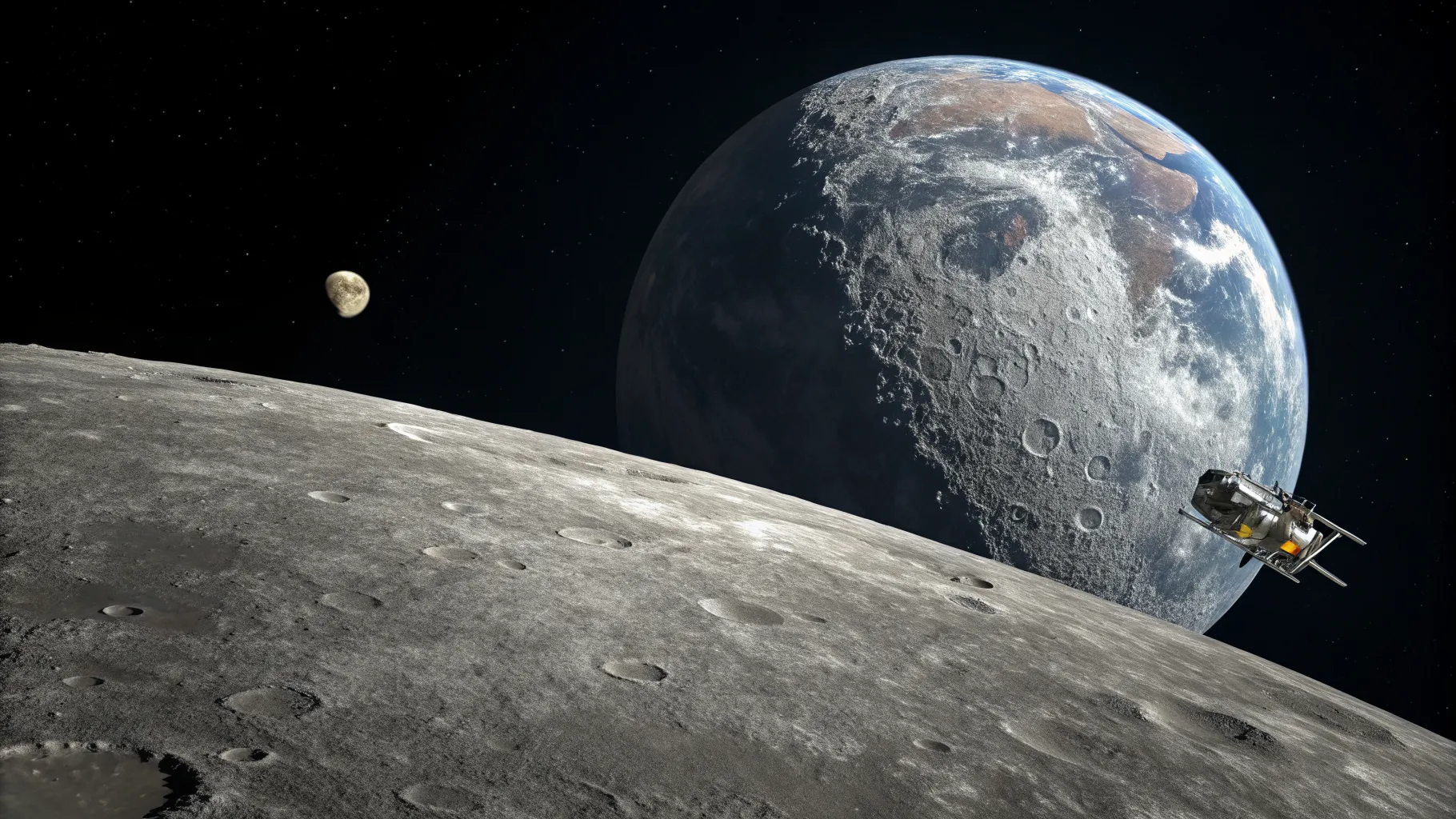
A planned lunar flyby will send astronauts farther from Earth than any crew in history, according to mission planners, setting up a record-setting pass as the spacecraft arcs past the Moon. The crew will travel to a point roughly 10,300 kilometers past the lunar far side before heading home. The flight path was chosen to balance safety, fuel, communications, and mission goals.
The plan revives a style of flight not used since the Apollo era. NASA records show Apollo 13 set the standing mark in 1970, reaching about 400,171 kilometers from Earth while executing a lifesaving free-return loop. The new mission aims to exceed that range by adjusting timing and geometry to take advantage of the Moon’s position and a carefully designed arc around the far side.
“The astronauts will arrive about 10,300 kilometers beyond our satellite, breaking all previous records for distance from Earth. But how was their route chosen?”
Why This Route Was Selected
Mission designers favored a free-return trajectory that bends the spacecraft around the Moon and sends it back to Earth without a major engine burn if problems arise. This approach reduces risk while still meeting the goal of crewed travel past the lunar far side. It also supports key test objectives for life support, navigation, and deep-space communications.
Planners shaped the path to hit specific lighting and temperature conditions. The spacecraft must stay within safe thermal limits, avoid prolonged darkness, and present good solar array angles. The route also lines up with tracking passes from ground stations and relay assets, keeping communications active during the most sensitive phases.
Safety, Fuel, and Communications Trade-Offs
Every kilometer added to the loop affects fuel margins, heat management, and reentry targeting. Engineers set guardrails on engine firings to protect reserves for contingencies. They also refined the timing so the spacecraft returns to an Earth entry corridor that avoids steep angles and high g-loads.
Navigation teams account for gravitational tugs from Earth and the Moon, plus small forces like solar radiation pressure. These factors can nudge the flight path. The plan includes short correction burns to keep the spacecraft on course, with larger margins than typical low-Earth-orbit missions.
- Free-return loop provides a built-in path home.
- Thermal and lighting limits shape timing and altitude.
- Fuel reserves protect against late-course surprises.
- Ground tracking and relay coverage reduce blackout risk.
A New Mark in Human Distance
A pass roughly 10,300 kilometers past the lunar far side would set a new human distance record if the Moon’s position and Earth-Moon range line up as planned. The previous record, set by the Apollo 13 crew of Jim Lovell, Jack Swigert, and Fred Haise, stood for more than five decades. This mission’s planned arc is designed to push that boundary while keeping a conservative safety posture.
Experts say the value is not just the number. A stable, repeatable profile gives crews and controllers practice for longer trips. It helps validate life support at distance, tests communications handoffs near lunar occultations, and sharpens procedures for navigation in cislunar space.
Implications for Future Flights
The route serves as a building block for missions that will later enter lunar orbit or rendezvous with staging platforms. A well-characterized free-return path can act as a safety net for more complex plans. It also gathers data on radiation levels, deep-space crew workload, and long-duration systems behavior that are important for extended stays near the Moon.
Program officials point to three expected outcomes. First, better confidence in guidance, navigation, and control at range. Second, improved models for thermal and power performance in deep space. Third, clearer rules for how much margin to keep in fuel and timeline planning.
NASA’s historical data from Apollo and modern deep-space probes inform these models. The combination helps reduce uncertainties that would otherwise force extra fuel or limit mission scope. Teams will compare predicted and actual performance from this flight to refine future profiles.
The upcoming flyby blends ambition with caution. It seeks a headline record while keeping a tested path home. If the plan holds, the crew will briefly become the most distant humans in history, then steer back to a precise splashdown. The result could reset expectations for crewed operations near the Moon and set the stage for more complex missions to follow. Watch for final trajectory updates, which will confirm the exact timing, altitude, and distance as the launch window nears.

Rashan is a seasoned technology journalist and visionary leader serving as the Editor-in-Chief of DevX.com, a leading online publication focused on software development, programming languages, and emerging technologies. With his deep expertise in the tech industry and her passion for empowering developers, Rashan has transformed DevX.com into a vibrant hub of knowledge and innovation. Reach out to Rashan at [email protected]