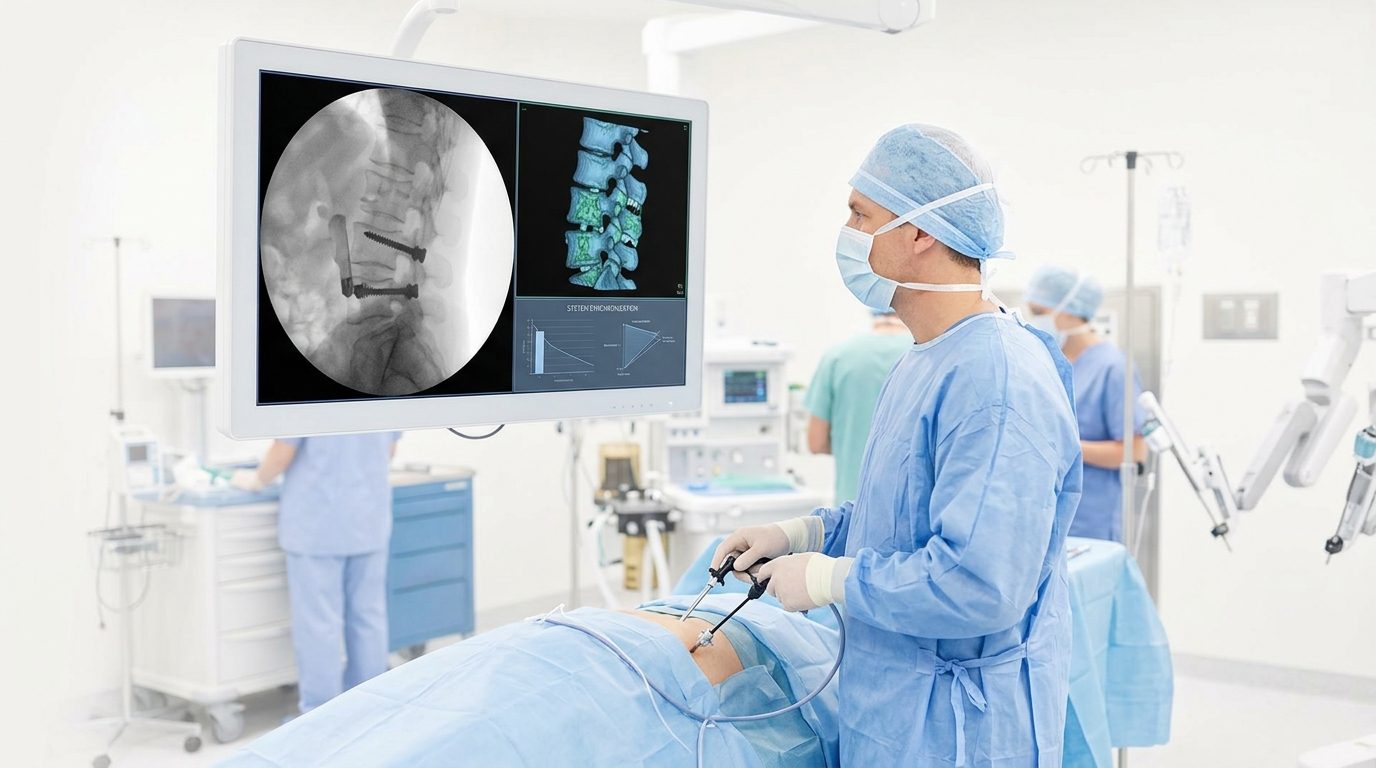
Researchers have designed an artificial intelligence system that could make minimally invasive surgery faster and safer by linking real-time X-rays with preoperative 3D scans.
The system rapidly matches images captured during an operation to the patient’s earlier medical scan. This process could help surgical teams locate instruments and internal structures without relying on large incisions.
The early description does not identify the researchers, institution, testing results, or publication date. Those details will be needed to judge the system’s accuracy and readiness for clinical use.
Connecting Two Types of Medical Images
Minimally invasive procedures often use small incisions and specialized instruments. Surgeons may view live X-ray images to understand where those instruments are inside the body.
Preoperative 3D scans provide richer anatomical detail. However, matching those scans with two-dimensional X-rays taken during surgery can be difficult and time-consuming.
The AI-driven system is intended to perform that matching rapidly. If it works reliably, surgeons could compare the current X-ray view with a detailed model of the patient’s anatomy.
This process, often described as image registration, must account for differences in viewing angle and patient position. Anatomy may also shift between the original scan and the operation.
Potential Gains for Surgical Teams
Faster image matching could give clinicians clearer guidance while a procedure is underway. The likely benefits center on speed, positioning, and situational awareness.
- Quicker alignment of live X-rays and preoperative scans
- Better guidance around sensitive anatomical structures
- Less time spent manually comparing medical images
- Potential support for more precise instrument placement
These gains could be important during procedures where small errors carry serious consequences. Better image alignment may help teams confirm their location before advancing an instrument or implant.
Yet the available information does not show whether the technology reduces complications, operating time, or radiation exposure. Those outcomes would require controlled studies involving patients and existing clinical methods.
Safety Depends on Reliable Performance
Medical AI tools face a high standard because an incorrect match could mislead clinicians. A system may perform well under laboratory conditions but struggle with unusual anatomy, poor image quality, or surgical movement.
Researchers will need to test whether performance remains stable across different patients, scanners, hospitals, and procedures. Studies should also measure how quickly the system produces a match and how often clinicians must correct it.
Human oversight will remain important. The software would serve as a guidance tool, while trained surgical teams would retain responsibility for interpreting images and making decisions.
Hospitals would also need clear plans for technical failures. Surgeons must be able to continue safely if the software produces uncertain results or becomes unavailable during an operation.
Evidence Will Determine Clinical Use
Before routine adoption, the system would likely require clinical validation and review under the relevant medical-device rules. Developers may also need to explain how patient imaging data is stored, processed, and protected.
Cost and workflow will influence adoption as well. Hospitals must assess whether the software works with existing imaging equipment and whether staff need added training.
The proposed system addresses a practical surgical problem: turning separate images into useful guidance within the limited time of an operation. Its value, however, will depend on independent testing against current techniques.
The next developments to watch are peer-reviewed results, patient studies, error rates, and comparisons with experienced clinicians. If those findings confirm safe and rapid performance, AI-assisted image matching could become a useful aid for minimally invasive surgery.

Deanna Ritchie is a managing editor at DevX. She has a degree in English Literature. She has written 2000+ articles on getting out of debt and mastering your finances. She has edited over 60,000 articles in her life. She has a passion for helping writers inspire others through their words. Deanna has also been an editor at Entrepreneur Magazine and ReadWrite.