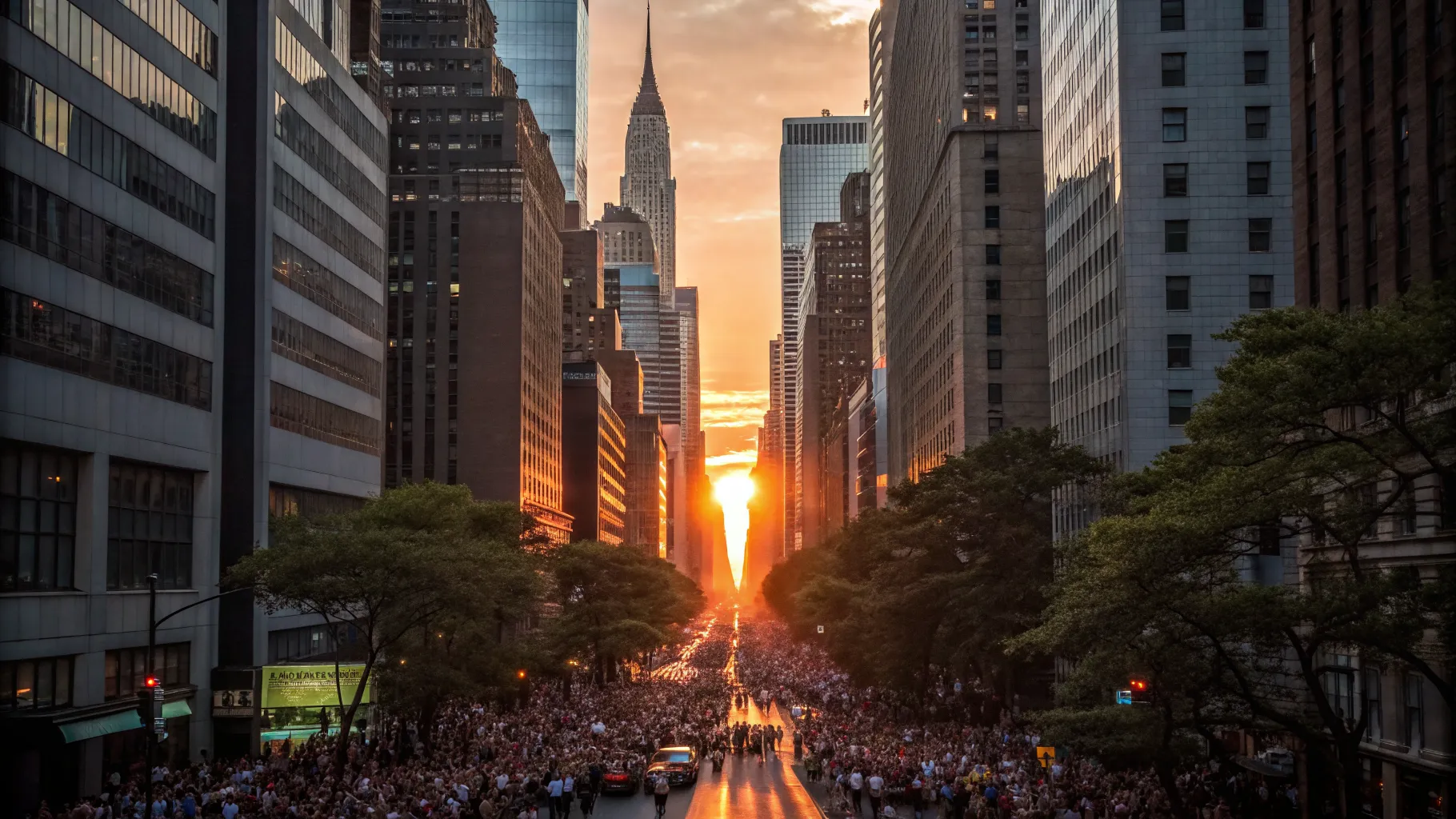
As the sun slides between Manhattan’s towers twice each year, thousands line the avenues to watch a brief, glowing corridor of light sweep across the city. The seasonal spectacle, known as Manhattanhenge, is expected to draw large crowds at key cross streets as the setting sun aligns with the island’s street grid, creating a postcard view framed by steel and glass.
The event typically arrives in late spring and mid-summer, depending on the year’s solar calendar and weather. Photographers, commuters, and tourists gather on wide east–west streets to see the orange disk settle neatly at the horizon. City officials often remind onlookers to keep sidewalks and crosswalks clear, as interest has surged in recent years.
What Is Manhattanhenge?
New York City residents and visitors are treated to a phenomenon twice a year known as Manhattanhenge, when the setting sun aligns with the Manhattan street grid and sinks below the horizon framed in a canyon of skyscrapers
The term “Manhattanhenge” was popularized by astrophysicist Neil deGrasse Tyson of the American Museum of Natural History. It draws a parallel to Stonehenge, where the stones align with the sun during solstices. In New York, the effect is urban, dramatic, and fleeting, lasting just a few minutes on each qualifying day.
What makes it distinctive is not a single date, but a pattern. Typically, two evenings feature a full sun sitting on the street horizon, and two evenings feature a half sun. The exact dates can shift by a day from year to year.
Why It Happens
Manhattan’s grid, laid out under the Commissioners’ Plan of 1811, is rotated roughly 29 degrees from true east–west. That tilt means the sun sets along the sightlines of the major crosstown streets only on select days each year, as Earth’s tilt and orbit change the sun’s position on the horizon through the seasons.
Unlike the summer solstice itself, which is fixed to a single day, the city’s alignment occurs before and after that point. The geometry is simple but exacting: a clear view to New Jersey’s horizon, a transparent band of sky, and a street corridor pointing toward the sunset.
Where and How to Watch
Experience and crowd behavior suggest that wider crosstown streets offer the best views. Bridges and elevated plazas also help by lifting sightlines above traffic. As interest has expanded, several locations have become favorites.
- 34th Street and 42nd Street, with views of landmarks like the Empire State Building and the Chrysler Building
- 57th Street and 23rd Street for broad sky and long corridors
- Tudor City overpasses on the East Side for elevated perspectives
- Queens spots facing Manhattan, such as Hunters Point South Park and the Queensboro Bridge area
Officials and seasoned viewers recommend arriving at least 30 minutes early to secure a spot and to account for the exact time the sun reaches street level. Sturdy tripods, while useful for photos, can crowd sidewalks; handheld setups are often easier. Sunglasses protect eyes, and crossing lanes should remain clear to keep traffic moving.
Weather, Timing, and Safety
Cloud cover is the main spoiler. Even thin clouds on the western horizon can scatter the light and hide the sun at the key moment. Haze and wildfire smoke, when present, can dim the disk but sometimes deepen the colors.
The New York Police Department typically manages crowds at the busiest intersections, and traffic agents may direct cars through heavy foot traffic. Onlookers are urged to stand back from the curb, obey signal lights, and avoid stepping into bike lanes while aiming cameras.
Cultural Pull and Economic Impact
Manhattanhenge has become a small seasonal draw for the city’s tourism economy. Hotels promote viewing tips, and social media fills with images that define New York’s summer mood. Local camera shops report higher foot traffic on event days.
For residents, the alignment offers a moment of calm in the evening rush. For visitors, it is an accessible, free experience that pairs skyline views with the day’s last light. City museums and science institutions often use the dates to explain urban planning, astronomy, and how a 19th-century grid created a 21st-century tradition.
What to Watch Next
Forecasts in the days ahead will determine whether the next alignment shows in full or fades behind clouds. Event timing tools from reputable astronomy sources can help pinpoint the minute the sun reaches street level for each viewing corridor.
As the city heads into summer, the alignment will repeat once more before the sun’s path shifts toward autumn. Crowds are expected to return, phones held high, waiting for the brief moment when avenue traffic pauses and the streets glow.
The draw endures because it is simple and shared: a city’s straight lines meeting nature’s clock. Expect packed corners, more photos, and one more chance this season to see the sun set in perfect alignment with New York’s grid.

Rashan is a seasoned technology journalist and visionary leader serving as the Editor-in-Chief of DevX.com, a leading online publication focused on software development, programming languages, and emerging technologies. With his deep expertise in the tech industry and her passion for empowering developers, Rashan has transformed DevX.com into a vibrant hub of knowledge and innovation. Reach out to Rashan at [email protected]