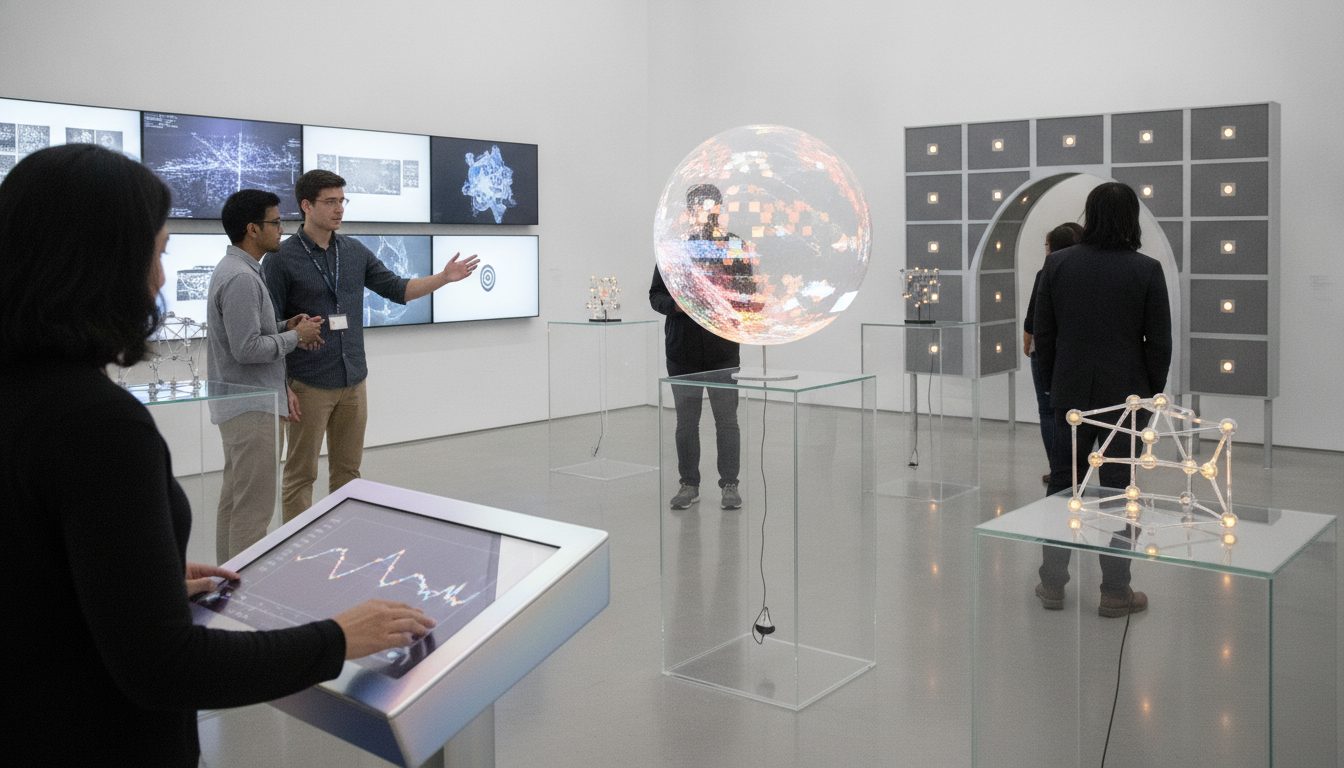
An MIT Keller Gallery show is asking how machines judge beauty and how people respond to it. The exhibition, led by MIT Architecture alumnus and researcher Alexandros Haridis, opens a window into the past and future of computational aesthetics through hands-on displays and physical installations.
Set on MIT’s campus, the project presents algorithms, machine learning systems, and theories of aesthetic judgment in forms that visitors can see and manipulate. It aims to make technical ideas tangible while inviting debate about what “taste” means when software enters the studio. The timing feels urgent as generative tools spread across art, architecture, and design classrooms.
Background: From Plotters to Machine Learning
The show sits on a long arc of computer-assisted art and design. Early experiments in the 1960s used plotters and simple rules to create lines and patterns. Designers later adopted scripting and parametric methods to automate form-finding. Today, machine learning models can analyze styles, label images, and generate visuals in seconds.
Across these waves, one question repeats: who is making the aesthetic call? The designer, the tool, the dataset, or the person who set the rules? Haridis’s project addresses that question by turning algorithms into objects and interactions that lay bare their choices and limits.
Inside the Exhibition
“MIT Architecture alumnus and researcher Alexandros Haridis explores the history of computational aesthetics in ‘Beyond Data-Driven Aesthetics,’ a Keller Gallery exhibition that translates algorithms, machine learning systems, and theories of aesthetic judgment into physical installations and interactive visualizations.”
The exhibition frames code not as a black box but as a set of decisions that can be tested in public. Visitors engage with interfaces that expose criteria such as symmetry, color contrast, or pattern density. Installations compare outputs under different rules, making trade-offs visible.
- Algorithms are presented as physical artifacts and visuals.
- Interactive stations invite side-by-side comparisons of results.
- Historical references link rule-based art to present tools.
By letting people modify inputs and see results, the show highlights how small parameter shifts lead to large aesthetic changes. That experience is difficult to grasp when work happens only on a screen.
How Machines “See” Taste
Machine learning systems often rely on labeled examples. They learn patterns from images that reflect human judgments, which can include bias or narrow preferences. When those systems score or generate designs, they may echo the limits of their training data.
The exhibition turns this issue into a learning moment. It asks viewers to compare machine judgments to their own and to consider what gets lost when quality is reduced to metrics. It also shows where metrics help, such as finding consistency across large sets or revealing hidden repetition and noise.
Design Education and Industry Impact
Design schools and studios face pressure to adopt generative tools. The promise is speed and breadth. The risk is a drift toward uniform styles shaped by popular datasets and standard prompts.
Haridis’s work suggests a middle path. Use algorithms to test options and see patterns faster. Keep human critique at the center. Frame models as collaborators that surface possibilities, not as final judges of value.
For practice, this approach may change workflows. Teams can set shared criteria, then measure them, while still leaving room for outliers that break rules and stand out. Such a mix can raise quality without flattening taste.
What Visitors Take Away
Visitors leave with a clearer sense of how code weighs choices and how those weights affect outcomes. They also see that aesthetic judgment is never neutral. It carries the marks of training data, authorship, and purpose.
By converting abstract systems into material form, the exhibition builds a shared language for critique. That language can help educators, students, and clients talk about value in a way that balances evidence with intuition.
The show closes on a practical note. Computational tools will keep shaping creative work. The next step is to pair transparent methods with open discussion about goals and criteria. Watch for studios and schools to seek tools that explain their scores, allow human overrides, and record how decisions were made. That mix—clear methods and active critique—may define the standard for judging beauty in the age of machines.

Rashan is a seasoned technology journalist and visionary leader serving as the Editor-in-Chief of DevX.com, a leading online publication focused on software development, programming languages, and emerging technologies. With his deep expertise in the tech industry and her passion for empowering developers, Rashan has transformed DevX.com into a vibrant hub of knowledge and innovation. Reach out to Rashan at [email protected]