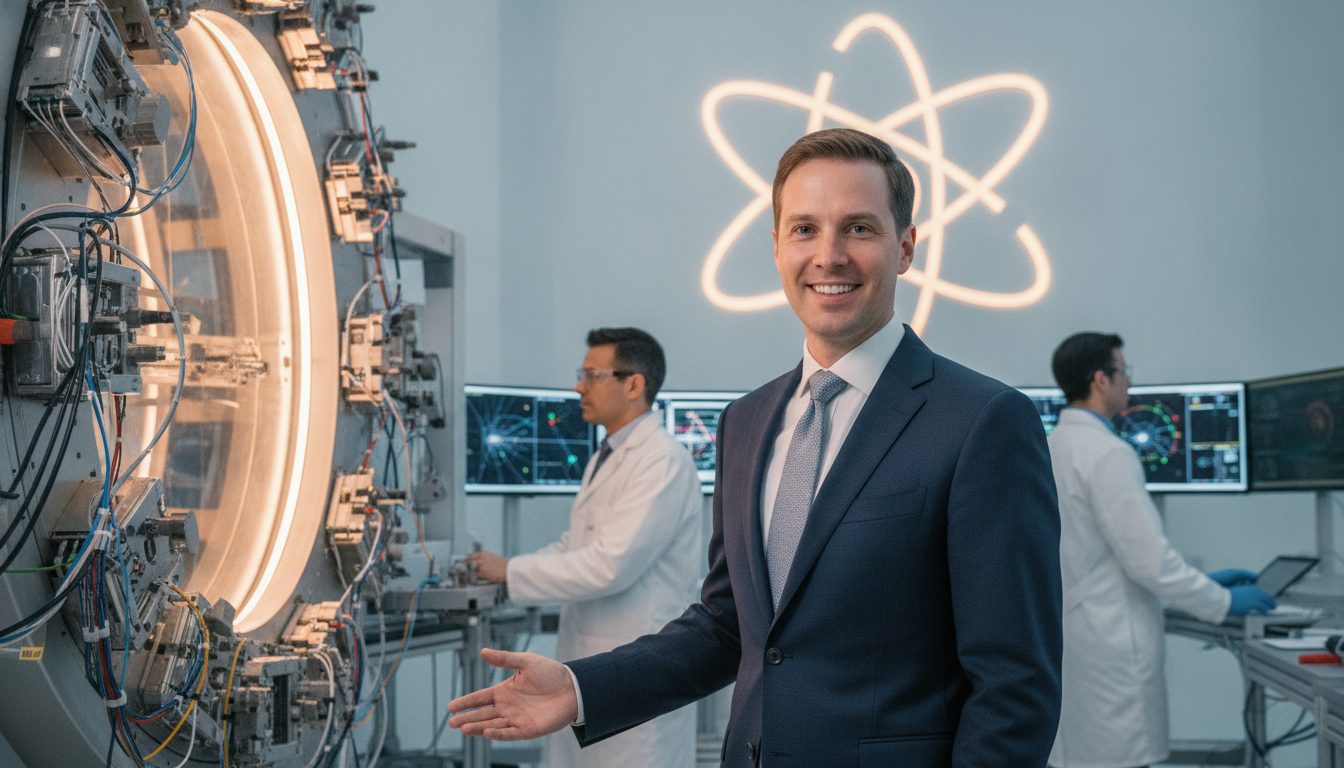
MIT has appointed Jesse Thaler as the new director of the Laboratory for Nuclear Science, placing a leading theorist at the helm of one of the institute’s core research units. The appointment brings a specialist in particle physics and modern computation into a key role at a time of rapid change in research methods.
Thaler is a theoretical particle physicist based at MIT. He is known for work that blends quantum field theory with machine learning. The laboratory conducts research on the building blocks of matter, from quarks to neutrinos, and collaborates widely with national labs and international experiments.
Background on the Laboratory for Nuclear Science
The Laboratory for Nuclear Science, founded after World War II, supports both experimental and theoretical programs. Its researchers have long contributed to high energy collider studies, neutrino physics, and nuclear structure. Many groups based at the lab work with facilities such as CERN, Fermilab, and other accelerator and detector projects.
MIT’s nuclear and particle programs have a history of training students who later join major experiments or lead theory efforts. The lab also hosts instrumentation and computing teams that build and analyze detectors and data systems.
Thaler’s Research Focus and Approach
Thaler’s work rises from open questions in fundamental physics. He studies the rules that govern particles and forces, then tests ideas against data. He is part of a new generation using data science to sift through complex signals from colliders and cosmic sources.
“Jesse Thaler has been named director of the MIT Laboratory for Nuclear Science.”
“Thaler is a theoretical particle physicist who combines techniques from quantum field theory and machine learning to address outstanding questions in fundamental physics.”
At colliders like the Large Hadron Collider, events can involve thousands of particles produced in a fraction of a second. Algorithms can help physicists tag jets, classify patterns, and search for rare processes. Thaler’s scholarship has helped formalize these tools so that models remain testable and transparent.
Why This Leadership Choice Matters Now
Physics is facing a data surge. Detectors are more sensitive, and upgrades will expand data rates. Teams need strategies that keep analyses reliable while speeding up discovery. Placing a theorist fluent in statistics and learning methods in a director role signals a push to align theory, computation, and experiment.
It also reflects a wider shift. Many groups worldwide are adopting open source software, shared datasets, and common benchmarks. These practices support reproducibility and help younger researchers build skills that work across projects.
Potential Priorities Under Thaler
While specific plans were not detailed, several areas stand out as likely focal points because they match current needs in nuclear and particle research:
- Building training pipelines in physics-informed machine learning.
- Strengthening links between theory and hardware groups for faster feedback.
- Expanding computing resources and data stewardship for large collaborations.
- Encouraging open practices, from code release to shared analysis workflows.
Balancing Promise and Caution
Machine learning can find patterns that are hard to spot by hand. Still, physicists must preserve interpretability and control uncertainties. The field is testing hybrid methods, where theory guides model design and calibration sets check performance. Thaler’s background suggests attention to both sides of this balance.
There is also a mission to keep core nuclear science strong. Detector development, accelerator physics, and precision measurements remain essential. A healthy program needs both exploratory tools and careful cross checks.
What This Means for Students and Collaborations
Students could see more chances to work at the interface of physics and computing. Interdisciplinary seminars and shared software projects may grow. Closer ties with computer science, statistics, and engineering would support this shift.
On the collaboration front, the lab may look to deepen roles in global efforts that need advanced analysis, such as collider upgrades and next-generation neutrino experiments. Partnerships with national labs and industry could follow, focused on data systems, accelerators, and sensors.
The appointment places a respected theorist in a post that touches every part of MIT’s nuclear and particle effort. The lab’s next phase could blend classic precision with modern data tools. The outcome to watch will be how these methods speed discovery while keeping results reliable and clear.

Rashan is a seasoned technology journalist and visionary leader serving as the Editor-in-Chief of DevX.com, a leading online publication focused on software development, programming languages, and emerging technologies. With his deep expertise in the tech industry and her passion for empowering developers, Rashan has transformed DevX.com into a vibrant hub of knowledge and innovation. Reach out to Rashan at [email protected]